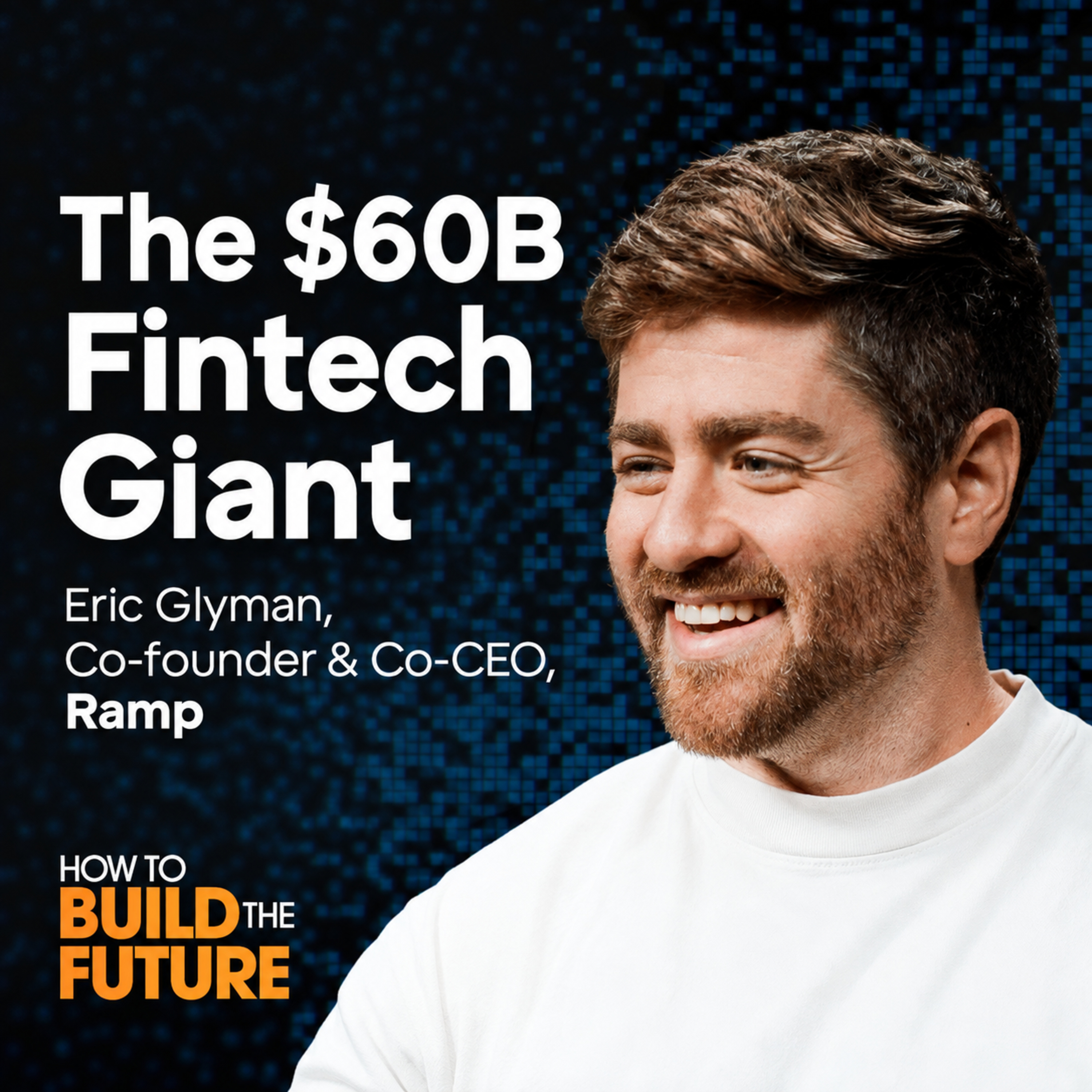
How To Build The Future: Eric Glyman, Co-CEO of Ramp
55 min
Listen through the publisher, then discuss the episode here or arrange an in-person Roundtable. Your city determines where to meet.
Roundtables are designed for groups of four, with a shared subject and room for everyone to speak. Come for discussion, with no dating expectation.
Ramp started with a simple promise: help companies save time and money. Seven years later, it’s a $60 billion platform running the financial operations of tens of thousands of businesses, with more than $2 billion in annual revenue.Now, Ramp is using AI not just inside its products, but to rethink how the company itself works.On this episode of How to Build the Future, Ramp co-founder and CEO Eric Glyman joins Garry Tan to talk about the company’s journey from its earliest days and how AI has made some people at Ramp radically more productive. That shift led Ramp to rethink how work gets done across the organization, and Eric believes it could eventually let even large companies move with the speed of startups again.
Episode information is provided by the publisher. Listening takes place on the publisher’s service.
The Huge Conversation with Mark Zuckerberg... I interviewed Meta CEO Mark Zuckerberg before Connect. There are not many people with more power over our future. Right now, Mark Zuckerberg and his team are imagining the future billions of people might live in, soon, and building towards it. So, in this conversation, my goal is to figure out what that future looks like. To paint a picture of the future Mark Zuckerberg is trying to build, so that you can decide for yourself what you think of it. We talked about the Meta's new Orion prototype AR glasses, creating holograms and the Star Trek universal translator, generative AI changing social media, big trends in human connection, open sourced AI, Ray Ban Meta glasses and Quest 3S, the biggest genuine question on his mind right now, and more... Welcome to the first episode of our new series, Huge Conversations… Special thanks to Derek Thompson, for his generous guidance on my first long-form interview! Chapters: 0:00 What is Mark Zuckerberg
The human brain remains one of the greatest unsolved mysteries in science. We have roughly 86 billion neurons firing in a way that somehow produces intelligence, and yet the brain is still largely a black box. In the early days of AI, researchers looked to the brain for clues about how to build smarter machines. But today, that relationship has been flipped on its head. Join Professor Hannah Fry and neuroscience researchers Maria Eckstein and Kim Stachenfeld to see how scientists are using AI to better understand the human mind. Please leave us a review on Spotify or Apple Podcasts if you enjoyed this episode. We always want to hear from our audience whether that's in the form of feedback, new idea or a guest recommendation! Hosted by Simplecast, an AdsWizz company. See https://pcm.adswizz.com for information about our collection and use of personal data for advertising.
What happens when AI doesn't just write your code but also reviews it, fixes broken builds, resolves merge conflicts, and approves changes without waiting for a human developer? In this episode of TechDaily.ai, host David and AI expert Sophia explore Anthropic's Claude Ship, an AI-powered tool suite designed to automate critical stages of the software development lifecycle. From intelligent code reviews and automated pull request fixes to AI-driven approvals, this conversation examines how autonomous AI agents could transform software engineering, developer productivity, and enterprise code governance. AI coding assistants are already generating thousands of lines of code in minutes. But traditional development pipelines still depend on human reviewers to inspect pull requests, troubleshoot failed CI checks, resolve merge conflicts, and approve deployments. That creates a growing bottleneck between AI-powered code generation and production delivery. Claude Ship aims to address that cha
A.I. for Learning Meditation: Building a Practice Even If Your Mind Never Stops, a practical, beginner-friendly look at how artificial intelligence can help you build a practice even if your mind never stops. Learning Meditation? Press play on Episode 431 of A.I. for Beginners and learn exactly how artificial intelligence, especially ChatGPT, alongside Headspace and Calm, can help you build a practice even if your mind never stops. WHAT YOU WILL LEARN IN THIS EPISODE - Why learning meditation is so hard to handle alone, and what is actually going on underneath it - A specific way to use Headspace to work through it, step by step - An example prompt you can copy word for word: "Give me a simple two minute guided breathing exercise I can do right now" - A second practical technique, with another ready-to-use prompt: "Help me build a tiny, realistic meditation habit I could actually keep for a week" WHO THIS EPISODE IS FOR - Anyone currently working on learning meditation - Anyone curious
90 days to fix your life.. (discipline challenge)Jack Hopkins guides you in reclaiming your masculinity in a feminine world and awakening the beast that lives inside you. Episodes created by entrepreneur and masculinity ace Jack Hopkins for his youtube channel, this podcast is dedicated to helping men rediscover their inner strength and confidence in a society that often promotes feminine values over masculine ones.Follow the podcast for valuable insights, inspiring stories, and practical advice on how to embrace your masculinity, build your confidence, and achieve your goals. Whether you're looking to improve your relationships, advance your entrepreneurial career, or simply feel more confident and capable, Jack has valuable insights that can help you achieve your goals.So, if you're ready to reclaim your masculinity and awaken the beast that lives inside you, follow the podcast & turn on notis Follow Jack Hopkins:Insta: @jackhopfitnessYT: @JackhopkinsCEODisclaimer: All content rights
(03:47) - The Boomer Put (19:01) - Stripe @ $200b (23:45) - CrowdStrike to Buy ZScaler (28:04) - Iowa Braces For Controlled Blast (30:36) - Microsoft Declares Code Red (32:57) - 𝕏 Timeline Reactions (45:42) - Jason Buechel, CEO of Whole Foods Market and Amazon Worldwide Grocery Stores, discusses his path from a food-focused upbringing and technology career to leading Amazon’s grocery business. He covers Thanksgiving planning, demand forecasting, supply-chain automation, customer service, and the growing role of AI-powered shopping through Alexa. (59:46) - Brian Halligan discusses his return as HubSpot’s co-founder and CEO, driven by the transformative opportunities created by AI. He outlines plans to make HubSpot more accessible through AI agents, accelerate experimentation and acquisitions, and reshape sales and marketing while remaining focused on the CRM market. (01:16:08) - Owen Rapaport & John Harris. Owen Rapaport, a leader at Erebor Bank, discusses the bank’s partnership with H
On November 21, 2026, Boom Supersonic (YC W16) fired their prototype engine core for the first time. They're developing a shared core for two products: Superpower, a natural-gas turbine for AI data centers, and Symphony, the engine intended for the Overture supersonic airliner. The turbine business could help fund Overture while giving Symphony years of real-world operating data before it ever flies. In this episode of Hard Tech, Boom founder and CEO Blake Scholl shows YC's Jared Friedman around their new Superpower Superfactory in Colorado and explains how they’re building a jet engine from scratch. On the factory floor, we explore in-house manufacturing, the challenge of making turbine blades survive extreme heat, and the custom software Boom uses to design and iterate on engine parts.
At SpaceXSI, Lauren Tan and Roman Ugarte are on the core team that took Grok Bot from first line of code to launch in seven weeks. It lets you spin up AI teammates with their own identities and logins, and they just keep working in the background. Their marketing team gave a bot its own ad budget. Lauren built an entire feature with her bot in one Slack thread without ever opening Cursor. They joined us on the Lightcone to talk about what it’s actually like working next to bots every day, and how the hard part is shifting from doing the work to figuring out what to do and why.
Replit was building toward the AI coding era years before it had a name. In 2024, the company shipped an agent that could take a request in plain English, work through errors, provision its own infrastructure, and keep going until the software actually worked. The model companies even reached out to ask how Replit had pulled it off.Co-founder and CEO Amjad Masad had been thinking about making programming radically more accessible since 2008, and Replit’s original pitch deck predicted AI-generated code before the Transformer paper was published. Today, that same technology is moving into banks, manufacturers, and other large companies, where Amjad says teams are replacing software projects once scoped at $10 million with $250,000 of Replit.On How to Build the Future, Paul Graham sits down with Amjad to talk about why Replit was so well positioned when coding agents arrived, what comes after vibe coding, and his bigger vision for the “self-driving company,” where AI agents increasingly b
Public contracts should consider quality and reliability, even when the lowest bid costs less.
Share your view, then see how readers voted. No sign-in required. This poll is shared across stories.
Do you agree or disagree?
Common Quandary
A Common Quandary to discuss
Another conversation to explore, separate from this news story.
Rich parents want to buy their public-school class an art teacher. Should the school say no?
Parents at a well-resourced public school raise enough money for art teachers and smaller classes. Nearby schools cannot raise comparable amounts, widening differences within the same district.
Can helping your own community become unfair to the larger one?