On Track Companion Podcast, Episode 3 (italiano) | Zurigo
22 min
Listen through the publisher, then discuss the episode here or arrange an in-person Roundtable. Your city determines where to meet.
Roundtables are designed for groups of four, with a shared subject and room for everyone to speak. Come for discussion, with no dating expectation.
This is the companion podcast to On Track Episode 3: the third day of the race, starting in Zurich. Watch On Track Episode 3 (https://www.youtube.com/watch?index=6&list=PLVAysq-bowvw&v=K6U9Y7E_s_o) Francesca tells the story of day three from Team Green's side, in a short Italian text written for learners. This time the challenges are in German, and in Zurich they're full of numbers: telling the time and reading dates out loud. Francesca says "mastichiamo un pochino il tedesco": literally "we chew a little German", which means they have a smattering of it. And she opens with "visto che", "given that" or "since", a very natural way to give a reason in everyday Italian. Can't wait a week? Pick your language here and the code is applied for you (https://coffeebreaklanguages.com/ontrack). Everything about On Track, including the Companion Courses, can be found here (https://coffeebreaklanguages.com/ontrack). On Track is brought to you in collaboration with Teachable. The On Track companion courses are hosted on Teachable. Future course creator? Find out more here (https://www.teachable.com/welcome/coffeebreak). Hosted on Acast.
Episode information is provided by the publisher. Listening takes place on the publisher’s service.
Most people are looking at wealth wrong. They think it comes from doing something big — picking the right stock, starting the right business, inheriting the right money, catching the right break. Uploaded 15-06-26 They're watching for the big move. The dramatic decision. The lucky moment that's going to change their financial life. They're watching in the wrong direction. Wealth doesn't come from a big move. Wealth comes from a thousand small ones, done quietly, every single day, for decades. The people who actually have money — not the people who look like they have money, but the people who actually have it — share a set of habits that are almost embarrassingly quiet. None of these habits would make a good news story. None of them would sell a book. None of them feel like the answer when you first hear them. They are too small, too slow, too unimpressive. But the quiet habits are doing the work. While other people are looking for the big move, the quietly wealthy are running these ha
The real story about “de-extinction”... The Tasmanian tiger was declared extinct in 1982. But now… scientists are trying to bring it BACK. And it’s not alone! You might’ve seen news about dire wolves, woolly mammoths, passenger pigeons… dodo birds… dinosaurs?? “De-extinction” has become a huge and urgent scientific debate. But when I took a deep dive into what’s really going on here, I realized we're getting this conversation very, very wrong. We're on the cusp of a huge genetic breakthrough… and yet the most "huge if true" thing happening here isn’t bringing back extinct animals. It's what this means for all the animals alive today! And very few people seem to know about it… Chapters: 00:19 Can we bring back extinct animals? 01:22 Can we bring back a mammoth? 02:24 Is Jurassic Park possible? 05:44 Are Dire Wolves brought back from the dead? 6:26 What is de-extinction? 09:04 How do we save cute little animals? 11:08 Is the Tasmanian tiger coming back? 12:50 When is it ok to bring back
Explore what makes polio so dangerous, what is causing the 21st century resurgence of cases, and how we can eradicate the disease. -- In 1952, polio was everywhere: killing or paralyzing roughly half a million people annually. Yet just 10 years later, paralytic polio cases in the US dropped by 96% and we were on track to get rid of polio for good. But in recent years, the virus started striking back. So, what’s behind these recent spikes? Explore the dangers of poliovirus and the possibility of eradicating this deadly disease. Directed by Anton Bogaty. This video made possible in collaboration with Gates Ventures Learn more about how TED-Ed partnerships work: https://bit.ly/TEDEdPartner A special thanks to Ananda Bandyopadhyay, Amber Zeddies, and Kathleen O'Reilly who provided information and insights for the development of this video. Support Our Non-Profit Mission ---------------------------------------------- Support us on Patreon: http://bit.ly/TEDEdPatreon Check out our merch: htt
Text me what you thought of the show (https://www.buzzsprout.com/1959372/fan_mail/new) Can working night shifts affect your fertility, ovulation or IVF success? After speaking with numerous women trying to fall pregnant while working shifts, including those undergoing expensive IVF treatment, I wanted to explore what the research actually tells us. In this episode of A Healthy Shift, we discuss how night shifts, disrupted sleep and circadian misalignment may affect reproductive health. We cover: Why the fertile window is so short. Shift work, reproductive hormones and menstrual irregularities. What research says about night shifts, fertility and IVF outcomes. The roles of sleep, stress, nutrition, weight and exercise. Practical steps for women trying to conceive while working shifts. Research links shift work with menstrual irregularities, but evidence that night shifts directly cause infertility or reduce IVF success remains uncertain. If you're trying to get pregnant while working ni
PBS Member Stations rely on viewers like you. To support your local station, go to:http://to.pbs.org/DonateSPACE Sign Up on Patreon to get access to the Space Time Discord! Physics is the business of figuring out the structure of the world. So are our brains. But sometimes physics comes to conclusions that are in direct conflict with concepts fundamental to our minds, such as the realness of space and time. How do we tell who’s correct? Are time and space objective realities or human-invented concepts? Episode Companion Playlist Check out the Space Time Merch Store Search the Entire Space Time Library Here: https://search.pbsspacetime.com/ Hosted by Matt O'Dowd Written by Bahar Gholipour & Matt O'Dowd Post Production by Leonardo Scholzer, Yago Ballarini, Pedro Osinski, Caique Oliveira, Adriano Leal & Stephanie Faria Directed by Andrew Kornhaber Associate Producer: Bahar Gholipour Executive Producers: Eric Brown & Andrew Kornhaber Executive in Charge for PBS: Maribel Lopez Director of P
A.I. for Starting to Exercise: Building a Routine That Actually Sticks, a practical, beginner-friendly look at how artificial intelligence can help you build a routine that actually sticks this time. Starting to Exercise? Press play on Episode 429 of A.I. for Beginners and learn exactly how artificial intelligence, especially ChatGPT, alongside Nike Training Club, can help you build a routine that actually sticks this time. WHAT YOU WILL LEARN IN THIS EPISODE - Why starting to exercise is so hard to handle alone, and what is actually going on underneath it - A specific way to use Nike Training Club to work through it, step by step - An example prompt you can copy word for word: "Here is my current fitness level and schedule, help me build a realistic beginner routine" - A second practical technique, with another ready-to-use prompt: "Give me a simple way to track my progress that doesn't rely on willpower alone" WHO THIS EPISODE IS FOR - Anyone currently working on starting to exercise
This is the companion podcast to On Track Episode 2: the second day of the race, starting in Milan. Watch On Track Episode 2. (https://www.youtube.com/watch?list=PLVAysq-bowvw&v=uSbK1bfKeh8) Get the free episode 2 handout for your own copy of the text, plus the word list. (https://coffeebreaklanguages.com/2026/11/on-track-companion-podcast-episode-2-italiano-milano/) Francesca tells the story of day two from Team Green's side, in a short Italian text written for learners. In Milan there's a race through the Galleria Vittorio Emanuele II, and an opera performed right outside La Scala. Francesca says "penso che per Pablo sia stato interessante": after "penso che", "I think that", Italian uses the subjunctive, so it's "sia stato", not "è stato". For a simple opinion she also uses "secondo me", "in my opinion", which takes the ordinary verb. Can't wait a week? Pick your language here and the code is applied for you. (https://coffeebreaklanguages.com/ontrack) Everything about On Track, incl
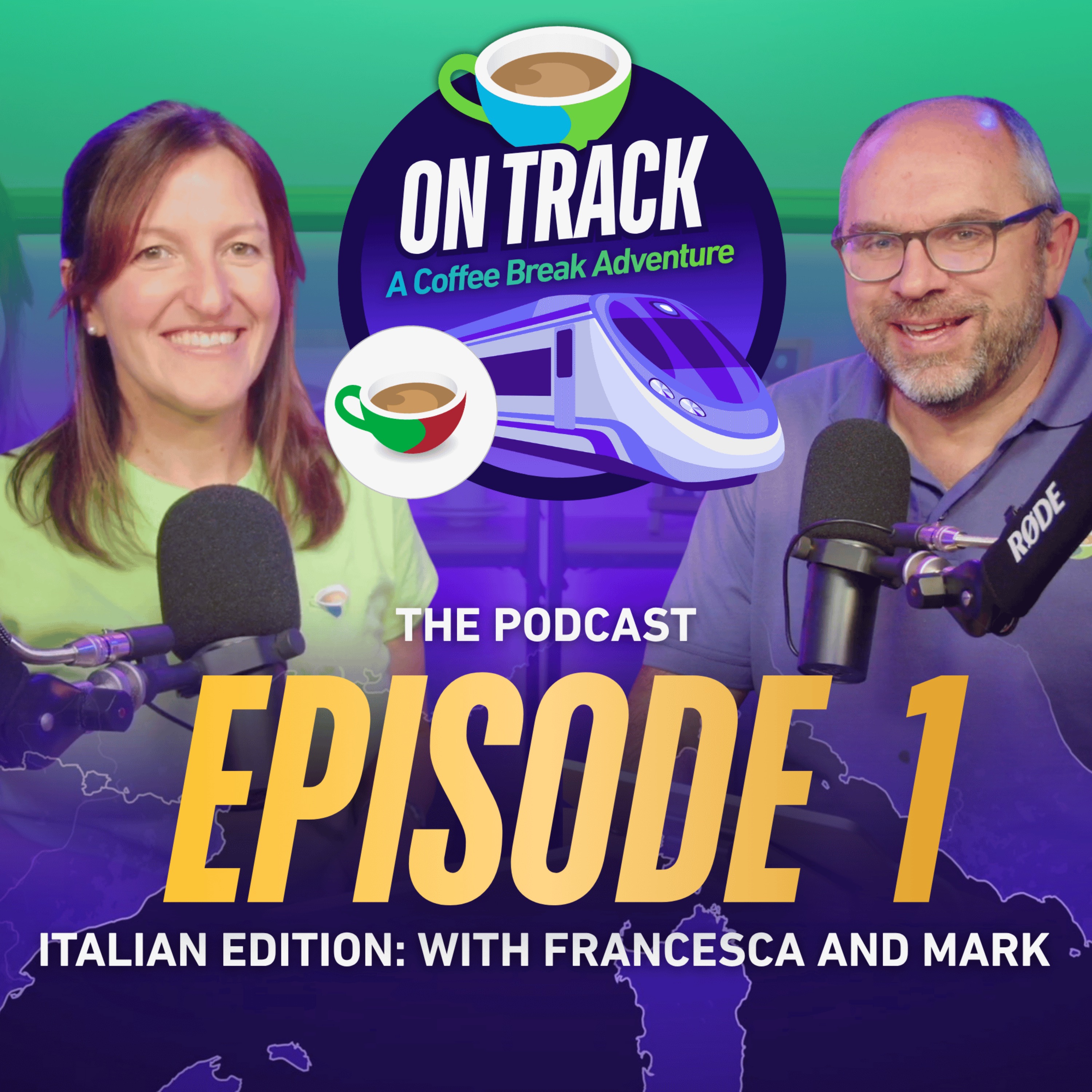
This is the companion podcast to On Track Episode 1: the first day of the race, starting in Venice. Watch On Track Episode 1: https://youtu.be/_-_lH0rYCVg Francesca is on home ground for day one, and she tells the story from Team Green's side in a short Italian text written for learners: Venetian masks with secret lives, and a tongue twister. Francesca uses "che" with an adjective to say "how...!", as in "che bello!" and "che creativo!", and it works with almost any adjective. Then there's "un sacco", which you'll hear all the time in everyday Italian. Can't wait a week? Episode 2 is already on Coffee Break TV: https://coffeebreaktv.com/join?utm_source=acast&utm_medium=podcast&utm_campaign=ontrack&utm_content=podcast-it-ep1 (https://coffeebreaktv.com/join) Everything about On Track, including the Companion Courses: https://coffeebreaklanguages.com/ontrack?utm_source=acast&utm_medium=podcast&utm_campaign=ontrack&utm_content=podcast-it-ep1 (https://coffeebreaklanguages.com/ontrack) On Tr
Retraining programs should provide financial support as well as new skills.
Share your view, then see how readers voted. No sign-in required. This poll is shared across stories.
Do you agree or disagree?
Common Quandary
A Common Quandary to discuss
Another conversation to explore, separate from this news story.
A disgraced billionaire's name is on the beloved campus library. Does it come down?
A major donor funded a beloved public building decades ago. New evidence shows they also caused serious harm that was legal and accepted by many peers at the time. Removing the name may jeopardize future donations.
What does an institution owe the truth when its history funded the present?