Listen through the publisher, then discuss the episode here or arrange an in-person Roundtable. Your city determines where to meet.
Roundtables are designed for groups of four, with a shared subject and room for everyone to speak. Come for discussion, with no dating expectation.
Fireworks have been lighting up our autumn skies for centuries - but what’s actually going on inside those dazzling bursts of colour, sound and stars? Hannah and Dara set out to discover the science behind the sparkle. From the chemistry that creates vivid reds, greens and blues, to the physics that launches shells high above our heads before exploding into perfectly planned patterns, they learn that every firework is a carefully choreographed feat of engineering. Along the way, they explore why some fireworks whistle while others crackle, trace the remarkable history of fireworks from ancient China to modern-day spectacles, and ponder whether drones and laser shows could one day replace the traditional fiery festivities. If you have a curious question for our team, get in touch via [email protected]. Contributors: Jackie Akhavan - Professor of Explosive Chemistry at Cranfield University John Withington - histroian broadcaster and author of ‘A History of Fireworks from Their Origins to the Present Day’ Darryl Fleming - Director of Titanium Fireworks Producer: Lucy Taylor Executive Producer: Sasha Feachem A BBC Studios Production
Episode information is provided by the publisher. Listening takes place on the publisher’s service.
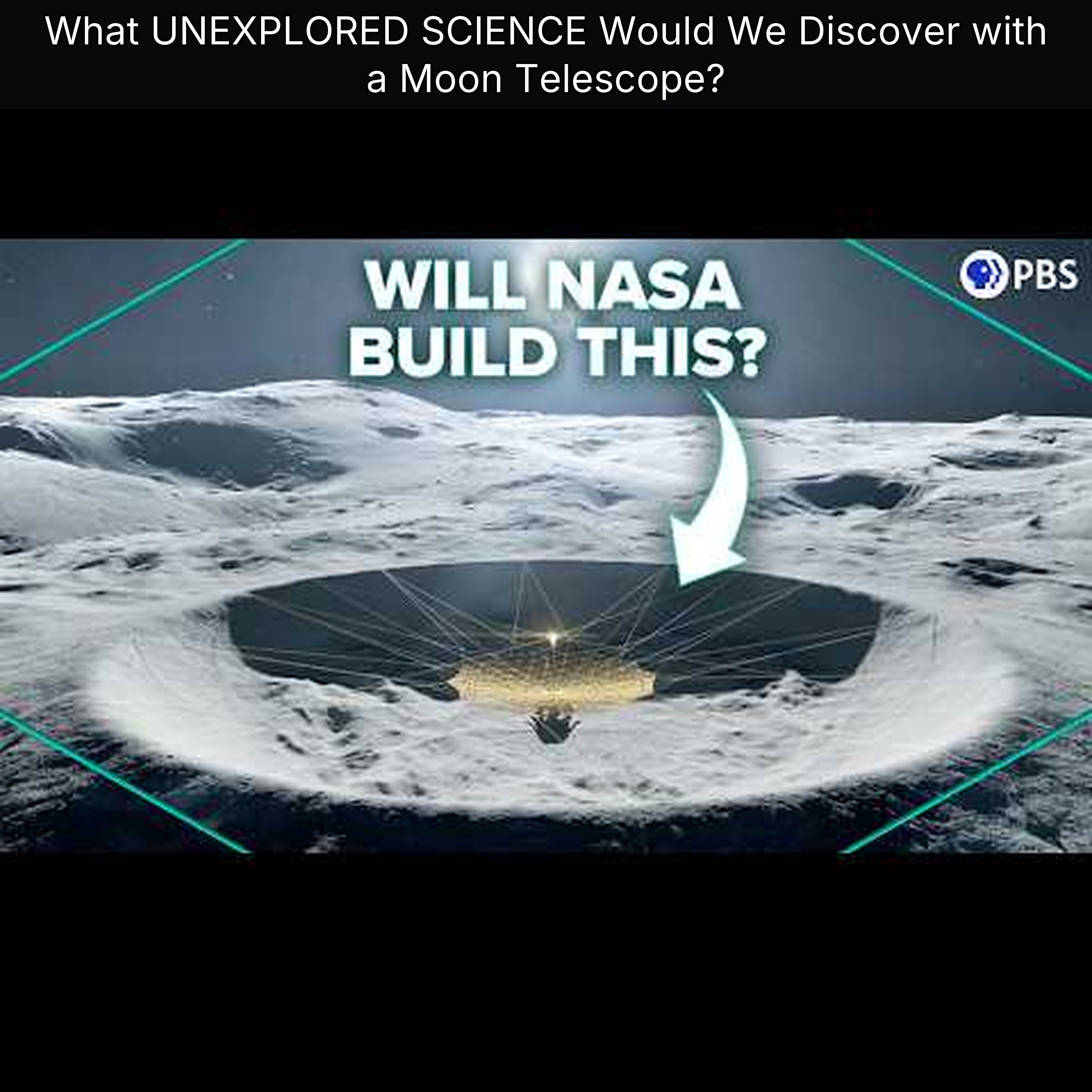
PBS Member Stations rely on viewers like you. To support your local station, go to:http://to.pbs.org/DonateSPACE Sign Up on Patreon to get access to the Space Time Discord! In order to see the faint light from objects in deepest space, astronomers go to the darkest places on the planet. In order to listen to their quite radio signals, they head as far from any radio-noisy humans as possible. But there’s nowhere on the earth, or even orbiting the Earth, that’s far enough to hear to the faint radio hum from the time before stars. In fact, we may need to build a giant radio telescope in the quietest place in the solar system—the far side of the moon. Check out the Space Time Merch Store Sign up for the mailing list to get episode notifications and hear special announcements! Search the Entire Space Time Library Here: https://search.pbsspacetime.com/ Hosted by Matt O'Dowd Written by Matt Caplan & Matt O'Dowd Post Production by Leonardo Scholzer, Yago Ballarini, Adriano Leal & Stephanie Far
☀️ HARNESSING THE POWER OF THE SUN — THE SCIENCE BEHIND C60 EVO! What happens when scientists recreate extraordinary, sun-like temperatures inside a laboratory to produce one of the most fascinating carbon molecules ever studied? Michael Jaco welcomes Patty Greer and Chris Burres back to Unleashing Intuition for a fascinating behind-the-scenes look at C60 Evo, the technology used to produce ESS60, and the science behind this unique carbon molecule. Chris takes us inside the laboratory to explain the intense temperatures, specialized production methods, and purification processes involved in creating ESS60 — C60 Evo's proprietary form of Carbon 60. The conversation explores the relationship between antioxidants, mitochondria, cellular energy, and oxidative stress, along with why C60 Evo combines ESS60 with carefully selected extra virgin olive oil. Patty and Chris also share their perspectives on wellness, personal experiences, and the growing interest in carbon-based technology. Inside
This new tech is changing how movies get made. So @mkbhd and I tested it out... Watch MKBHD's video: https://youtu.be/RM7SobH8ZO0 I’ve been obsessed with sci-fi movies since I was a kid. I love being transported to another world. But lately, I’ve been wondering: How do those worlds look so… REAL? The tech behind movies has exploded in complexity and realism, changing how stories come to life on screen. Luckily, at the same time, those tools are becoming more and more available to more people telling stories. It’s not just blockbusters like Avatar 2 or Avengers or Dune. It’s also smaller budget films like Everything Everywhere All at Once or even… YouTube creators? In this video, Marques Brownlee and I test out 3 movie-making tools that are changing how movies, shows, and maybe even YouTube videos (??) get made. We’re at ZeroSpace Studios in New York to show you how each of these crazy technologies work - and how you might be able to use them. Along the way, we hit big questions like: W
For all references, extra nuances, and early access to breakdowns like this, see the associated newsletter: https://staycuriousmetabolism.substack.com/p/shrink-visceral-fat-by-feeding-your?r=40ekz2 Winnow Microplastic Binding Probiotic: https://www.winnowlabs.com/STAYCURIOUS Microplastics and Heart Health, Letter https://staycuriousmetabolism.substack.com/p/microplastics-in-my-heart-its-worse?r=40ekz2 Microplastics and Brain Health, Letter: https://staycuriousmetabolism.substack.com/p/this-graph-changed-how-i-think-about?r=40ekz2 Description: In this video we examine the scientific evidence behind resistant starch, including randomized controlled trials showing reductions in body weight, total fat mass, and visceral fat measured by MRI—even when calorie intake remains controlled. We also explore the biological mechanism, including how changes in the gut microbiome may drive these effects. But there’s an important twist: not everyone responds the same way. We’ll look at new research exp
In this 360° animation, explore the vibrant world of neon signs and learn the science of what makes them glow. Uploaded 19-09-19 -- When the Hoover Dam was completed, it created a huge source of hydroelectric power and zapped a sleepy desert town to life: Las Vegas, Nevada. With the power supply from the dam, Las Vegas soon exploded with vibrant displays. The source of these dazzling lights was electrified neon gas. In this special 360° animation, explore the colorful world of neon signs as Lippy shares what makes them glow. -- How to view this TED-Ed animated 360° video: If you have access to a Google Cardboard viewer and a smart phone: 1. Open this video in the YouTube app on your phone. 2. Hit pause on the video. 3. Tap the 3 vertical dots on the top right corner of the view window. This will slide up a sub-menu where you will choose the quality setting of your video stream. Choose "2160s." Note that if you are not streaming over Wifi, YouTube will only allow "720s" quality. 4. Tap
In this calm and sleepy facts episode, we journey far beyond our own solar system to explore the thousands of worlds orbiting distant stars, places we have only recently learned to find and are only just beginning to understand. We start with the basics of what an exoplanet is and how astronomers detect them, from the gentle dimming of a star as a planet passes in front of it to the tiny gravitational wobble a hidden world imprints on its sun. We visit the extraordinary harvest of the Kepler space telescope, which revealed that planets are not rare exceptions but the rule, scattered across nearly every star in the Milky Way. Along the way we encounter strange and extreme worlds, gas giants so close to their stars that they complete an orbit in mere days, tidally locked planets with one face locked in permanent daylight and the other in endless night, and rogue planets drifting alone through interstellar space with no star to call home. We explore the habitable zone, the narrow region a
Why do we find the young of other species cute? Finding baby humans adorable makes evolutionary sense, ensuring that we care for them properly. But what about babies of other species? Hannah and Dara go down a fluffy rabbithole of cuteness: pondering the science behind things that make us go 'ahhhh'; exploring the phenomenon of 'cute aggression'; and discovering there can be such a thing as cuteness overload. We also discover what Dara would look like as an elf, and what happens when you make Hannah scientifically less cute. Brace yourselves... If you have a scientific mystery for the team to investigate, contact them on [email protected]. Contributors: Anthony Little – Reader in Psychology at the University of Bath Daniel Mills – Emeritus Professor of Veterinary Behavioural Medicine at the University of Lincoln Chris Holliday – Senior Lecturer in Liberal Arts and Visual Cultures Education at King's College London Producer: Lucy Taylor Executive Producer: Sasha Feachem A BBC Studi
Public funding for a small group can be justified when the wider community also benefits.
Share your view, then see how readers voted. No sign-in required. This poll is shared across stories.
Do you agree or disagree?
Common Quandary
A Common Quandary to discuss
Another conversation to explore, separate from this news story.
A better public school is one borrowed address away. Would you use it?
Your child is struggling at the assigned school. A grandparent lives inside the boundary of a much stronger public school and offers to let you use their address. The desired school has limited places and verifies residency unevenly.
Can a parent's duty justify taking an opportunity allocated by an unfair boundary?