Severe BP Intrapartum, Non-severe on Repeat: PreE with Severe Nuances
25 min
Listen through the publisher, then discuss the episode here or arrange an in-person Roundtable. Your city determines where to meet.
Roundtables are designed for groups of four, with a shared subject and room for everyone to speak. Come for discussion, with no dating expectation.
Now, if you’ve been in OB care for more than a month, you know that preeclampsia is one of those topics we talk about constantly. We have endless guidelines, algorithms, and diagnostic criteria plastered all over our unit walls. But here’s the truth: despite all the literature out there, the real world doesn't always read the textbook. The clinical nuances… The gray areas…That’s where things get tricky. Take a classic labor and delivery scenario: Your patient in active labor throws a blood pressure in the severe range. You follow protocol and get a repeat BP 15 minutes later—and it’s back down in the non-severe range. So, what now? Does that initial single severe reading still count toward a diagnosis of preeclampsia with severe features, or does severe range have to be sustained? And let’s make it even more interesting: What if later in the shift, she hits another severe-range BP, but again, it drops to non-severe on the 15-minute recheck- yet both of those spikes under that standard 4-hour window? Is that officially preeclampsia with severe features? That right there is the absolute peak of clinical nuance. It’s the difference between blindly following a chart and actually delivering sharp, nuanced bedside care. So, grab your coffee, settle in, and let's break down the details. ASPIREDRINKS.com PROMO CODE: https://aspiredrinks.com/discount/CHAPANOSPINOBG ACOG PB 222 Countouris ME, Bello NA. Advances in Our Understanding of Cardiovascular Diseases After Preeclampsia. Circ Res. 2025 Mar 14;136(6):583-593. doi: 10.1161/CIRCRESAHA.124.325581. Epub 2025 Mar 13. PMID: 40080539; PMCID: PMC11921930.
Episode information is provided by the publisher. Listening takes place on the publisher’s service.
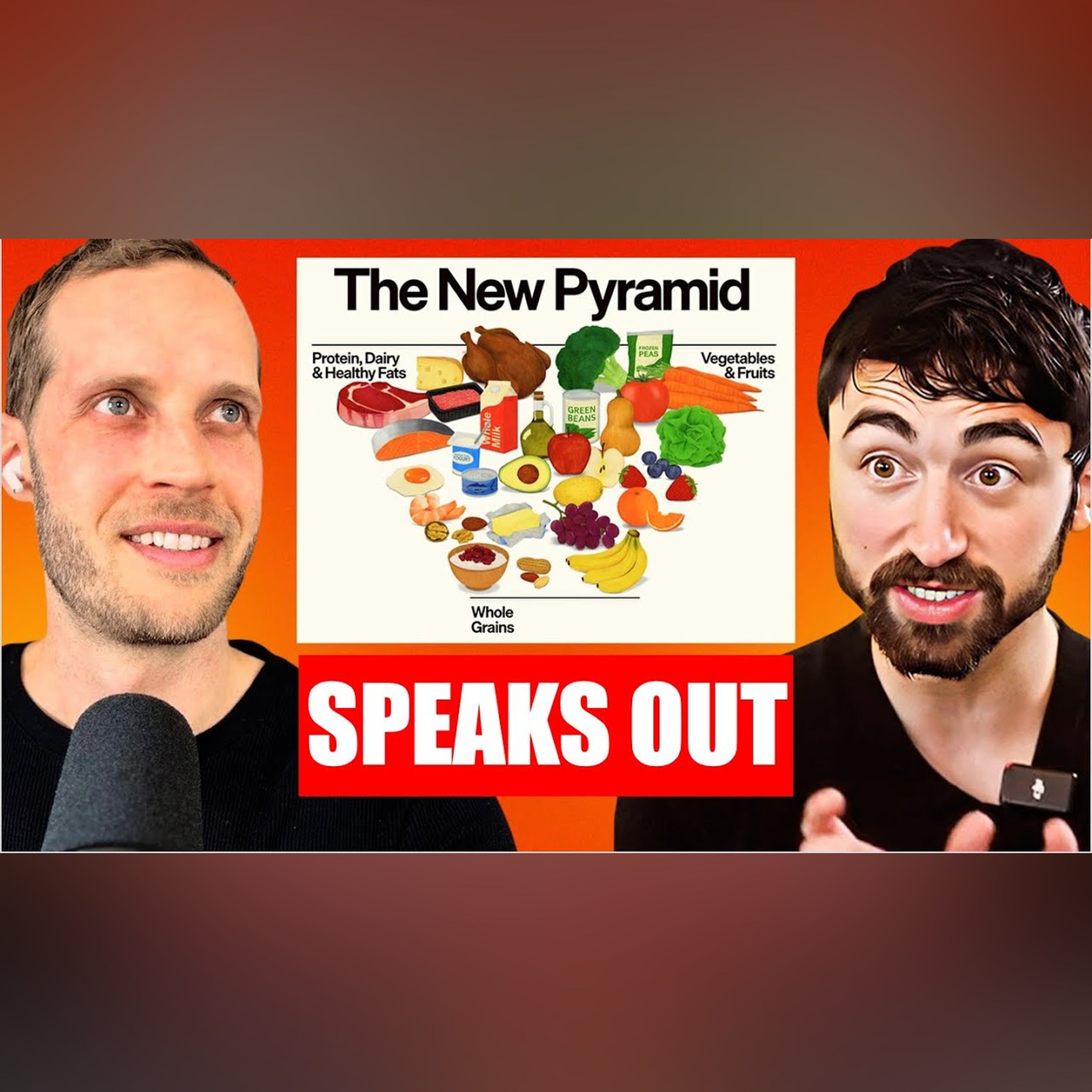
For a written digest on the guidelines, see the StayCurious Metabolism Letter: https://staycuriousmetabolism.substack.com/p/the-new-dietary-guidelines-actually?r=40ekz2 The 2025–2030 Dietary Guidelines are being marketed as a major reset with a simple message: put “real food” back at the center of the American diet. And in a lot of ways, they do represent progress. But when you actually read what’s written, some of the most important details raise real questions. For example, the document still states that saturated fat should not exceed 10% of total daily calories. To separate signal from spin, I’m joined by Dr. Ty Beal PhD, who worked on the evidence review side of the Guidelines process, to explain what the scientific background documents actually say, what happens after scientists submit reviews, and why the final public-facing document can end up with compromises, inconsistencies, or imprecise terminology. If you want a clear, good-faith breakdown—what’s genuinely better, what sti
A kiss can be wonderful. It can create an instant connection, spark romance, or make you feel closer to someone. But a kiss can also have the opposite effect — and sometimes ruin everything. So what makes kissing so powerful, and why can one kiss make such a difference? There's some fascinating science behind it. https://www.scientificamerican.com/article/why-we-kiss/ We spend an enormous amount of time worrying about what's going to change. What's next? What's coming? How do we prepare? But what if we're paying attention to the wrong things? Some of the most important forces shaping our lives never change, and understanding them may be far more valuable than trying to predict the future — something humans are notoriously bad at. Morgan Housel, partner at The Collaborative Fund and author of Same as Ever: A Guide to What Never Changes (https://amzn.to/3SwWn6u) (https://amzn.to/3SwWn6u)), joins me to explain why the things that stay the same may be the most important things to understan
Sign up for our newsletter and never miss an animation: http://bit.ly/TEDEdNewsletter Uploaded 14-01-19 View full lesson: https://ed.ted.com/lessons/the-truth-about-electroconvulsive-therapy-ect-helen-m-farrell In 1982, a young nurse was suffering from severe, unrelenting depression. She couldn’t work, socialize or concentrate. One controversial treatment changed everything: after two courses of electroconvulsive therapy (ECT) her symptoms lifted. So what exactly is electroconvulsive therapy and why is it so stigmatized? Helen M. Farrell details the history and evolution of ECT. Lesson by Helen Farrell, directed by Artrake Studio. Thank you so much to our patrons for your support! Without you this video would not be possible! Dan Paterniti, Jerome Froelich, Tyler Yoshizumi, Martin Stephen, Justin Carpani, Faiza Imtiaz, Khalifa Alhulail, Tejas Dc, Benjamin and Shannon Pinder, Srikote Naewchampa, Sage Curie, Exal Enrique Cisneros Tuch, Ana Maria, Vignan Velivela, Ahmad Hyari, eden sher,
PBS Member Stations rely on viewers like you. To support your local station, go to: http://to.pbs.org/DonateSPACE ↓ More info below ↓ Uploaded 24-08-20 Sign Up on Patreon to get access to the Space Time Discord! Check out the Space Time Merch Store If you wanna make an omelet you gotta break a few eggs. And by omelet I mean a theory of everything, and by eggs I mean a billion billion subatomic particles obliterated in the next generation of giant particle colliders. Hosted by Matt O'Dowd Written by Dan Garisto and Matt O'Dowd Graphics by Leonardo Scholzer, Yago Ballarini, and Pedro Osinski Directed by: Andrew Kornhaber Camera Operator: Bahaar Gholipour Executive Producers: Eric Brown and Andrew Kornhaber End Credits Music by J.R.S. Schattenberg: https://www.youtube.com/channel/UCRl6-nb4iOnsij-vnpAjp0Q In June, the consortium of Europe’s top particle physicists published their vision for the next several years of particle physics experiments in the EU. A big part of that is the Future C
Are we in an AI stock bubble, or are investors betting on a genuinely bigger economy? Justin Wolfers examines AI stock valuations with Stacey Vanek Smith, separating what the technology could do for the economy from what investors might actually earn. A deliberately hypothetical valuation exercise shows why a trillion-dollar company isn't automatically absurd—but a breakthrough for society doesn't guarantee profits for shareholders. Competition can give you powerful tools at low prices while squeezing the companies selling them. The Thanksgiving turkey problem illustrates why a long run of good news can hide rare, severe risks. Justin connects that analogy to fat tails and the peso problem, then explains why spotting a bubble and successfully betting against it are different challenges. He also unpacks what the CAPE ratio can—and can't—tell you about whether stocks are overpriced. The stakes are your savings, not just Wall Street's scoreboard: Justin discusses an S&P 500 decline of 7.5
This new tech is changing how movies get made. So @mkbhd and I tested it out... Watch MKBHD's video: https://youtu.be/RM7SobH8ZO0 I’ve been obsessed with sci-fi movies since I was a kid. I love being transported to another world. But lately, I’ve been wondering: How do those worlds look so… REAL? The tech behind movies has exploded in complexity and realism, changing how stories come to life on screen. Luckily, at the same time, those tools are becoming more and more available to more people telling stories. It’s not just blockbusters like Avatar 2 or Avengers or Dune. It’s also smaller budget films like Everything Everywhere All at Once or even… YouTube creators? In this video, Marques Brownlee and I test out 3 movie-making tools that are changing how movies, shows, and maybe even YouTube videos (??) get made. We’re at ZeroSpace Studios in New York to show you how each of these crazy technologies work - and how you might be able to use them. Along the way, we hit big questions like: W
If you’ve scrolled through your feed lately, you might havecaught a buzzworthy new study suggesting that eating avocados during pregnancy could lower your odds of having a C-section by more than a quarter. On the surface, it sounds like an easy, delicious prescription—grab some guacamole and avoid major surgery. Today, we’re going to put that study under the microscope. We’re dissecting the November 2026 Kuopio Birth Cohort paper by Cheng and colleagues to see what the data actually says- and more importantly, what itdoesn't. Because in obstetrics and nutritional science, how a study is designed, who funds it, and what variables get left out can completely change how we interpret the results. Understanding a study's limitations isn't about being cynical; it's about separating real clinical breakthroughs from statistical noise so you can make truly informed decisions. Let's dive into the data- no spin. Aspire Drinks - Greentea-powered energy drink: 1. F. W. Cheng, N. A. Ford, K. Backman
Welcome back to the show. Let’s take a quick step back in time. Think about how far we’ve come: we went from pressing a classic OB fetoscope up against a pregnant belly just to catch a faint, muffled thumping, to relying on advanced, continuous electronic monitoring. We live in an era of high-tech obstetrics. But even with all these modern advancements, room for error still exists, especially during the high-stakes chaos of the second stage of labor. In fact, this exact vulnerability was flagged as a critical warning in ACOG’s Clinical Practice Guideline Number 10. The issue? Relying on an external fetal heart rate Doppler that can silently mistake the maternal heart rate for the fetal heart rate. And now, a team of authors from New York writing in the AJOG are bringing even sharper focus to this danger, introducing a brand-new term for your clinical radar: "The Dolphin Sign." It’s a striking visual descriptor for a phenomenon born from maternal-fetal Doppler ambiguity—and if it goes u
Yes, we have covered cervical cancer screening many, many times on this show. It is truly a testament to science and research just how far we have come from using slide-based cytology for cervical cancer screening. Primary high-risk HPV, as a screening modality, has been favored for many years and is now officially part of the age-based, ACOG cervical cancer screening guideline (July 2026). We will summarize that update in this episode. Plus, we will also review about what to do when the hrHPV expanded genotype panel returns positive for 56/59/66. Modern cervical screening reports frequently refer to HPV 56, 59, and 66, typically grouping them together into a single pooled result (often labeled as a trio "HPV 56/59/66"). This is due to the widespread adoption of extended HPV genotyping technology. WE, what do we do with that? Listen in for details. 1. ACOG Committee Statement No. 28: Screening for Cervical Cancer; July 2026 2. Massad LS, Clarke MA, Perkins RB, Garcia F, Chelmow D, Cheu
Lawmakers should review laws when their real effects differ from the original promises.
Share your view, then see how readers voted. No sign-in required. This poll is shared across stories.
Do you agree or disagree?
Common Quandary
A Common Quandary to discuss
Another conversation to explore, separate from this news story.
If a good deed is filmed for likes, is it still a good deed?
A local creator films themselves buying groceries for strangers. The videos generate substantial income, but they also inspire donations and allow the creator to help more people.
Do mixed motives diminish a genuinely helpful act?