Listen through the publisher, then discuss the episode here or arrange an in-person Roundtable. Your city determines where to meet.
Roundtables are designed for groups of four, with a shared subject and room for everyone to speak. Come for discussion, with no dating expectation.
A few months ago, scientists announced the discovery of a new moon of Uranus – number 29 for the giant planet. But some other discoveries suggest that we’re still missing some. One or more tiny moons might be supplying the material that makes up one of the planet’s faint rings. The new guy is an oddly shaped chunk of rock about six miles in diameter. It orbits about 20,000 miles above the planet’s cloudtops, just outside one of its rings. The moon might act as a “shepherd,” helping keep the ring in place. A recent study looked at the planet’s widest rings. Scientists found that another small moon, called Mab, appears to be the source of one of the rings. The moon is bluer and icier than the other small moons. Impacts by tiny space rocks probably flake off some of its ice. The ice then spreads out along the moon’s path, forming the ring. The study didn’t find a source for the other ring, which is red and dusty. Small moons flank the ring, keeping it in check. But something must be supplying fresh material to keep the ring going – perhaps one or more even smaller moons inside the ring itself. So the tally of the moons of Uranus should keep climbing. Uranus is at its best this week. It’s low in the east at nightfall, and is in view all night. And it’s brightest for the entire year. It’s too faint to see with the eye alone, but it’s an easy target for binoculars. More about Uranus tomorrow. Script by Damond Benningfield
Episode information is provided by the publisher. Listening takes place on the publisher’s service.
A year from today you are going to be in a meaningfully different place than you are right now. The question is which direction. Most people don't decide — they keep doing whatever they have been doing, and the year drifts them somewhere, usually somewhere similar to where they started, or slightly further along the same path that wasn't quite working. Uploaded 30-06-26 Here is the truth: the shape of the next year of your life is determined by a small number of decisions you'll make, deliberately or by default. Not big dramatic decisions — small ones. How you spend your evenings, how you respond to drama, how you treat the people around you, how you handle the small uncomfortable moments that come up dozens of times a week. Each decision is tiny. Cumulatively, they reshape your life. Most people focus on the big decisions and ignore the small ones. But the big decisions get made under conditions that were set up by the small ones — and the small decisions, made consistently for a year
PBS Member Stations rely on viewers like you. To support your local station, go to: http://to.pbs.org/DonateSPACE ↓ More info below ↓ Uploaded 23-09-19 Sign Up on Patreon to get access to the Space Time Discord! Sign up for the mailing list to get episode notifications and hear special announcements! You know what a planet is, right? A big round thing that orbits a star. Uh, not so fast. The surprisingly vicious debate over the planetary status of Pluto has given us a fascinating glimpse into what a scientific definition really is. And perhaps the word planet is too vague to be used as a scientific definition at all. Hosted by Matt O'Dowd Written by Drew Rosen and Matt O'Dowd Graphics by Leonardo Scholzer Directed by: Andrew Kornhaber Produced By: Kornhaber Brown Check out the new Space Time Merch Store! We love to classify things. Labels help us keep stuff organized in our heads. In science, categorization provides a fast and easy way to know the properties of a member of the group ju
Every year in January, millions of people write their New Year’s resolutions, committing to what they are going to change in the coming year. For nearly half, these resolutions are related to health, such as weight loss and fitness. Yet 80% of New Year’s resolutions will fail by February. Uploaded 08-01-20 To be successful, your resolution needs three things: a desired outcome, smart strategy and focused action. So many of us fail because we are missing the middle piece – smart strategy – and we opt for blindly taking action, like starting a crash diet or blasting out your resume. The good news? You can avoid this trap and beat the odds this year – just use Tony’s strategy for success: Get clear on your desired outcome, know your purpose, take massive action, notice your results, and change your approach. Your 2020 vision starts here: https://core.tonyrobbins.com/new-years Learn how to create a Massive Action Plan with Tony's innovative and easy-to-use life vision and productivity plan
This is a Grave Talks CLASSIC EPISODE! West Hill Manor in Burlington, New Jersey, is a historic treasure—one built between 1797 and 1799 in rare Federal style. But this stately home is more than a museum of early American architecture—it’s a place where history refuses to stay silent. Psychic medium and paranormal investigator Beth O’Brien joins us on The Grave Talks to share what she’s experienced while volunteering at West Hill. A passionate advocate for its preservation, Beth has seen and felt things most visitors never do—things that suggest the spirits of West Hill are still very much present. Within its walls, the cries of Susanna Emlen may still linger. She underwent one of the earliest known breast cancer surgeries in the United States—performed without anesthesia—and survived. Many believe she never truly left the room where it happened. Then there’s Eliza Gurney, the manor’s second owner, whose deep friendship with President Abraham Lincoln left such an impression that one of
Show notes The Supernova That Wouldn't Fade SN 2024vjm, discovered by BlackGEM at La Silla on 13 September 2024 in NGC 6744, is possibly the faintest supernova ever observed — 100 to 300 times dimmer than an ordinary one. It should have faded fast under the 30-year-old Phillips relation; instead its slow ejecta (~3,000 km/s) kept radiation trapped for more than 70 days. A Euclid image from 11 months earlier shows no star at the site, pointing to a faint white dwarf system. Zimmerman, Gal-Yam et al., Nature Astronomy, 26 Nov 2026 (preprint Feb 2026). Less Dark Matter Than Expected Lei, Zhu et al. (Shanghai Astronomical Observatory) modelled 136 nearby galaxies with MaNGA/CALIFA stellar kinematics and HI including FAST data. Above ~10 billion solar masses in stars, central dark matter densities fall below IllustrisTNG, EAGLE and SIMBA predictions. Cause unclear. Nature Astronomy, 26 Nov 2026 (preprint Sept 2026). Dating the Moon's Biggest Scar Qian, Zhao et al. (HKU) combine Chang'e-6 sa
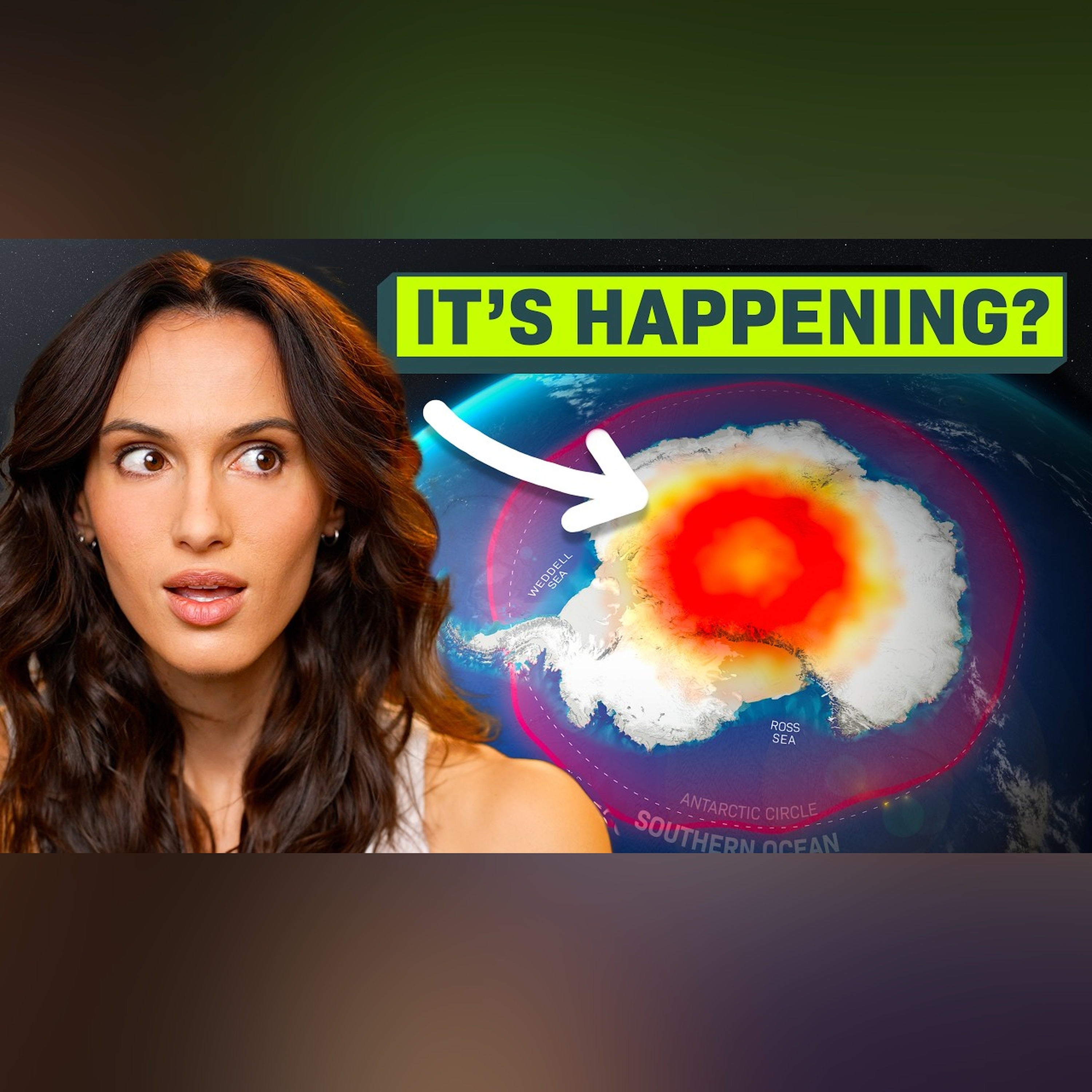
This is ANTARCTICA. And in 1985, it became the center of a global crisis… Directly over Antarctica, high up in the stratosphere was a massive hole. And if we hadn’t done anything about it, today, we’d be living in an alternate world. By now, a hole would be forming over the North Pole as well. By 2040, the “hole” would be over the entire planet. By 2065, skin cancer rates would be soaring. Kids wouldn’t play outside much anymore… But that’s NOT the world we’re living in! In fact, you’ve probably stopped hearing this story altogether. That wasn’t by accident. It was a choice. Two choices, both of which dramatically changed the course of human history for the better. So let me show you how that happened and what's about to happen next. Because it turns out, the little sliver at the bottom of the map is actually the center of everything/our whole planet. And you need to see this now, because scientists say we need to make the next big choice. Visit http://mercury.com (http://mercury.com/)
Uranus is putting in its best appearance of the year. The planet lines up opposite the Sun, so it’s in view all night. It’s also closest to us, so it shines at its brightest. It’s in the east-northeast at nightfall. Through binoculars, it looks like a faint star above Aldebaran, the “eye” of the bull. William Herschel discovered the planet in 1781. He named it after his patron, King George III. Other astronomers objected. One of them suggested Uranus, after a Greek sky god. But the name wasn’t fully accepted for decades. In 1787, Herschel found the planet’s first two moons. He called them one and two. And everyone was fine with that. But in 1851, William Lassell discovered two more, so it seemed like a good time to pick proper names. Within a couple of years, they’d been named for characters from the plays of William Shakespeare and a poem by Alexander Lock. It’s unclear whether the names were bestowed by Lassell, or by William Herschel’s son, John, a leading astronomer of the time. Th
The brightest stars of Taurus have something in common. They’ve both completed the prime phase of life, so they’ve puffed up to become giants. But that’s about all they have in common – everything else is quite different. Taurus climbs into view in the east in early evening, with the Moon near its middle. Aldebaran, the bull’s eye and the constellation’s brightest light, is to the lower right of the Moon. Number two is Elnath, the tip of one of the horns, to the lower left of the Moon. As a bonus, the planet Uranus is closer to the right of the Moon, and is visible through binoculars; more about that tomorrow. Aldebaran is 67 light-years away. It’s about six-and-a-half billion years old – older than the Sun. It’s “burned” through the hydrogen fuel in its core. That’s caused its outer layers to puff up to about 45 times the diameter of the Sun. Aldebaran entered the giant phase of life a few billion years earlier than the Sun will. That’s because it’s a little more massive than the Sun.
The planet Venus and the star Spica are standing side by side in the dawn sky. They’re well up in the southeast at the first blush of twilight. Venus is the brilliant “morning star” – the brightest object in the night sky other than the Moon. Spica is quite close to the right or lower right of Venus. It’s only about one-half of one percent as bright as Venus. Even so, it’s one of the brighter true stars in the night sky, so you won’t have any trouble picking it out. The two bodies look like they could practically reach out and touch each other. But that appearance is completely misleading. They’re actually far, far apart. Right now, Venus is closer to us than any other major object except the Moon – about 35 million miles away. That distance is equal to about 6,000 round-trips between New York and Los Angeles. At a trip length of 12 hours, that’s more than eight years in the air. Spica is 250 light-years away – roughly 42 million times farther than Venus. At the speed of an airliner, i
A striking scientific discovery should face stronger scrutiny before changing established practice.
Share your view, then see how readers voted. No sign-in required. This poll is shared across stories.
Do you agree or disagree?
Common Quandary
A Common Quandary to discuss
Another conversation to explore, separate from this news story.
A patient records every doctor visit for their followers. Can the doctor refuse to be filmed?
A patient with a large social-media following livestreams their health journey and wants to record every appointment. They say the videos help others and keep doctors accountable. Their physician finds the camera distracting and worries that casual remarks will be edited out of context.
Whose comfort should control a conversation about one person's body and another person's work?