Listen through the publisher, then discuss the episode here or arrange an in-person Roundtable. Your city determines where to meet.
Roundtables are designed for groups of four, with a shared subject and room for everyone to speak. Come for discussion, with no dating expectation.
Every night when we fall asleep, our brains and bodies switch into a mode of functioning that’s entirely different from that of our waking lives. During sleep, our bodies become essentially paralysed, and our brains conjure up bizarre scenarios through dreams or even nightmares. But what exactly is happening during this period of our daily lives, why do we do it in the first place, and what can we learn about ourselves from it? In this episode, we’re joined by Dr Baland Jalal to talk about his latest book, The Phantom Mind – Insights from the Borderlands of Sleep. He tells us how our brain functions alter when we fall asleep, why the emotional content of our dreams feels so real despite often being so bizarre, and why some of us remember our dreams more than others after waking.
Episode information is provided by the publisher. Listening takes place on the publisher’s service.
Explore how pulling an all-nighter can impact your cognitive function, and find out what happens to your brain when you don't sleep. -- You’re just one history final away from a relaxing spring break. But you still have so much to study! You decide to follow in the footsteps of many students before you, and pull an all-nighter. So, what happens to your brain when you stay up all night? And does cramming like this actually help you prepare for a test? Anna Rothschild explores how a sleepless night impacts your cognitive function. Lesson by Anna Rothschild, directed by Biljana Labović. Animation by Noam Sussman & Ali Kellner, Homework Studio. This video made possible in collaboration with the Bezos Family Foundation Learn more about how TED-Ed partnerships work: https://bit.ly/TEDEdPartner A special thanks to Dr. Mathias Basner, Andrew Fuligni, Adriana Galván, and UCLA Center for the Developing Adolescent who provided information and insights for the development of this video. Support Ou
If you're interested in going deeper, check out our StayCurious Metabolism library on "Peptides and More" https://staycuriousmetabolism.substack.com/p/peptides Referenced Letters Russian Longevity Peptides: https://staycuriousmetabolism.substack.com/p/can-these-longevity-peptides-be-real?r=40ekz2 Pinealon and Sleep: https://staycuriousmetabolism.substack.com/p/why-im-trying-this-peptide-for-sleep?r=40ekz2 To Try Pinealon Thymic Health and Longevity: https://open.substack.com/pub/staycuriousmetabolism/p/the-most-overlooked-organ-in-aging?utm_campaign=post-expanded-share&utm_medium=web (https://open.substack.com/pub/staycuriousmetabolism/p/the-most-overlooked-organ-in-aging) Chapters 0:00 – Are These Russian Longevity Peptides Real?! 1:57 – Part 1, All Roads Lead Back to Russia 6:24 – Part 2, How These Peptides Work 10:20 – Part 3, My Personal Experience 14:28 – Part 4, Looking Towards the Future Can short peptides really influence aging, immunity, sleep, and even mortality? In this vide
In this calm and sleepy facts episode, we spend eight peaceful hours exploring some of the quietest wonders of the natural world. We begin beneath a gathering thunderstorm, following warm air as it rises into towering clouds and learning how a single flash of lightning can briefly heat the air to several times the temperature of the surface of the Sun. From there we settle into the hidden world of hibernation, where animals slow their breathing and their heartbeats to just a few beats a minute and wait out the long winter in stillness. Next, we wander among the trees, discovering how they lift water hundreds of feet into the air without a single moving part and quietly record each passing year in rings of wood. Finally, we cross the deserts, where the heat of the day gives way to cold, clear nights and some dunes hum softly as the sand slides down their slopes. Each story unfolds slowly and gently, with no sudden sounds, so the whole night can pass in calm and quiet wonder. Let these c
The world’s most astonishing science experiment, simply explained. On the border between France and Switzerland is the biggest science experiment humanity has ever built. Over a 100 meters underground, there’s a tunnel 27 kilometers long in a big loop under nearby homes, businesses, and farms. Inside that tunnel, scientists built a blue tube big enough to crawl through, and inside that tube, they put two pipes that they keep colder and emptier than outer space. Down those pipes, they fire particles smaller than atoms in opposite directions…. and push them faster and faster… until when they’re almost at the speed of light… they SMASH TOGETHER. This underground particle-smasher is also known as the Large Hadron Collider at CERN. It took thousands of scientists from over nearly 100 different countries $5 billion dollars and 30 years to plan and build. My question is: Why? Why did they do that??? Why spend so much money and time to smash particles underground? And now… why do so many scien
This is a Grave Talks CLASSIC EPISODE! PART TWO Steve and Judy Skinner weren’t searching for a dream home. They were searching for a haunted one. After a paranormal experience in Eureka Springs changed the way they viewed the unexplained, the lifelong skeptics decided they wanted answers. For Steve, a doctor with a scientific mindset, that meant finding a place where paranormal activity could be studied firsthand—without outside influence or manipulation. In 2018, they found exactly what they were looking for in the small town of Brumley: the infamous Haunted Castle House. The home’s violent history, tragic past, and reputation for intense paranormal activity quickly proved this was no ordinary house. Apparitions, unexplained voices, knocks, shadows, and eerie encounters soon became part of everyday life inside what many now call the “Most Haunted House in the Midwest.” Dr. Steve Skinner shares what really happens inside the Haunted Castle House—and why some mysteries refuse to stay bu
For some reason, it did not stop him.Now I just want to ask you something real quick to put you in the mind of a bear. If you found some of your favorite food just left out and you somehow, like me most of the time, just couldn’t resist the temptation. Bears live and eat by what is detected by their noses, so logically, after eating its fill, a proper expectation would be that the bear would go sleep off a large meal upwind of where its food was cached. The wind carries both scent and sound to the bear as it rests and acts as an alarm to it to defend its cache. The hide was still up in the birch, untouched. He dropped his packboard at the base of the tree and glanced up to see where he would need to climb. Movement in the brush, some three hundred feet away, caught his eye. Two bears, roughly thirty feet apart, moved through the brush. From their color and build, he identified them as grizzlies, also called coastal brown bears.Up to that day, every bear he had met in the wild had chose
Throughout history, either accidentally or through deliberate action, non-native species of animals and plants have found their way into an environment in which they didn’t naturally evolve to live in. In some cases, these species thrive in such a way that they significantly affect the balance of the ecosystem they find themselves in. These are termed invasive species. But how profound is the effect they have on other animals and plants, is it always a bad thing, and what can we do once an invasive species has taken hold in a new environment? In this episode, we’re joined by science writer and author Amy Crawford to talk about her latest book, Undesirable – Invasive Species, Humans, and Where We All Belong. She tells us about some of the most common examples of invasive species, explains how non-native species can embed themselves in new environments, and shares some ideas about how we could be managing invasive species more effectively.
In the late 1950s the scientist and novelist C.P. Snow declared that there’s a deep divide between the world of the arts and the world of science, as he famously said they are two cultures. He argued that, oftentimes, those involved in the arts have little knowledge or interest in science and the same vice versa. Even at the time this was a controversial opinion, but it’s an idea that has never truly gone away. In this episode, we’re joined by Prof Anne Osbourn, a biologist based at the John Innes Centre and founder of the Science, Art and Writing (SAW) Trust to talk about the crossover between art and science and to share some poems from her collection Rockall. She talks to us about her lifelong love of both science and the arts, how creative thinking is essential in both disciplines, and shares the work the SAW Trust does on encouraging us all to explore every aspect of the way we view the world.
Evolution by natural selection has given rise to a fascinating tapestry of living organisms, each occupying their own individual niche. The result is a world filled with a dizzying array of weird and wonderful creatures that won the battle for survival in bizarre and fascinating ways. In this episode, we’re joined by evolutionary biologist and author Prof Richard Dawkins to talk about his latest book, 42 Tales from Life – A Modern Bestiary. He tells us how the driving forces of natural selection have shaped the vast variety of the living things that populate the Earth, how different organisms cooperate in strange, unusual ways to win the race for survival, and the many things we can learn from investigating every branch of the tree of life.
Research participants' welfare should take priority over possible benefits to society.
Share your view, then see how readers voted. No sign-in required. This poll is shared across stories.
Do you agree or disagree?
Common Quandary
A Common Quandary to discuss
Another conversation to explore, separate from this news story.
Your friend is forty minutes late. Can the restaurant give away their chair?
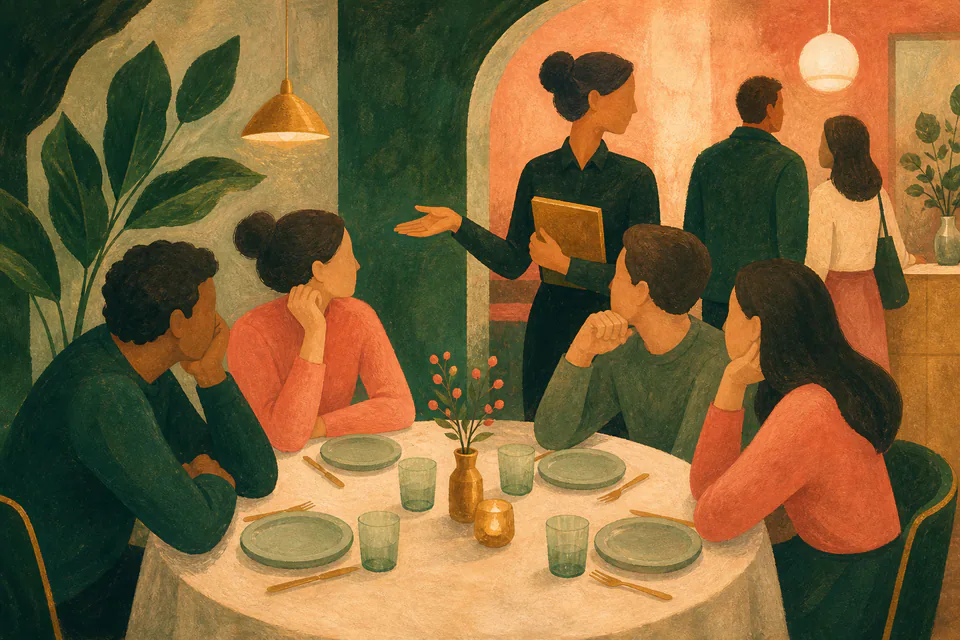
A busy restaurant seats your group only after everyone arrives. One friend is forty minutes late and keeps texting that they are almost there. A couple waiting nearby could use the empty place, and the server asks your group to order without them.
How long should one person's delay control everyone else's evening?