In part one of Red Eye Radio with Gary McNamara and Eric Harley: bob cats and coyotes and wild boars oh my! / Transportation Secretary Duffy says the previous administration under Joe Biden converted 19% of the old copper air traffic network to fiber over 4 years while his team has completed more than 50% of the transition in just 1 year / We live in an instantaneous" society / Adding to the current social media panic, the FBI has issued a flash advisory warning that cybercriminals and state-aligned hackers are exploiting ARTEX, a super intelligence-powered penetration testing framework, to automate attacks against businesses and organizations worldwide / Regarding the war with Iran becoming a forever war, Vice President Vance says "we signed up to not do this". Who is "we"? / Trump to meet with Putin and Xi.
In part two of Red Eye Radio with Gary McNamara and Eric Harley, Shark Tanks' Kevin O'Leary debates liberal gen-z social media influencers on economics and it goes as you would expect / Taxes are not sharing / Work-life balance.
The Ninth Circuit considers whether a court order temporarily stopping deportation also changes the rules governing a person's continued detention. The petitioner is a Mexican citizen who had previously been deported and returned to the United States. In 2025, after he posted bond in a separate criminal case, immigration officers took him into custody and reinstated an old removal order. The criminal case was dismissed, but immigration detention continued. He said he feared persecution or torture in Mexico. An immigration judge upheld an adverse initial decision on that fear, and he sought review in the Ninth Circuit. The court temporarily stopped his removal, but he remained in custody. He also sought release on bond and then brought a habeas case, asking a federal court to review the legality of his detention. The district judge denied that petition. The dispute turns on two statutory frameworks. Section twelve twenty-six generally governs detention while a decision on removal is pen
The Second Circuit considers whether a company can be liable for failing to protect an employee from sex-based harassment by someone who works for a different business. Collins worked at a Dunkin' Donuts inside a Connecticut highway service plaza. Her complaint alleges that the manager of the Mobil Mart in the same building pulled her ears, repeatedly threw objects at her, and mocked her work with a remark about showing her how a man would do the job. She says she reported his behavior to Applegreen, her employer, but managers told her to ignore him or seek a restraining order. Applegreen later fired her, citing a cash shortage that she disputed. Collins sued for harassment and other employment claims. A federal judge dismissed her complaint before trial, finding insufficient allegations that Applegreen controlled the alleged harasser or knew the harassment was sex-based. The Equal Employment Opportunity Commission, appearing in support of Collins, will argue that the focus should be A
Senior Editor Michael Feinberg sits down with Nick Harkaway, author and son of John le Carré, to discuss the enduring legacy of George Smiley, one of spy fiction’s most indelible characters. They talk about fact and fiction in the world of spy novels—and about Nick’s new book, “The Taper Man: A Novel of John le Carré's Circus (https://www.penguinrandomhouse.com/books/865730/the-taper-man-by-nick-harkaway/9798217356249/).” Hosted on Acast.
American University professor Omékongo Dibinga joins Chuck Todd to argue that the fight over words like “woke,” “DEI” and “CRT” is doing real damage in both directions — terms that originated inside marginalized communities have been weaponized against them, while the left has drained others of meaning by swapping “homeless” for “unhoused” and “Latino” for “Latinx.” He walks through how “woke” became a simple synonym for liberal, what he hears when AOC says “Woke 1.0 was crazy,” and why an administration railing against DEI while staffing itself with the unqualified is the cleanest tell that the term has stopped describing anything. Plus why the CRT and 1619 fight landed so differently than the affirmative action one, what the defensiveness around teaching history actually reveals, and why “real Americans” may be the most corrosive phrase in politics. His book Trigger Words: How Political Language Has Made America Less Inclusive (And How to Bring Us Back Together) is out now. Timeline:
Chuck Todd on a week where everything seemed to break at once, and why the nervousness is warranted. His read on the election is that the country issued a primal scream for basic competence, and the administration’s answer has been a shrug — “move fast and break things” applied to a government where breaking things gets people killed, with the expertise DOGE cut now conspicuously missing. Sean Duffy is asking Congress for $50 billion for the FAA after a ground stop whose cause still isn’t public, and DHS Secretary Markwayne Mullin took a government plane to the LSU-Texas game the next day, which he defended by noting the airways had been open for 21 hours. Plus Jensen Huang saying he’d be “honored” to return as Nvidia’s CEO while agreeing to sit for transcribed interviews with three House committees on December 1st, what roughly $12 billion in midterm spending actually bought, and a Florida city canceling a 56-year-old St. Patrick’s Day parade because DeSantis’s anti-DEI law appears to
Chuck Todd on a week where everything seemed to break at once, and why the nervousness is warranted. His read on the election is that the country issued a primal scream for basic competence, and the administration’s answer has been a shrug — “move fast and break things” applied to a government where breaking things gets people killed, with the expertise DOGE cut now conspicuously missing. Sean Duffy is asking Congress for $50 billion for the FAA after a ground stop whose cause still isn’t public, and DHS Secretary Markwayne Mullin took a government plane to the LSU-Texas game the next day, which he defended by noting the airways had been open for 21 hours. Plus Jensen Huang saying he’d be “honored” to return as Nvidia’s CEO while agreeing to sit for transcribed interviews with three House committees on December 1st, what roughly $12 billion in midterm spending actually bought, and a Florida city canceling a 56-year-old St. Patrick’s Day parade because DeSantis’s anti-DEI law appears to
Senior Editor Michael Feinberg sits down with Nick Harkaway, author and son of John le Carré, to discuss the enduring legacy of George Smiley, one of spy fiction’s most indelible characters. They talk about fact and fiction in the world of spy novels—and about Nick’s new book, “The Taper Man: A Novel of John le Carré's Circus (https://www.penguinrandomhouse.com/books/865730/the-taper-man-by-nick-harkaway/9798217356249/).” Hosted on Acast.
Washington is consumed by one question: What the hell is going on? A wave of outages, groundings and disruptions has thrown the country into a frenzy. Lawmakers on both sides of the aisle are seeking answers and growing increasingly frustrated by the White House’s response. Then the other stories animating Washington: Rep. Robert Garcia has his sights set on his top targets as the incoming chair of the Oversight Committee, while Rep. Alexandria Ocasio-Cortez makes a rare appearance on Fox News to talk about bipartisanship. We want to hear from you! We have a survey out and would love to know what you like about the podcast and what we could do differently. The survey will take max five minutes: politico.com/survey (https://politico.com/survey)
The scandal involving the Nvidia tech company is sharply dividing (https://www.washingtonpost.com/technology/2026/11/16/fight-between-bessent-lutnick-over-nvidia-chips-heats-up/) Donald Trump’s advisers. Faced with revelations (https://www.nytimes.com/2026/10/29/us/politics/nvidia-china-jensen-huang-trump.html) about its leader Jensen Huang having an affair with an alleged spy who may have channeled AI tech to China, Treasury Secretary Scott Bessent is pillorying (https://www.washingtonpost.com/technology/2026/11/16/fight-between-bessent-lutnick-over-nvidia-chips-heats-up/) Commerce Secretary Howard Lutnick for failing to act to curb China’s access to Nvidia technology. It’s getting humiliating for Trump, who’s adrift and listless, exercising no leadership, even as he appears to have been far too solicitous (https://www.nytimes.com/2026/10/29/us/politics/nvidia-china-jensen-huang-trump.html) of Huang, possibly for corrupt personal reasons. Meanwhile, Fox News is now running interferenc
America’s ability to project power anywhere in the world begins at sea. An aircraft carrier moves an airfield across an ocean. A submarine disappears beneath the surface while maintaining nuclear advantage. Destroyers defend a fleet, strike targets hundreds of miles away, and protect the sea lanes that connect the global economy. When access disappears, bases become vulnerable, or a crisis erupts thousands of miles from American shores, the United States Navy (https://www.navy.com/) can arrive without asking for permission. The US Navy may have the most sophisticated hardware on the seas, but the sailor is the most important weapon system. From the Delbert D. Black National Chief’s Mess at the United States Navy Memorial (https://www.navymemorial.org/) in Washington, D.C., Fran Racioppi (https://www.linkedin.com/in/francisracioppijr/) sat down with Master Chief Petty Officer of the Navy John Perryman (https://www.navy.mil/Leadership/Flag-Officer-Biographies/BioDisplay/Article/4296771/)
In this episode of Army Matters, hosts LTG (Ret.) Leslie Smith and SMA (Ret.) Dan Dailey sit down with Jill Stephenson, a Gold Star Mother who lost her son, Corporal Benjamin S. Kopp, an Army Ranger, on July 18, 2009, after he was shot days earlier during a firefight with the Taliban in Afghanistan. He saved six fellow Rangers during combat, and his organ donation saved or enhanced the lives of 60 other people, with his heart still beating in one recipient. While losing a child is not the outcome parents hope for, being Ben’s mom gave Jill’s life meaning, then and now. Today, she discusses what influenced her son to serve, from idyllic summers up north with his great grandfather and his reaction to the 9-11 terrorist attacks to the dream of becoming an elite Army Ranger. Service is a calling that comes with risk, and CPL Ben Kopp’s story is one of heroism both during life and after. Honoring his commitment to our nation, his mother Jill Stephenson shares his inspiration, energy and spi
Hub Headlines features audio versions of the best commentaries and analysis published daily in The Hub. Enjoy listening to original and provocative takes on the issues that matter while you are on the go. 0:23 - Antisemitism doesn’t stop at the office door. Neither should our response (https://thehub.ca/2026/11/18/antisemitism-doesnt-stop-at-the-office-door-neither-should-our-response/), by Amanda Eskenasi 8:32 - ‘If there’s a visa, we will leave Canada’: The Jewish expats helping Canadian Jews resettle in the U.S. (https://thehub.ca/2026/11/15/if-theres-a-visa-we-will-leave-canada-the-jewish-expats-helping-canadian-jews-resettle-in-the-u-s/), by Graeme Gordon This program is narrated by automated voices. https://tinyurl.com/3a7zpd7e (Apple) https://tinyurl.com/y8akmfn7 (Spotify) Watch The Hub on YouTube: https://www.youtube.com/@TheHubCanada The Hub on X: https://x.com/thehubcanada?lang=en Hosted on Acast.
A television merger raises a practical question: how much of the combined business must remain separate while an antitrust challenge goes to trial? Nexstar acquired Tegna, bringing two groups of local television stations under the same ownership. DirecTV pays station owners for the rights to carry their programming to its subscribers. It sued, alleging that combining rival stations in the same local markets would give Nexstar more leverage to charge higher fees and reduce competition in local news. A group of states brought a parallel challenge on behalf of their residents. The merger closed, but a federal judge ordered the companies to stop further integration and keep Tegna operating as an independent business during the lawsuit. That is a temporary safeguard, not a final decision about whether the merger must be undone. The appeal focuses on the reach of that safeguard. Nexstar's lawyer will argue that the order should target Tegna's major-network stations in thirty-one overlapping
A banking consultant asks whether the banks that hired it must pay an additional performance fee. Methods Research helped a group of banks consolidate information technology and improve their operations. Their written agreement provided for fixed payments and a further fee tied to financial improvements from the consultant's recommendations. The fixed payments were made, but the performance fee became a dispute. One flashpoint was a signing bonus from Mastercard, whose contract the consultant had negotiated. The consultant billed a fee tied to that bonus, and the parties disagreed about expenses, measurement, and how to account for payments already made. Methods Research sued, also accusing the banks of making misleading representations about the fee calculations. The federal trial judge ruled for the banks before trial, finding the performance-fee provision too indefinite to enforce and rejecting the remaining claims. The consultant is now appealing. Its lawyer will argue that the par
The first ever Best Of compilation from That Family Law Guy: Unfiltered. Revisit some of the biggest, funniest and most powerful moments from the series so far — including Lejla’s unforgettable “butcher’s knife” feminism moment, Lucie on OnlyFans and online judgement, Mike on marriage, family and Family Court, and Camilla bringing the barrister’s perspective on law, relationships and the courtroom. One compilation. Four unforgettable guests. Plenty of unfiltered moments.Subscribe for new episodes, clips and more from That Family Law Guy. #ThatFamilyLawGuy #familycourt #familylaw #bestof #OnlyFans #Barrister #divorce #relationships
In this episode of Books to Battles, Dr. Brian McNeil discusses his new book, Frontiers of Need: American Humanitarianism and the Nigerian Civil War. Exploring the humanitarian crisis in Biafra, McNeil examines how domestic political pressures shaped American intervention during the Johnson and Nixon administrations. The conversation highlights the tensions between humanitarian ideals, national interests, and political realities, offering important lessons for understanding the challenges and unintended consequences of humanitarian intervention today.
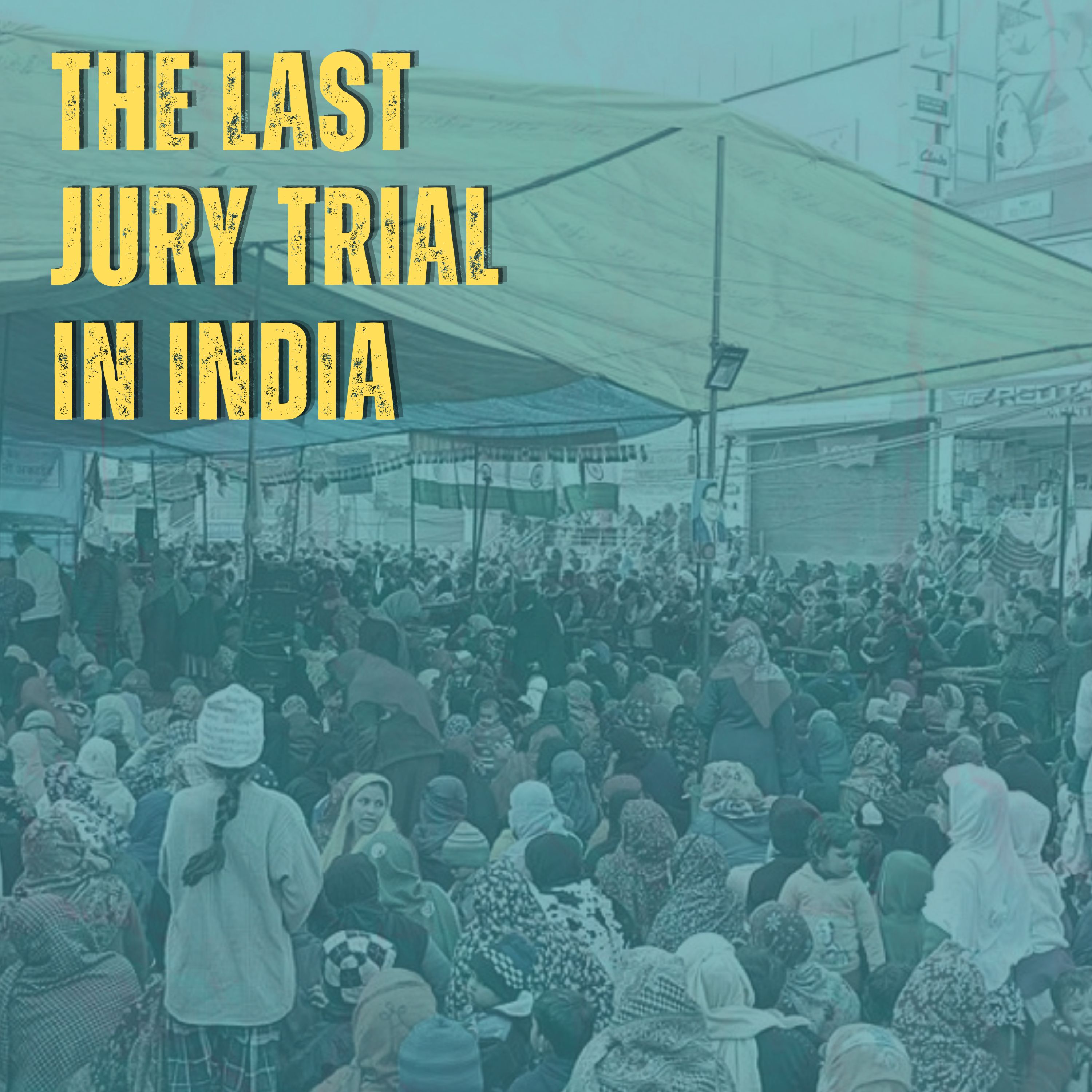
How is the judge-centered legal system working in India today? Tremendous backlogs and a feeling of distance between the people and the courts are the concerns I heard most about. The detention of Umar Khalid, an activist who protested the 2019 Citizenship Amendment Act has gone on for more than 5 years. What would happen if he had his case heard before a jury? This thought experiment of the jury trial in India is paired with a discussion of the legal system in Argentina where jury trials have recently been introduced in the most serious cases. Hosted by Simplecast, an AdsWizz company.
What happens when European politics goes digital? Behind the scenes in European Union institutions, a quiet transformation is reshaping the way power works. Based on long-term ethnographic research, The Brussels Bubble: Inside the European Union in the Digital Age (https://bookshop.org/a/12343/9781009756808)(Cambridge University Press, 2026) by Dr. Rebecca Adler-Nissen & Dr. Kristin Anabel Eggeling follows diplomats, civil servants, spokespersons, and interpreters through the corridors, meeting rooms, cafés, and smartphone screens of Brussels' European Quarter. Against the backdrop of Brexit, the COVID-19 pandemic, and Russia's war on Ukraine, it reveals how digital technologies have become inseparable from the practice of international politics—reshaping trust, tact, and authority in unexpected ways. Far from a tale of technological revolution, The Brussels Bubble exposes digitalisation as a messy, human negotiation about what diplomacy and Europe itself mean today. Combining vivid na
This week on Democracy Dialogues, Rachel Beatty Riedl speaks with Filip Milačić to discuss his book, Abandoning Democracy for the Nation. (https://bookshop.org/a/12343/9781009734738)They examine the paradox of why democratically minded citizens choose to support undemocratic leaders and how political actors leverage narratives of national threat to convince voters to prioritize protecting the nation over upholding democratic principles. In this episode, Milačić outlines how political entrepreneurs fabricate threat narratives surrounding national identity, security, and economic well-being to justify subverting democratic practices. He shares findings from his research showing how political parties can effectively push back against radical right platforms—explaining why ignoring or emulating these narratives fails. The conversation concludes with a discussion on the power of courageous counter-narratives, direct grassroots voter engagement, and the need for a forward-looking vision of d
A warehouse worker's wage-and-hour lawsuit begins with a dispute about where her case can be heard. Her work involved handling goods inside a distribution warehouse. She sued a retailer and a staffing company under California labor law. The companies asked the federal trial court to enforce an arbitration agreement, so her claims would go to a private arbitrator rather than proceed in court. The judge refused, and the companies appealed. This hearing concerns that choice of forum, not whether the companies owe the wages she seeks. The Federal Arbitration Act excludes certain transportation workers' employment contracts. The question here is whether moving goods inside a warehouse connects a worker closely enough to interstate transportation to qualify. The companies' lawyer will argue that her role was too indirect, and that the judge should have held a hearing on conflicting evidence about her duties. The worker's lawyer will argue that moving goods along their distribution chain can
A parent asks who should pay for a child's private schooling while a public school district works out a new special-education plan. The child had attended private schools for several years. In spring 2021, her mother contacted the local public school district to explore returning to public school. She wanted an updated evaluation and an individualized education program, or I E P, so she could understand what the district would offer before the next school year. Her follow-up emails went unanswered until her lawyer contacted the district. An evaluation was completed in September, after classes began. The child attended private school, and the family and district continued working on a plan. The district later agreed to fund private placement beginning in January 2022. The parent seeks reimbursement for the earlier period. An administrative law judge ruled for the district. The federal district court also ruled for the district, despite finding that the absence of a new plan at the start
Rail parks have the power to change communities, for better and sometimes for worse. They tend to boost the real estate value of neighboring buildings. They connect people to nature. But these transformations of old, abandoned infrastructure have also caused severe neighborhood gentrification and displacement in some cities. But there are practitioners leading these transformations in public spaces intentionally thinking about how they impact neighborhoods. Hear from leaders in Philadelphia, Chicago, and Washington, D.C. as they discuss how linear and rail parks across the country can promote neighborhood connection and access to alternative forms of mobility. This program is made possible with support from the William Penn Foundation.