Mr E and Jay Clone discuss a tall tale that may be grounded in more truth than we realized. Is it possible for a snake to form a hula hoop and roll away to escape predators? Initial reaction would say nay, but we’re here to uncover there may be more truth to this claim than fiction. Call your local snake wrangler named Earyaan and enjoy this episode of Cryptids of the Corn! Privacy & Opt-Out: https://redcircle.com/privacy
Dig into the myth of Baucis and Philemon, a couple who unknowingly showed the gods hospitality after their neighbors refused. -- It was dark when two mysterious, shrouded figures appeared in a hillside village. The strangers knocked on every door in town, asking for food and shelter. But, again and again, they were turned away. Soon, there was just one door left: that of a small, thatched shack. Would the owners help the visitors — or spurn them? Iseult Gillespie shares the myth of Baucis and Philemon. Lesson by Iseult Gillespie, directed by Vitalii Nebelskyi, and action creative agency. Support Our Non-Profit Mission ---------------------------------------------- Support us on Patreon: http://bit.ly/TEDEdPatreon Check out our merch: http://bit.ly/TEDEDShop ---------------------------------------------- Connect With Us ---------------------------------------------- Sign up for our newsletter: http://bit.ly/TEDEdNewsletter Find us on Twitter: http://bit.ly/TEDEdTwitter Peep us on Instag
Naturewatch is a weekly celebration of British wildlife. Bringing together the stories that make us curious, the behaviours that make us wonder and the unexpected discoveries about the wildlife we think we know. It’s a lively, entertaining deep dive into the natural world on our doorstep. Chris Packham is joined by Kyle Thomas and Megan McCubbin - three curious minds, a wealth of expertise and one shared obsession with the natural world. Expect fascinating insights, brilliant observations and entertaining conversations that follow the natural world wherever it leads. From seasonal spectacles to the tiny everyday wonders happening right outside our doors - Naturewatch will keep audiences connected to Britain’s extraordinary wildlife all year round. Alongside the big questions, Naturewatch will explore the stories making waves in the natural world, uncover the science behind the headlines and bring the audience into the conversation with their own questions, observations and wildlife dis
A little remote viewing, a dash of geopolitical disclosure, and finish off with a helping of the Varginha case. That's what is on Stephen Diener's mind today during this unique episode of UAP, as Stephen serves up a lot of the important topics that have been on his mind lately that relate to the discussions currently surrounding the UFO topic...
Listen to the Financial Freedom subliminal I mentioned in the episode (https://manifest-it-2.passion.io/lesson?courseId=59588&lessonId=1613960) What do you do when you know all the manifestation techniques, but you're feeling completely disconnected from your own magic? After an incredibly overwhelming October, I found myself exhausted, uninspired, out of my routines and questioning everything, including my business. And I realized something important: I'd been so busy doing everything for everyone else that I'd completely stopped doing the things that make ME feel good. So I'm declaring November my manifestation reset! In this episode, I'm getting vulnerable about the ups and downs of entrepreneurship, the pressure we put on ourselves, and how easy it is to fall out of alignment when life gets chaotic. I'm also sharing three intentional changes I'm making to shift my mindset, reclaim my energy and get back into creative flow. Plus, I'm walking you through a manifestation journaling ex
View full lesson: https://ed.ted.com/lessons/why-it-s-so-hard-to-cure-hiv-aids-janet-iwasa Uploaded 16-03-15 In 2008, something incredible happened: a man was cured of HIV. In over 70 million HIV cases, this was a first, and, so far, a last, and we don’t yet understand exactly how he was cured. But if we can cure people of various diseases, like malaria and hepatitis C, why can’t we cure HIV? Janet Iwasa examines the specific traits of the HIV virus that make it so difficult to cure. Lesson by Janet Iwasa, animation by Javier Saldeña.
Is recognition really enough? In our final episode of Crash Course Political Theory, we’ll explore this concept, from its 19th-century philosophical origins to modern-day Native land acknowledgements. Crash Course Political Theory #13 Introduction: Recognizing Palestine 00:00 Hegel & Recognition 1:55 Fanon & Decolonial Theory 4:54 Axel Honneth & Charles Taylor 6:10 Redistribution & Reparations 10:01 Review & Credits 12:58 Sources: https://docs.google.com/document/d/1u5zJCbVA0xCurLbQwWzcxXEdlqXAPpAyYVS1quwKIis/edit?usp=sharing *** Support us for $5/month on Patreon to keep Crash Course free for everyone forever! https://www.patreon.com/crashcourse Or support us directly: https://complexly.com/support Join our Crash Course email list to get the latest news and highlights: https://mailchi.mp/crashcourse/email Get our special Crash Course Educators newsletter: http://eepurl.com/iBgMhY Thanks to the following patrons for their generous monthly contributions that help keep Crash Course free
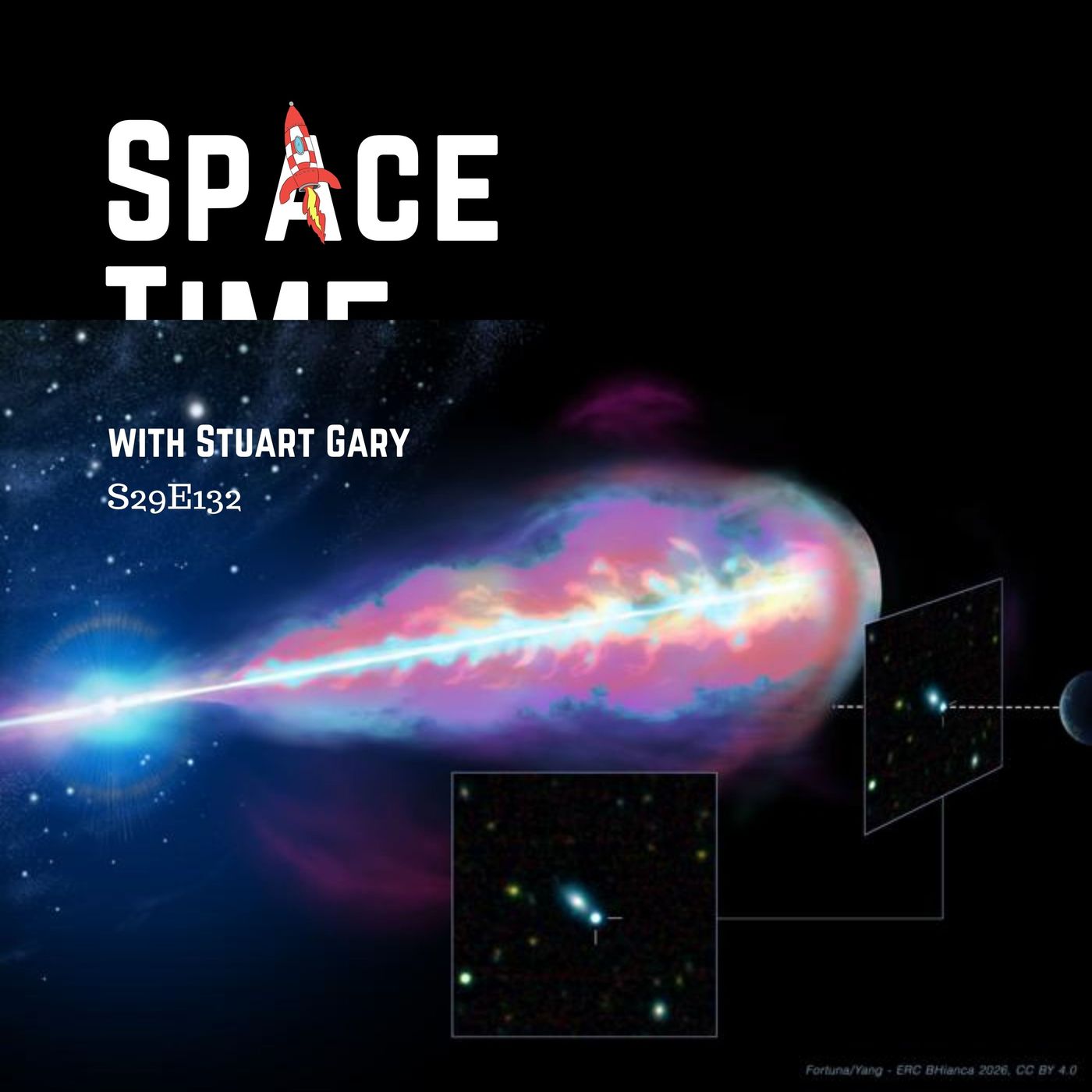
Wednesday SpaceTime 20261104 Series 29 Episode 132 A cosmic blast’s dazzling glow hints at a monster in hiding Astronomers say a seemingly ordinary flash of gamma rays followed by an unusually bright afterglow is pointing to a powerful stellar monster lurking out of sight. Coronal mass ejections discovered erupting from a black hole Astronomers have for the first time, discovered an event similar to a coronal mass ejection blasting out of a Black hole. Virgin Galactic unveils its new Delta Class Space Plane Virgin Galactic has formally unveiled the first of its new next generation Delta class spaceplanes at its New Mexico Space Port. The Science Report Exposure to bushfires while pregnant linked to kids being later diagnosed with autism. Antarctic Intermediate Water rapidly reversing is long-term trends in salinity and density. Paleontologists have discovered the remains of a new species of herbivorous dinosaur. Bans on smartphones in schools shown not to have had any impact on teen me
Show notes Swift's Last Orbit: NASA's burst hunter falls home, a gamma-ray burst that is two explosions in one, and 3I/ATLAS's dusty ice. Swift's Last Orbit NASA's Neil Gehrels Swift Observatory is expected to re-enter Earth's atmosphere on Wednesday 4 November; the US Space Force prediction is about 03:30 EST (08:30 UTC, 19:30 AEDT), plus or minus 11 hours. Surviving fragments are confined between 20.6°N and 20.6°S, a band that includes northern Australia; NASA puts the risk of harm to anyone at about 1 in 2,100. We look back at 22 years of science from a two-year mission: more than 2,000 gamma-ray bursts, the first short-burst afterglow in 2005, the BOAT in 2022, and about 7,000 papers. Two Bursts, Two Births GRB 160425A, caught by Swift in April 2016, is a 1.7-second short spike, four minutes of silence, then a 51-second long burst from the same place. A Nature Astronomy paper (Li, Wang, Zhang, Cai et al., 23 October; preprint March) argues the first is merger-like and the second co
What if the key to living longer isn't just adding years to your life, but adding more healthy years? In this episode of the WHOOP Podcast, WHOOP Founder and CEO Will Ahmed sits down with Dr. Eric Verdin, President and CEO of the Buck Institute for Research on Aging, to explore the science of longevity and how everyday habits can shape the way we age. Dr. Verdin shares why healthspan matters more than lifespan, the lifestyle factors that have the greatest impact on long-term health, and how the partnership between WHOOP and the Buck Institute is helping turn decades of longevity research into actionable insights through WHOOP Age and Pace of Aging. The conversation dives into the importance of sleep consistency, intermittent fasting, movement, stress management, and human connection. Dr. Verdin also reveals his personal experience with undiagnosed sleep apnea, the surprising discovery that helped him dramatically improve his heart rate variability (HRV), and what it taught him about th
Dive into the Japanese folktale of a scholar’s quest to purify his body and mind, and the spiritual secret he discovers along the way. Uploaded 14-09-20 -- In ancient Kyoto, a Shinto scholar found himself distracted from his prayers and sought to perform a purification ritual that would cleanse him. He decided to travel to the revered Hie Shrine; walking the path alone, ignoring any distractions in his quest for balance, and never straying. But setting out for home one day, he hears desperate pleas for help. Iseult Gillespie shares the tale of mercy. Lesson by Iseult Gillespie, directed by Amir Houshang Moein. Animator's website: https://vimeo.com/user35291637 Sign up for our newsletter: http://bit.ly/TEDEdNewsletter Support us on Patreon: http://bit.ly/TEDEdPatreon Find us on Twitter: http://bit.ly/TEDEdTwitter Peep us on Instagram: http://bit.ly/TEDEdInstagram View full lesson: https://ed.ted.com/lessons/the-japanese-folktale-of-the-selfish-scholar-iseult-gillespie Thank you so much
With the rise of personal AI assistants, the internet isn't just for humans anymore. This story was written by Grace Huckins and narrated by Noa - newsoveraudio.com. Listen to more curated articles on the Noa app.
"Predator-free 2050 is this hugely ambitious goal. And I think one the world's a little bit envious of, because imagine if we could do it!? It just shows that when you remove the pressure of introduced predators, that our nature knows what to do, and our native species can bounce back pretty quickly." New Zealand has no native land mammals apart from two bats, so its birds never evolved defences against rats, stoats, possums and cats. In this episode of Rewilding the World, Ben Goldsmith talks to Jessi Morgan, who runs the Predator Free New Zealand Trust, about the country’s goal of removing the worst invasive predators by 2050. They discuss why over 4,000 native species are threatened, and how fenced sanctuaries like Zealandia Te Māra a Tāne in Wellington are bringing birdlife back to the city. Jessi explains which predators are easiest to eradicate and why stoats are so hard, and describes the technology now being deployed, from self-resetting traps to AI cameras and species-specific
Human activity in outer space has surged dramatically in recent years, in what some are calling the dawn of a new space age. And there’s big money to be made, with some estimates suggesting that the global space industry could generate revenues of more than $1tn within the next two decades. But as our activities in space ramp up, big questions over who gets to control, and benefit from space and how we prevent today’s space race from reproducing the inequalities and conflicts on our planet are urgently needed. In this episode of the We Society podcast, Professor Andrew Futter, Director of the University of Leicester’s newly opened Leverhulme Centre for Humanity and Space, joins host Will Hutton to discuss the centre’s ambitious research programme and its vision, as the first centre of its kind to look at space through a social sciences lens. They discuss the urgent need to address the challenges and opportunities of this new global chapter, including whether we are asking the necessary
It’s the end of the world as we know it. Or is it? In this episode of Crash Course Religions, we explore end-of-the-world predictions across time and faith traditions. It turns out that, more often than not, those predictions have been more about a group’s present problems than any future calamity. Introduction: Fire and Ice 00:00 Apocalypticism 1:14 Revelation & Nero 3:53 Ragnarök 6:30 The Kali Yuga & the Mahdi 7:33 Unfulfilled Prophecies 9:12 Review & Credits 11:23 *** Support us for $5/month on Patreon to keep Crash Course free for everyone forever! https://www.patreon.com/crashcourse Or support us directly: https://complexly.com/support Join our Crash Course email list to get the latest news and highlights: https://mailchi.mp/crashcourse/email Get our special Crash Course Educators newsletter: http://eepurl.com/iBgMhY Thanks to the following patrons for their generous monthly contributions that help keep Crash Course free for everyone forever: Shruti S, Quinn Harden, Spilmann Reed,
If being alive on Earth were a contest, humans would win it hands down. We're like the Michael Phelps of being alive but with 250,000 times more gold medals. Today, Hank is here to tell us the specifics of why and how human population growth has happened over the past hundred and fifty years or so, and how those specifics relate to ecology. Table of Contents 1) R vs. K Selection Theory 01:41 2) Causes of Exponential Human Growth 03:24 3) Human Carrying Capacity 03:30 4) Ecological Footprints 06:40 5) Causes for Decline in Human Growth Rate 08:10 Crash Course is on Patreon! Want to find Crash Course elsewhere on the internet? Facebook - http://www.facebook.com/YouTubeCrashCourse Twitter - http://www.twitter.com/TheCrashCourse Instagram - https://www.instagram.com/thecrashcourse/ CC Kids: http://www.youtube.com/crashcoursekids
Is it possible to lose weight fast— in a healthy way? Dig into how different forms of dieting affect your body. -- In the wealthiest circles of Victorian England, dieters would swallow an unhatched tapeworm and let it grow inside them by consuming undigested meals. And while modern fad diets aren’t usually this extreme, they do promise similar results; specifically, losing weight fast. So, are there any fast diets that do work? And are any of them actually healthy for you? Hei Man Chan investigates. Lesson by Hei Man Chan, directed by Avi Ofer. Support Our Non-Profit Mission ---------------------------------------------- Support us on Patreon: http://bit.ly/TEDEdPatreon Check out our merch: http://bit.ly/TEDEDShop ---------------------------------------------- Connect With Us ---------------------------------------------- Sign up for our newsletter: http://bit.ly/TEDEdNewsletter Find us on Twitter: http://bit.ly/TEDEdTwitter Peep us on Instagram: http://bit.ly/TEDEdInstagram ----------
A family vacation through Europe included stays in some remarkable historic buildings, including a centuries-old property in France and a Spanish castle rumored to be haunted. There was a mysterious glowing figure in a photograph and a door handle that seemed to move on its own. But those experiences would pale in comparison to something that happened after an unimaginable personal loss. Six months after his son passed away, a grieving father read about the possibility of receiving signs from loved ones on the other side. He decided to ask his son for something very specific—a dime. Within hours, he found one. But he wasn't the only person to discover a dime that day. And when they later compared the dates on those two coins, the coincidences became much harder to dismiss. Could his son really have found a way to let them know he was still around? #RealGhostStoriesOnline #TrueGhostStories #SignsFromBeyond #AfterDeathCommunication #SpiritMessages #LovedOnesInSpirit #ParanormalEncounters
An eleven-year-old boy claims he encountered a terrifying figure while helping his family prepare a new home. Soon, his behavior begins to change. There are violent episodes, disturbing voices, and reports of objects moving on their own. His family seeks medical help, turns to the Catholic Church, and eventually brings in paranormal investigators Ed and Lorraine Warren. But not everyone believes the boy is possessed. His own father has doubts, his brothers remember events differently, and the Church refuses to authorize a formal exorcism without further evaluation. As the family grows increasingly desperate, the boy's sister's boyfriend makes a decision that will change everything. He challenges whatever might be tormenting the child to leave him alone and take him instead. The boy reportedly improves. But has something truly left him—or has it simply found someone else? #TheDevilMadeMeDoIt #RealGhostStoriesOnline #DemonicPossession #DavidGlatzel #EdAndLorraineWarren #ParanormalInvesti
We don't know a lot about deep-sea eels, so when 2.8 million of them are found in the same place every year, scientists (and science reporters) get excited. Why are they there? Where are they coming from, and why should we care about these creatures from the depths? Jonathan Webb dives into this world of eels off the coast of Tasmania with environment reporter Peter de Kruijff. You can binge more episodes of the Lab Notes podcast with science editor and presenter Jonathan Webb on the ABC Listen app (Australia). You'll find episodes on animal behaviour, human health, space exploration and so much more. Get in touch with us: [email protected] Featuring: Peter de Kruijff, environment reporter Further information: Australia's giant spawning eel ball estimated to contain 2.8 million eels (https://www.abc.net.au/news/science/2026-10-28/australia-biggest-eel-ball-2-8-million-off-tasmania/107309716) This episode of Lab Notes was produced on the lands of the Gadigal, Ngunnawal and Ngambri peo
We don't know a lot about deep-sea eels, so when 2.8 million of them are found in the same place every year, scientists (and science reporters) get excited. Why are they there? Where are they coming from, and why should we care about these creatures from the depths? Jonathan Webb dives into this world of eels off the coast of Tasmania with environment reporter Peter de Kruijff. Get in touch with us: [email protected] Featuring: Peter de Kruijff, environment reporter Further information: Australia's giant spawning eel ball estimated to contain 2.8 million eels (https://www.abc.net.au/news/science/2026-10-28/australia-biggest-eel-ball-2-8-million-off-tasmania/107309716)
The primary individual at the center of this incredible survival event was Montana Department of Fish, Wildlife and Parks Regional Warden Supervisor Louis Keys, stationed out of Kalispell. Across his long, dedicated career as a wildlife officer, Keys had successfully handled, trapped, and relocated numerous problem grizzly bears throughout the Flathead Valley and surrounding wildlands. Known by his colleagues as an exceptionally experienced, calm, and capable field warden, he approached every wildlife operation with professional discipline.During this particular operation near the Bob Marshall Wilderness boundary, Keys was on duty managing the direct field release of a captured grizzly bear. Keys did not have a dog accompanying him on this assignment, but as a seasoned state game warden, he was equipped with his department sidearm, a three--fifty-seven Magnum service revolver carried securely in his duty holster.The chain of events began when a five-hundred-pound grizzly bear was captu
Ninety minutes, back to back, no filler. This is the full marathon: Real bear attack stories, one after another, from the moment things went wrong to what happened after. Some end in survival. Some don't. All of them really happened. Stories featured in this episode will leave chills down you spine! Get new stories early and ad-free on Patreon: patreon.com/8650258/join ▶️ Watch on YouTube: youtube.com/@scarybearattacks
Today we’re going to discuss what it means for a place to be “developed”. Development is often associated with economic success — that is countries with higher standards of living and material wealth like those found in Europe and North America. But as we’ll see, this perspective is only one way to compare countries on the global stage, has strong ties to colonialist histories, and doesn’t necessarily capture a place’s environmental and socioeconomic sustainability or even the population’s general happiness. We’ll focus on the region in the Middle East and North Africa, called MENA, and examine how the histories of the United Arab Emirates and Lebanon have resulted in drastically different development scores. [Sources] General Getis, Bjelland, and Getis. Introduction to Geography, 15 ed. McGraw-Hill Education. 2017. ISBN: 978-1-259-57000-1 Gregory, Derek, Ron Johnston, Geraldine Pratt, Michael Watts, and Sarah Whatmore, eds. 2009. The Dictionary of Human Geography. 5th ed. Willey-Black