English-language podcasts

TED-Ed

Can you solve the giant iron riddle? - Alex Gendler

6 min

Listen through the publisher, then discuss the episode here or arrange an in-person Roundtable. Your city determines where to meet.

Roundtables are designed for groups of four, with a shared subject and room for everyone to speak. Come for discussion, with no dating expectation.

Practice more problem-solving at https://brilliant.org/TedEd/ Solution to bonus riddle: https://brilliant.org/TedEdGiantIron/ Uploaded 27-11-18 The family of giants you work for is throwing a fancy dinner party, but there’s a problem — the elder giant’s favorite shirt is wrinkled! To fix it, you’ll need to power up the giant iron. It needs two batteries to work, but the baby giant mixed the working battery pile with the dead pile. Can you test the batteries so that you get a working pair in seven tries or less? Alex Gendler shows how. Lesson by Alex Gendler, directed by Artrake Studio. Thank you so much to our patrons for your support! Without you this video would not be possible! Merit Gamertsfelder, Bev Millar, Rishi Pasham, Jhuval, SookKwan Loong, Daniel Day, Nick Johnson, Bruno Pinho, Javier Aldavaz, Marc Veale, Boytsov Ilya, maxi kobi einy, Misaki Sato, Andrew Bosco, Nik Maier, Mark Morris, Tamás Drávai, Adi V, Peter Liu, Leora Allen, Hiroshi Uchiyama, Julie Cummings-Debrot, Gilly, Ka-Hei Law, Maya Toll, Aleksandar Srbinovski, Ricardo Rendon Cepeda, Renhe Ji, Andrés Melo Gámez, Tim Leistikow, Chris, Megan Douglas, Barbara Smalley, Filip Dabrowski, Clair Chen, Vik Nagjee, Karen Goepen-Wee, Della Palacios, Bah Becerra, Marc Bilodeau, Ruby Solorzano, Ivan Tsenov, Claudia Mayfield, Yankai Liu, Duo Xu, Joy Love Om, Gi Nam Lee, Shawn Quichocho, Anika Westburg and Barun Padhy.

Episode information is provided by the publisher. Listening takes place on the publisher’s service.

Listen at the source ↗

Featured places to meet in Palo Alto, CA

Explore these places and arrange a conversation through ThinkMatch.

City guide for Palo Alto, CA

More from TED-Ed

TED-Ed

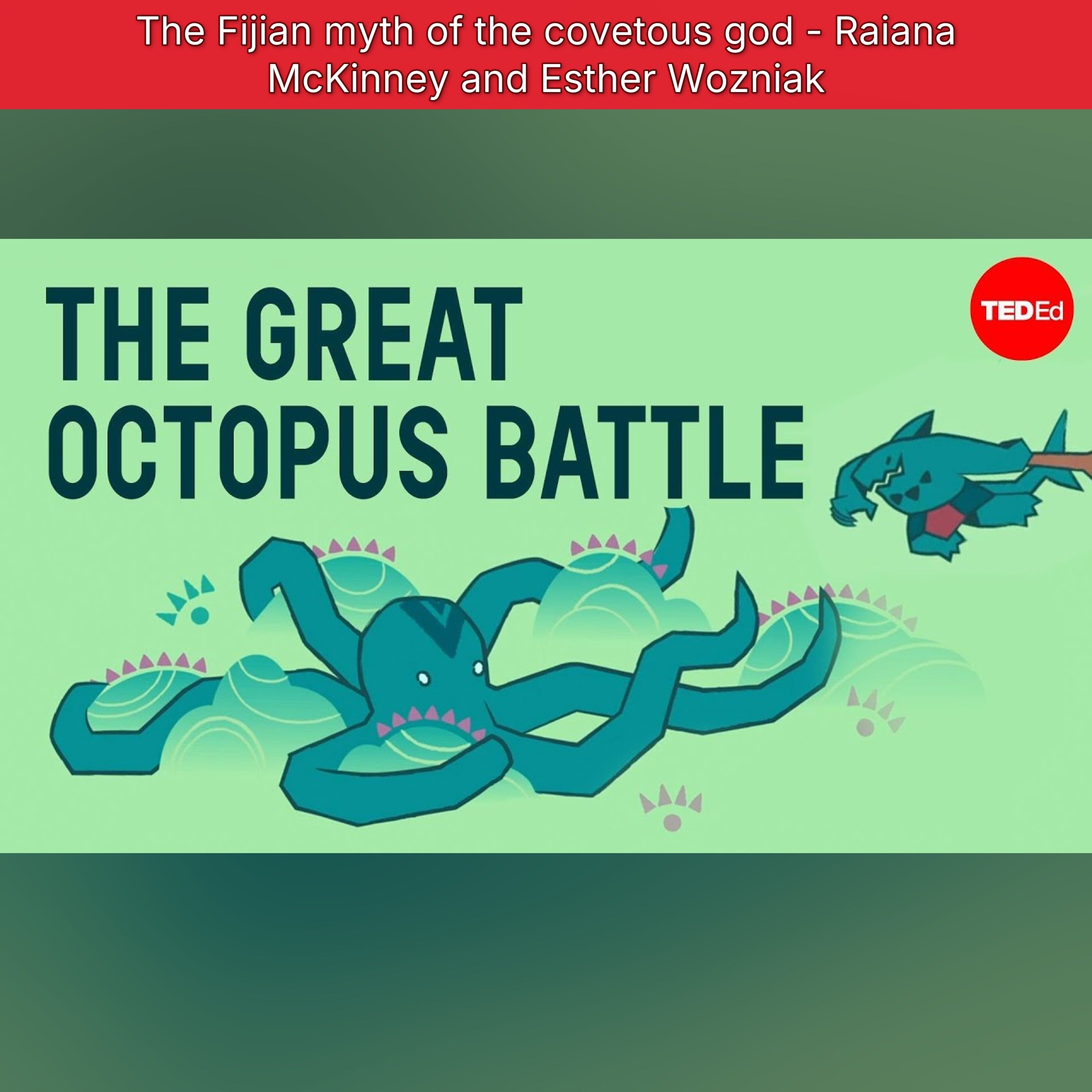
The Fijian myth of the covetous god - Raiana McKinney and Esther Wozniak

8 min

Dig into the Fijian myth of Dakuwaqa, the shape-shifting shark god who is determined to take over all of Fiji's islands. -- Long ago, the ancestral gods of Fiji settled on the Pacific archipelago. They eventually metamorphosed into various forms, with the god Dakuwaqa transforming into a shark. But he was unsatisfied. He became proud and greedy and wanted to establish himself as the mightiest god, and dominate all of Fiji’s islands. Raiana McKinney and Esther Wozniak share the tale of Dakuwaqa’s quest for power. Lesson by Raiana McKinney and Esther Wozniak, directed by KERO Animation. Support Our Non-Profit Mission ---------------------------------------------- Support us on Patreon: http://bit.ly/TEDEdPatreon Check out our merch: http://bit.ly/TEDEDShop ---------------------------------------------- Connect With Us ---------------------------------------------- Sign up for our newsletter: http://bit.ly/TEDEdNewsletter Find us on Twitter: http://bit.ly/TEDEdTwitter Peep us on Instagram

Discuss this episode

TED-Ed

HIV and flu -- the inoculation strategy - Seth Berkley

27 min

View full lesson: http://ed.ted.com/lessons/hiv-and-flu-the-vaccine-strategy-seth-berkley Seth Berkley explains how smart advances in vaccine design, production and distribution are bringing us closer than ever to eliminating a host of global threats -- from AIDS to malaria to flu pandemics. Talk by Seth Berkley.

Discuss this episode

Community Poll

Removing outdated rules is worthwhile even when it reduces some existing protections.

Share your view, then see how readers voted. No sign-in required. This poll is shared across stories.

Do you agree or disagree?

Choose one answer

Common Quandary

A Common Quandary to discuss

Another conversation to explore, separate from this news story.

Your best friend is an AI that profits when you stay lonely. Is the friendship real?

A lonely adult considers an AI companion their closest confidant. The service is always patient and supportive, but the company profits when users spend more time engaged with it.

Does a comforting system have a duty to make itself less necessary?

Explore this quandary