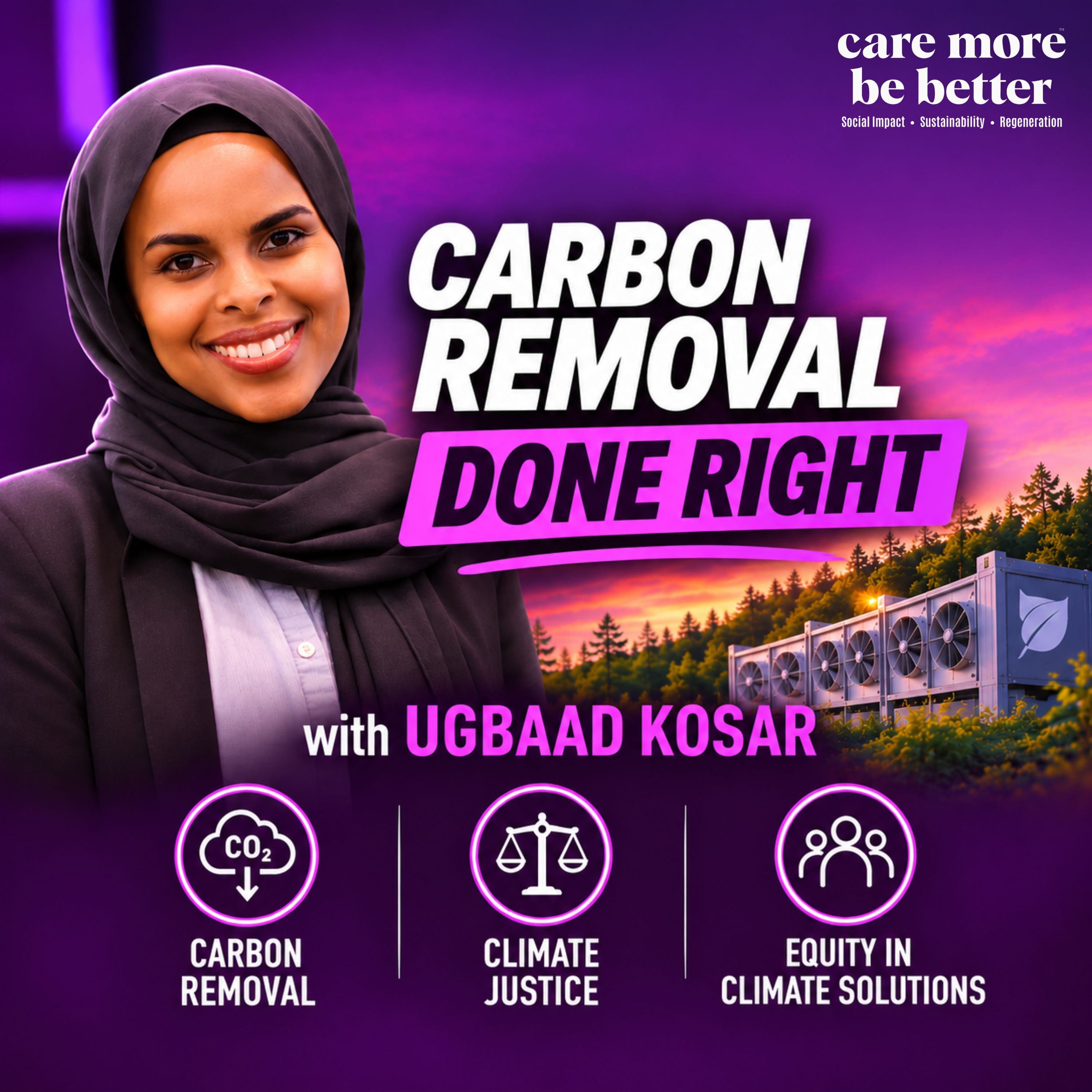
Carbon Removal, Done Right: Equity, Community, and Accountability with Ugbaad Kosar of Carbon180
Listen through the publisher, then discuss the episode here or arrange an in-person Roundtable. Your city determines where to meet.
Roundtables are designed for groups of four, with a shared subject and room for everyone to speak. Come for discussion, with no dating expectation.
Cutting emissions is the first job, but scientists say we also need to remove carbon that is already in the air, and how we do it will decide whether people trust it. Ugbaad Kosar brings a human-rights lens to the question, shaped by the 2011 drought and famine that reached her family in Somalia. In this conversation she explains the range of carbon removal approaches, from soil and forests to direct air capture and the ocean, and why the land-based options may be the ones ready to go today. She also makes the case that community input is not a courtesy but a requirement, with data centers as a real-time lesson, and shares what Carbon180's CORE framework asks of anyone building a project. You will leave with practical ways to get informed and speak up when a project is proposed near you. Show Note: 00:00 – Why Land-Based Carbon Removal Benefits Go Beyond Carbon 00:28 – Introduction to Care More Be Better 00:47 – Meet Ugbaad Kosar: Equity and Justice at Carbon180 02:26 – Ugbaad’s Journey Into Climate Science and Environmental Justice 06:07 – What Is Carbon Removal and Why Do We Need It? 08:01 – Why Carbon Removal Must Work Alongside Emissions Reduction 09:50 – Iceland’s Circular Carbon Removal and Algae Project 14:14 – Why Carbon Removal Requires a Portfolio of Solutions 15:10 – Exploring Carbon Removal Technologies and Their Potential 18:00 – Land-Based Carbon Removal: Practical Solutions We Can Scale Today 22:03 – Ocean-Based Carbon Removal: Opportunities and Uncertainties 25:48 – The Hidden Benefits of Regenerative Agriculture 26:32 – Technology-Based Carbon Removal and Community Benefits 28:34 – What Data Centers Teach Us About Community Engagement 32:05 – Creating Meaningful Benefits for Local Communities 37:47 – Supporting Farmers Through the Transition to Regenerative Practices 39:55 – Building Equity and Justice Into Carbon Removal 40:16 – Carbon180’s Community Regranting Program 43:15 – Bringing Science, Innovation, Equity, and Justice Together 47:23 – Introducing the CORE Carbon Removal Framework 50:56 – Transparency and Accountability in Climate Projects 52:46 – How Individuals Can Support Responsible Carbon Removal 55:11 – What Gives Ugbaad Hope for the Future? 56:37 – Closing Thoughts and Supporting Prescott College About Ugbaad Kosar Ugbaad Kosar is the Director of Equity and Justice at Carbon180, where she leads the organization's equity and justice program. Her work focuses on ensuring that carbon removal is credible, accountable, and shaped by the communities most impacted by climate solutions. With more than eight years of interdisciplinary experience in environmental science research, policy development, advocacy, and data analysis, Ugbaad works to advance inclusive and equitable climate policy. Previously, she worked for the City of Ottawa, informing municipal and provincial environmental legislation, and developed policy for both a grassroots organization and the City of Edmonton. Ugbaad holds a dual Master of Science in forest sciences and renewable resource management from the University of Alberta and the University of Freiburg, as well as a bachelor's degree from Carleton University. Her writing has appeared in The Hill and Electricity Journal. Connect with Ugbaad Kosar Carbon180 (https://carbon180.org/) Ugbaad Kosar on LinkedIn (https://www.linkedin.com/in/ugbaadkosar/) Learn More The CORE Carbon Removal Framework (https://carbon180.org/initiative/core-framework/) Introducing the CORE Carbon Removal Framework (https://carbon180.org/blog/introducing-the-core-carbon-removal-framework/) Carbon180 also publishes The Carbon Copy, a weekly news roundup, at Carbon180.org (http://carbon180.org/). CONNECT & SUPPORT CARE MORE BE BETTER YouTube: https://www.youtube.com/c/caremorebebetter TikTok: https://www.tiktok.com/@caremorebebetter Instagram: https://www.instagram.com/caremorebebetter Facebook: https://www.facebook.com/CareMoreBeBetter LinkedIn:https://www.linkedin.com/company/care-more-be-better Hosted by Simplecast, an AdsWizz company.
Episode information is provided by the publisher. Listening takes place on the publisher’s service.
Listen at the source ↗