[CHAIN REACTION] Three Theories of Depression and the Promise of Psychedelics: The Drugs That Shape Us, Episode 3
57 min
Listen through the publisher, then discuss the episode here or arrange an in-person Roundtable. Your city determines where to meet.
Roundtables are designed for groups of four, with a shared subject and room for everyone to speak. Come for discussion, with no dating expectation.
In the late 1950s, a tuberculosis drug was repurposed as the world’s first antidepressant. Then the selective serotonin reuptake inhibitor (SSRI) Prozac ushered in a new era of antidepressants. Today SSRIs are some of the most widely prescribed drugs in the country, but gaps still exist in our biological understanding of mental health, the overall efficacy of antidepressants, and predicting serious side effects. In response, some scientists and physicians are turning to different classes of drugs altogether to treat depression. Listen to Chain Reaction by ACS wherever you get podcasts and at acs.org/chainreaction. (http://acs.org/chainreaction)
Episode information is provided by the publisher. Listening takes place on the publisher’s service.
Should psychedelics be legal? You might be hearing about states and countries legalizing psychedelics. In 2020, Oregon became the first US state to decriminalize psilocybin and legalize it for therapeutic use. In 2022, Colorado followed suit. Researchers have recently been touting the benefits of psychedelics for health conditions like depression, anxiety, PTSD, addiction, cancer-related distress, and the list goes on. However - like cannabis - psilocybin is still illegal under US federal law. Given that ongoing fight, you might have questions. I know I do. Are psychedelics the next weed? Is that a good thing? Are psychedelics dangerous? Do they actually have scientific benefits? How do psychedelics work? In this episode of Huge If True, we find out. Thank you to Dr. Ben Rein, neuroscience researcher and consultant on this episode. If you enjoy Huge If True, you’ll love Dr. Rein’s videos on TikTok! https://www.tiktok.com/@dr.brein?lang=en Chapters: 00:00 The big debate about psychedeli
For extra nuances and all the references, please see the newsletter: https://staycuriousmetabolism.substack.com/p/can-we-become-like-captain-america?r=40ekz2 The StayCurious Human Enhancement Series We're launching a new series at StayCurious Metabolism called Peptides Plus, where we'll explore the most promising tools available today—and the innovations that may shape tomorrow. We have dozens of deep dives planned, covering everything from emerging therapeutics to cutting-edge performance and longevity interventions. GO HERE: https://staycuriousmetabolism.substack.com/p/peptides Chapters 0:00 — Superhuman Biology Is Already Starting 2:40 — Beyond GLP-1: Fat Loss Without Muscle Loss 7:28 — Gene Editing, CRISPR, and the Future of Disease Cure 14:57 — Cellular Reprogramming and Biological Age Reset 18:49 — MicroRNAs, Mitochondria, and What Comes Next Video Description What if the idea of “superhuman biology” isn’t science fiction anymore—but early-stage reality? From drugs that selective
PBS Member Stations rely on viewers like you. To support your local station, go to: http://to.pbs.org/DonateSPACE ↓ More info below ↓ Uploaded 10-08-20 The second in our two event series about Theories of Everything! Watch the first one: https://www.youtube.com/watch?v=_izocEgArtQ Please subscribe to Brian Keating's YouTube Channel to watch one-on-one interviews with the guest speakers and more: https://www.youtube.com/DrBrianKeating Existing Theories of Everything have not yet produced experimental evidence that solves the fundamental challenges facing physics. That lack of progress has opened up a sea of controversy, from disagreements about the very necessity of TOEs, to questioning the cost/benefit of mega-billion dollar particle accelerators in search of them, to the emergence of competing TOEs from physicists outside of the academic community. In this 90 minute chat we dive into the existential questions around TOEs. Special thanks to Brian Keating, Lee Smolin, Sabine Hossenfelde
For some reason, it did not stop him.Now I just want to ask you something real quick to put you in the mind of a bear. If you found some of your favorite food just left out and you somehow, like me most of the time, just couldn’t resist the temptation. Bears live and eat by what is detected by their noses, so logically, after eating its fill, a proper expectation would be that the bear would go sleep off a large meal upwind of where its food was cached. The wind carries both scent and sound to the bear as it rests and acts as an alarm to it to defend its cache. The hide was still up in the birch, untouched. He dropped his packboard at the base of the tree and glanced up to see where he would need to climb. Movement in the brush, some three hundred feet away, caught his eye. Two bears, roughly thirty feet apart, moved through the brush. From their color and build, he identified them as grizzlies, also called coastal brown bears.Up to that day, every bear he had met in the wild had chose
This is a Grave Talks CLASSIC EPISODE! For Melissa Clevenger, the spirit world has never been a distant mystery—it has been a lifelong reality. Since the age of five, Melissa has been able to see and hear spirits. But her early encounters weren’t comforting or controlled. The voices didn’t ask permission. The apparitions didn’t wait for understanding. What began as terrifying childhood experiences slowly evolved into something she could manage—and eventually embrace. As she matured, the chaos of those early years transformed into meaningful communication, guiding her toward a deeper understanding of her abilities and the messages coming through. Today, Melissa shares her journey from fear to purpose, reflecting on what it means to live with heightened sensitivity and dedicate her life to connecting the living with those who have passed on. On this episode of The Grave Talks, we explore the reality of growing up with psychic abilities, the challenges of navigating unseen energies, and t
Eleven billion years ago two quasars blazed side by side, and this week astronomers weighed the invisible gas around them by the shadow it casts on the cosmic microwave background. There is 3.6 times more heat in it than gravity can explain. Plus a triple star 28 light-years away that 'should not exist', a pulsar found in ten hours with an algorithm borrowed from cryptography, The Week That Was, and the weekend sky from both hemispheres. In this episode Lead: Hot bubble around the dual quasar J1549+1245 at z = 2.37, measured with ALMA via the thermal Sunyaev–Zel'dovich effect (Hall, Zakamska et al., Nature Astronomy, 18 Nov 2026). Fresh item: Welopōʻai, the closest known triple with two white dwarfs, 28 light-years away (Artigau et al., A&A, 19 Nov 2026). Week That Was: Starship Flight 15 ship catch, CSIRO GenDIReCT and M87, SN 2026ahvu, failed supernovae in gravitational waves (E230); Voyager 1 one light-day, Beta Pictoris ices, heavy-oxygen water, Roman alignment (E231); Terra ends,
In this episode of Tiny Show and Tell Us, a listener asks if the film company Kodak really knew about the Trinity atomic bomb test before the public, leading us down a fascinating story about radioactive fallout, x-ray film, and secret agreements. Then we tackle a mind-boggling question: if there are birds that look blue, then why don't any bird feathers contain blue pigment? Related episodes you may enjoy: When movies caught fire: The history and science of nitrocellulose film (https://www.acs.org/pressroom/tiny-matters/nitrocellulose-film.html) [BONUS] Decoding dinosaur colors and the failure of postpartum care (https://www.acs.org/pressroom/tiny-matters/dinosaur-colors-and-postpartum-care.html)
This week we’re sharing a special episode from the brand-new fifth season of Going Wild with Dr. Rae Wynn-Grant, the multi-award-winning podcast from our our friends at PBS’ Nature (https://www.pbs.org/wnet/nature/). In this new season, host and acclaimed wildlife ecologist, Dr. Rae Wynn-Grant, heads out into the field to bring you closer to the people, the animals, the sounds and the stories that make these wild spaces so magical and so worth protecting. Like in today’s episode, featuring soil ecologist and social media sensation, Jordon King, who gives Dr. Rae Wynn-Grant a proper initiation into the Florida Everglades, where even the dirt has a story to tell. But with drought transforming the wetlands in one of the region's driest seasons, they're discovering that what's missing can be just as fascinating as what's beneath their feet. For more episodes like this, be sure to follow Going Wild with Dr. Rae Wynn-Grant (https://play.megaphone.fm/q6eirfjdsckwxrpmdryvwq) on Apple Podcasts,
In nature, cannibalism is surprisingly common. Fish eat their offspring, insects consume their siblings, and some tadpoles transform into specialized cannibals with stronger jaws and a tooth. In this episode, we explore how cannibalism can shape entire ecosystems, influencing everything from fish populations to nutrient cycles, and why so many species are cannibalistic despite its costs. We discuss selfishness in nature, filial and sexual cannibalism, and the role of developmental plasticity in evolution.
Competing digital services should be required to support basic interoperability.
Share your view, then see how readers voted. No sign-in required. This poll is shared across stories.
Do you agree or disagree?
Common Quandary
A Common Quandary to discuss
Another conversation to explore, separate from this news story.
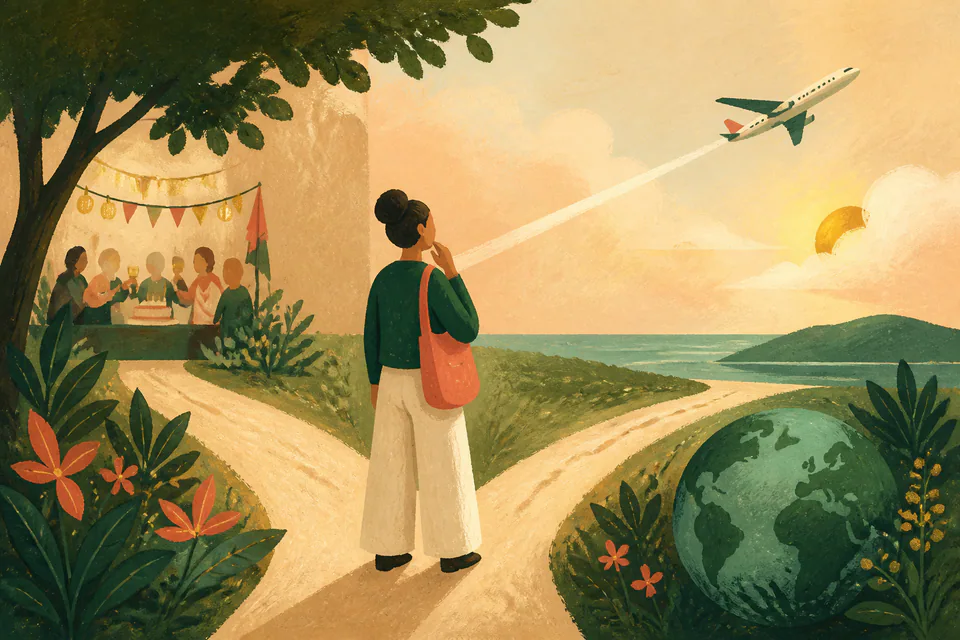
You lecture everyone about climate change—then get invited on a dream flight. Do you go?
A close friend living overseas invites you to an important celebration. Flying is affordable but carbon-intensive. Your individual decision will not determine whether the flight operates, yet it conflicts with commitments you publicly encourage others to make.
When is a small personal contribution to a large harm morally significant?