Daily Roundup | J&J to Buy Ollin for $2.2B Upfront & Roche’s Wilserdly Combo Approved for Breast Cancer
12 min
Listen through the publisher, then discuss the episode here or arrange an in-person Roundtable. Your city determines where to meet.
Roundtables are designed for groups of four, with a shared subject and room for everyone to speak. Come for discussion, with no dating expectation.
In this delayed Monday closeout, Johnson & Johnson agreed to buy Ollin Biosciences for $2.2 billion upfront, and Blackstone agreed to fund Phase 3 work on OLN324 in wet AMD and diabetic macular edema if the acquisition closes. The FDA approved Roche's Wilserdly (giredestrant) with everolimus for ESR1-mutated advanced breast cancer after endocrine therapy. In the daily roundup: CG Oncology's cretostimogene bladder cancer data, Servier's Ojemda (tovorafenib) follow-up in pediatric low-grade glioma, Lilly's Calytrix Bio deal, AstraZeneca's Klygefa (gefurulimab) approval in myasthenia gravis, Novo Nordisk's semaglutide data in children, and AriBio's split AR1001 Alzheimer's result. Alex Mercer and Maya Patel host.
Episode information is provided by the publisher. Listening takes place on the publisher’s service.
THE SEARCH FOR THE ULTIMATE RED LIGHT THERAPY IS OVER! After decades of exploring wellness technologies, Michael Jaco sits down with Rob Rene, founder of Exodus Strong, to explore the Red Light+ Total Body Reset system, the science behind red and near-infrared light, and why this technology has become such an important part of their wellness conversation. Rob's remarkable personal journey—including surviving five near-death experiences—inspired his mission to develop practical wellness tools that people can incorporate into their everyday lives. Discover the full-body Red Light+ Mat, designed for convenient 20-minute sessions, and the portable Red Light+ Wand, created for targeted use on areas such as the knees, shoulders, hands, and lower back. Michael and Rob discuss the technology, personal experiences, and how red light therapy may support a daily wellness routine. BLACK FRIDAY–CYBER MONDAY LISTENER EXCLUSIVE! This is your opportunity to explore Exodus Strong's special holiday offe
For additional nuances, references, and early access to content, see the StayCurious Metabolism Newsletter: https://staycuriousmetabolism.substack.com/p/hijacking-cancer-to-kill-alzheimers?r=40ekz2 Check out this link to access our StayCurious Brain Health Archives: https://staycuriousmetabolism.substack.com/p/brainhealth Omega-3 and Brain Health Video: https://youtu.be/B-kEn0FukXM To try the Accentrate Omega Max supplement containing LPC-DHA, click here: https://www.fenixhealthscience.com/staycurious Lithium Brain Health Video: https://youtu.be/Hcz0Eyp1LE4 NAD+ Brain Health Letter: https://staycuriousmetabolism.substack.com/p/never-get-alzheimers-disease-the?r=40ekz2 A new paper published in Cell reveals an unexpected biological connection between cancer and Alzheimer’s disease—one that challenges long-held assumptions about both. In this video, MD-PhD neuroscientist Nick Norwitz walks through the actual data behind the study, showing how proteins secreted by cancer cells reduced amyl
We’re about to time travel into the future Sam Altman is building… I interviewed Sam Altman, the CEO of OpenAI, the company behind ChatGPT. They’re trying to build a “superintelligence” that could far exceed humans in almost every field – and they just released their most powerful tool yet, GPT-5. A few years ago, that would’ve sounded like science fiction! Not anymore. In fact, they’re not alone. We’re in the middle of the most high stakes global race any of us have ever seen. Hundreds of billions of dollars and an unbelievable amount of human work… It’s a profound moment. Most people never see a huge technological shift like this in their lives and it’s happening all around us right now. So in this conversation, I’m going to try to time travel into the future with Sam Altman, to see what he’s trying to build… so you and I can really understand what’s coming. Welcome to HUGE* Conversations. Chapters: 0:00 What future are we headed for? 2:06 What can GPT-5 do that GPT-4 can’t? 6:57 Wha
Sign up for our newsletter and never miss an animation: http://bit.ly/TEDEdNewsletter Uploaded 14-01-19 View full lesson: https://ed.ted.com/lessons/the-truth-about-electroconvulsive-therapy-ect-helen-m-farrell In 1982, a young nurse was suffering from severe, unrelenting depression. She couldn’t work, socialize or concentrate. One controversial treatment changed everything: after two courses of electroconvulsive therapy (ECT) her symptoms lifted. So what exactly is electroconvulsive therapy and why is it so stigmatized? Helen M. Farrell details the history and evolution of ECT. Lesson by Helen Farrell, directed by Artrake Studio. Thank you so much to our patrons for your support! Without you this video would not be possible! Dan Paterniti, Jerome Froelich, Tyler Yoshizumi, Martin Stephen, Justin Carpani, Faiza Imtiaz, Khalifa Alhulail, Tejas Dc, Benjamin and Shannon Pinder, Srikote Naewchampa, Sage Curie, Exal Enrique Cisneros Tuch, Ana Maria, Vignan Velivela, Ahmad Hyari, eden sher,
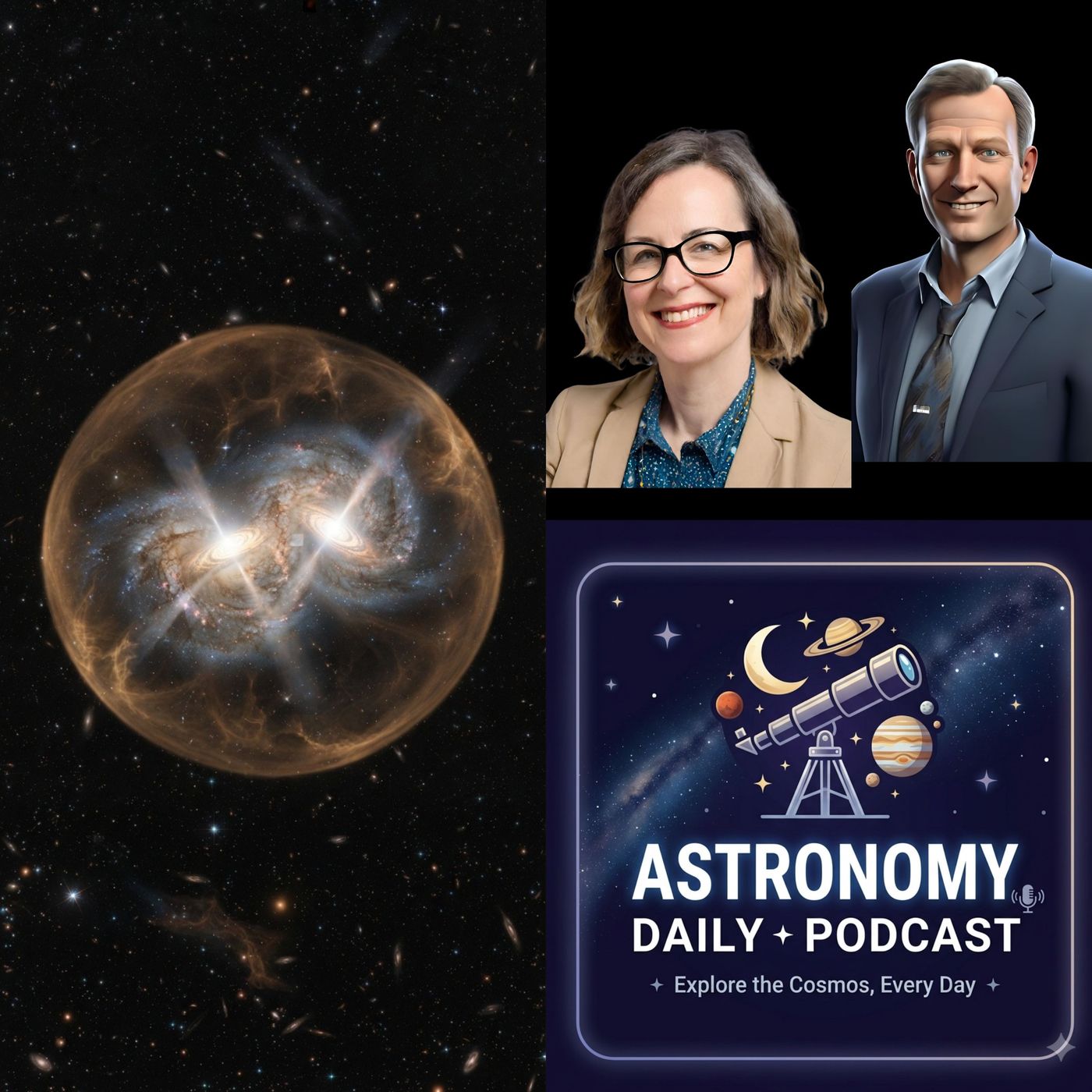
Eleven billion years ago two quasars blazed side by side, and this week astronomers weighed the invisible gas around them by the shadow it casts on the cosmic microwave background. There is 3.6 times more heat in it than gravity can explain. Plus a triple star 28 light-years away that 'should not exist', a pulsar found in ten hours with an algorithm borrowed from cryptography, The Week That Was, and the weekend sky from both hemispheres. In this episode Lead: Hot bubble around the dual quasar J1549+1245 at z = 2.37, measured with ALMA via the thermal Sunyaev–Zel'dovich effect (Hall, Zakamska et al., Nature Astronomy, 18 Nov 2026). Fresh item: Welopōʻai, the closest known triple with two white dwarfs, 28 light-years away (Artigau et al., A&A, 19 Nov 2026). Week That Was: Starship Flight 15 ship catch, CSIRO GenDIReCT and M87, SN 2026ahvu, failed supernovae in gravitational waves (E230); Voyager 1 one light-day, Beta Pictoris ices, heavy-oxygen water, Roman alignment (E231); Terra ends,
What if your AI agent could find the people you should know before you even start looking? Cosign is building a professional network around reputation and trusted recommendations, and now agents can use that network too. MTS host Sophia Dew sits down with a16z’s David Booth and Cosign’s Bella Nazzari to discuss what they’ve learned since launching Cosign, why traditional profiles often miss the operators doing the most important work, and how the Cosign Awards are surfacing talent through the people willing to vouch for them. They also explore an emerging behavior: people connecting their agents to Cosign to continuously find relevant people, lists, and opportunities, and what professional networking could look like when both humans and their agents participate. Resources: Follow David Booth: https://x.com/davidbooth Follow Bella Nazzari: https://x.com/nazzari Follow Sophia Dew: https://x.com/sophiadew Learn more about Cosign:https://cosign.co/ Connect your agent to Cosign:https://cosi
FDA again declines to approve Capricor’s Duchenne drug deramiocel, and Capricor disputes the agency’s reading of HOPE-3. Merck reports better overall survival with Kelun’s sacituzumab tirumotecan in advanced gastroesophageal cancer, while progression-free survival missed and the survival gain remains undisclosed. The roundup covers AstraZeneca’s sonesitatug vedotin priority review, PMV’s rezatapopt ovarian cancer data, Erasca’s ERAS-0015 pancreatic cancer plans and Germany’s ruling on Merck’s Keytruda SC. Also covered are Savara’s molgramostim review delay, J&J’s Tremfya (guselkumab) findings in axial psoriatic arthritis, CMS’s Medicare Advantage Part B proposal and FDA’s new biologics safety council. Delayed edition for Friday, November 20, 2026. Alex Mercer and Maya Patel host. Get the daily rundown in your inbox — subscribe at thepharmacloseout.com (https://thepharmacloseout.com/).
Delayed edition for Thursday, November 19, 2026. Celldex says it is ending barzolvolimab development in atopic dermatitis after its Phase 2 trial missed the primary itch endpoint. Revolution Medicines reports single-arm data for Rasonque (daraxonrasib) plus chemotherapy in first-line metastatic pancreatic cancer; a separate randomized study is designed to show what the drug adds. The roundup covers Pyxis Oncology’s Phase 1 micvotabart pelidotin data in head and neck cancer, the AbbVie–DISCO oncology discovery deal and Recursion’s proposed REC-4881 trial in familial adenomatous polyposis. Johnson & Johnson files to expand Caplyta (lumateperone) to manic or mixed episodes in bipolar I disorder, Novartis raises three peak sales forecasts, and a US biotech commission assesses China’s pharma competitiveness. Alex Mercer and Maya Patel host. Get the daily rundown in your inbox — subscribe at thepharmacloseout.com (https://thepharmacloseout.com/).
Pfizer commits $330 million upfront to license three autoimmune CAR-T programs from Starna Therapeutics before human trials — the lead in this delayed November 18 edition. Sanofi’s Infilbray (venglustat) is the first FDA-approved treatment for neurological symptoms of type 3 Gaucher disease, with clearer trial evidence for cognition than for movement alone. Regeneron reports FDA approval of Livsayis (cemdisiran), dosed every 12 weeks for AChR-positive adults with generalized myasthenia gravis. The roundup covers Biogen’s diranersen follow-up in early Alzheimer’s disease, Merck’s halt to Phase 3 nemtabrutinib in chronic lymphocytic leukemia and small lymphocytic lymphoma, and the FDA’s plan to expand review sharing for overseas filings. Alex Mercer and Maya Patel host. Get the daily rundown in your inbox — subscribe at https://thepharmacloseout.com (https://thepharmacloseout.com/).
Reinterpreting familiar stories for new audiences is usually worthwhile.
Share your view, then see how readers voted. No sign-in required. This poll is shared across stories.
Do you agree or disagree?
Common Quandary
A Common Quandary to discuss
Another conversation to explore, separate from this news story.
You are vegetarian, but the leftover steak is headed for the trash. Do you eat it?
A vegetarian avoids buying meat because of animal welfare concerns. At work events, untouched meat is routinely thrown away, and eating it would neither increase demand nor cause another animal to be harmed.
Should a moral practice be judged by its consequences or its consistency?