Euclid Finds the First Quasar Beyond Redshift 8, China Welcomes Its First Foreign Astronaut...
Listen through the publisher, then discuss the episode here or arrange an in-person Roundtable. Your city determines where to meet.
Roundtables are designed for groups of four, with a shared subject and room for everyone to speak. Come for discussion, with no dating expectation.
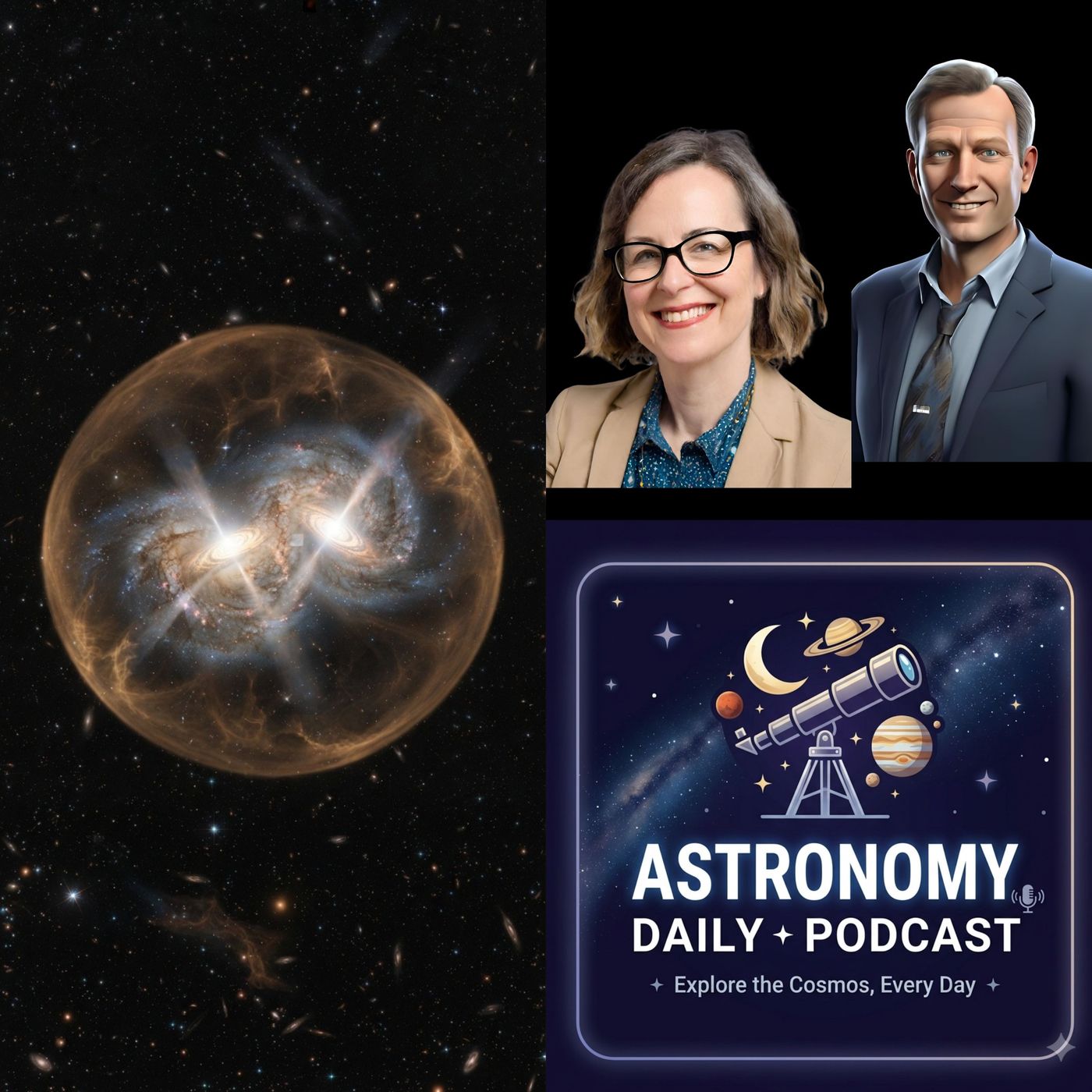
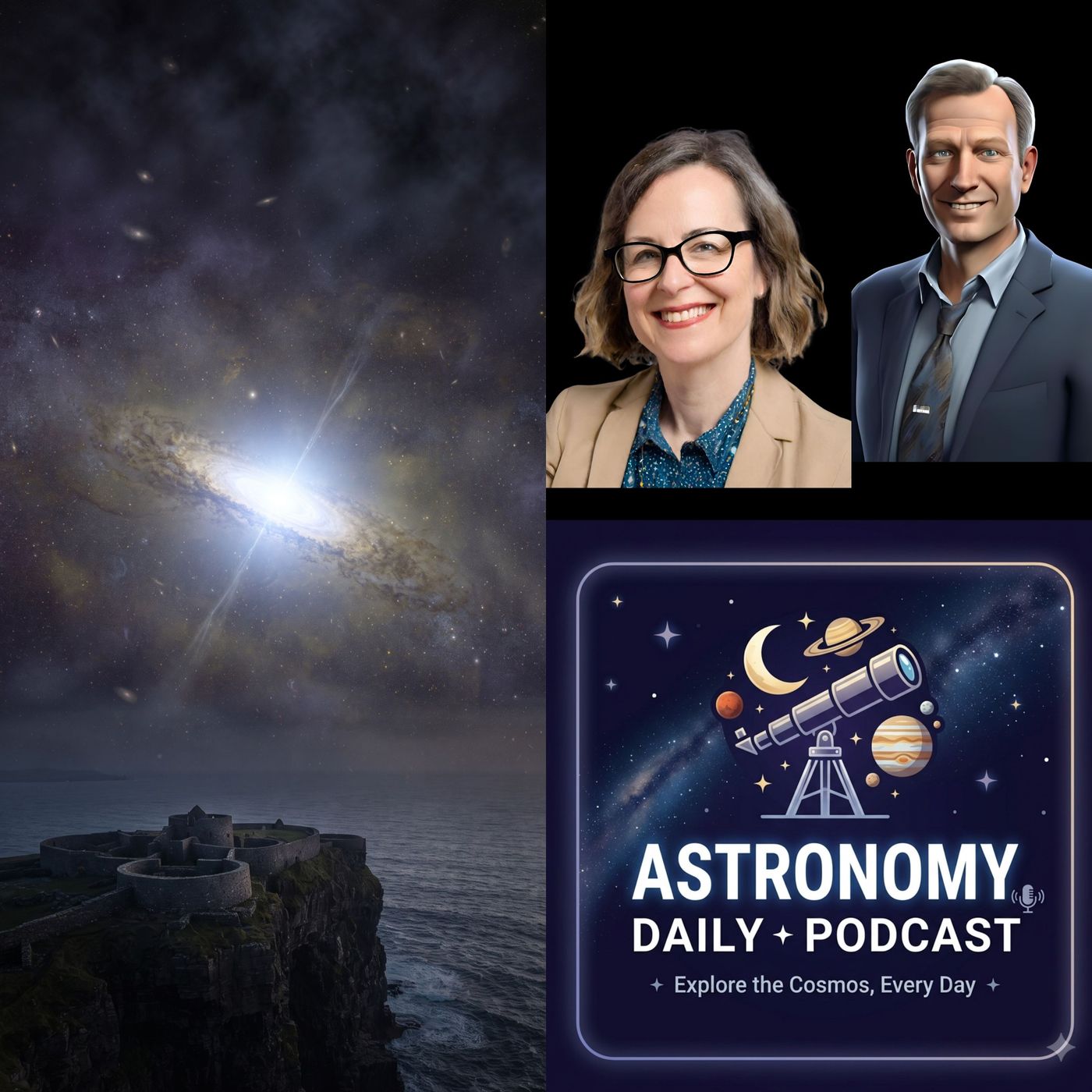
Euclid has taken the quasar distance record past redshift eight for the first time: J1504+6252, “Dún Aonghasa”, at z = 8.13, seen 630 million years after the Big Bang with a black hole of about 360 million suns. Also: Shenzhou-24 carries Pakistan's Muhammad Zeeshan Ali to Tiangong as its first foreign visitor; WASP-12 b's orbit turns out to be aligned, and may once have been retrograde; the first dark-energy measurement from fast radio bursts alone; an eclipse on an asteroid ahead of Hera's big reveal; and the Moon joining Jupiter, Mars and Regulus before dawn. Beyond redshift eight: Euclid's record quasar J1504+6252, nicknamed Dún Aonghasa, is the first quasar confirmed beyond z = 8 (z = 8.129 ± 0.005), seen about 630 million years after the Big Bang — 39 million years earlier than Euclid's July record at z = 7.77. Found in ~18 months of Euclid Wide Survey data and confirmed with Keck, Hubble, the LBT and JWST. Its black hole weighs about 360 million suns (calibration range ~200–800 million) yet is feeding at only 12–44% of the Eddington limit, so it must have grown faster earlier or started from a heavy seed. Wolf, Belladitta et al., A&A, published 24 Nov 2026. Shenzhou-24: Tiangong's first foreign visitor Launched 25 Nov at 08:18 Beijing time and docked 3 h 38 min later, carrying commander Tang Hongbo, pilot Wu Yi and Pakistani payload specialist Muhammad Zeeshan Ali. Ali stays about a week and returns on Shenzhou-23; Shenzhou-23 commander Zhu Yangzhu begins China's first year-long stay. WASP-12 b: aligned now, retrograde once? New Keck Planet Finder transits give a sky-projected obliquity of −1.3 ± 8.7°, overturning a 2012 measurement of about 60°. The star's slow surface spin suggests the planet arrived on a retrograde orbit and tidally dragged the star's outer layer into line. Preprint, Zhang, Dai et al. Dark energy from fast radio bursts alone 125 localised FRBs out to z = 2.148 give Ωm = 0.33 and w = −0.80 (+0.28/−0.38) — consistent with a cosmological constant, but with a degeneracy opposite to supernovae, making FRBs a powerful cross-check. Preprint, Wang, Gao, Zhang, Fan. Quick hit and skywatch Hera catches Dimorphos eclipsing Didymos ahead of ESA's livestream (05:45 AEDT Thu 26 Nov). Skywatch: the Moon joins Jupiter, Mars and Regulus before dawn (Mon 30 Nov in the north, Tue 1 Dec in Australia); Venus blazing at dawn; Saturn high in southern evenings. Sources • [Euclid quasar] MPIA/MPG — New quasar record tightens constraints on black hole formation scenarios (24 Nov 2026) — https://www.mpg.de/27030818/new-quasar-record-tightens-constraints-on-black-hole-formation-scenarios • [Euclid quasar] Wolf, Belladitta et al., Euclid: Discovery of a quasar at z = 8.13 hosting a 360-million-solar-mass black hole, A&A 715, A356, DOI 10.1051/0004-6361/202662243 — https://www.aanda.org/articles/aa/full_html/2026/11/aa62243-26/aa62243-26.html • [Euclid July record] ESA — Euclid discovers the most ancient quasar in the Universe (6 Jul 2026) — https://www.esa.int/Science_Exploration/Space_Science/Euclid_discovers_the_most_ancient_quasar_in_the_Universe • [Euclid July record] UC Santa Barbara — Earliest quasars yet observed (Jul 2026) — https://news.ucsb.edu/2026/022670/earliest-quasars-yet-observed-are-shedding-light-infancy-our-cosmos • [Shenzhou-24] AP via WTOP — China launches Shenzhou 24 spacecraft carrying 2 Chinese and a Pakistani astronaut (25 Nov 2026) — https://wtop.com/world/2026/11/china-launches-the-shenzhou-24-spacecraft-carrying-pakistani-astronaut-its-first-foreign-crew-member/ • [Shenzhou-24] Dawn — China's Shenzhou-24 docks with space station, carrying Pakistan's first astronaut (25 Nov 2026) — https://www.dawn.com/news/2046753/chinas-shenzhou-24-docks-with-space-station-carrying-pakistans-first-astronaut-in-orbit • [Shenzhou-24] The Japan Times / Reuters — Shenzhou-24 launches with first Pakistani national (25 Nov 2026) — https://www.japantimes.co.jp/news/2026/11/25/asia-pacific/china-shenzhou-24-space-pakistan/ • [WASP-12 b] Zhang, Dai et al., Where Did the Angular Momentum Go? WASP-12 b May Have Circularized on a Retrograde Orbit, arXiv 2611.25203 (18 Nov 2026) — https://arxiv.org/abs/2611.25203 • [WASP-12 b] Albrecht et al. 2012, Obliquities of hot Jupiter host stars, ApJ 757, 18, DOI 10.1088/0004-637X/757/1/18 • [FRB cosmology] Wang, Gao, Zhang, Fan, First Ωm–w Measurement Using Only Fast Radio Burst Observations, arXiv 2611.25312 (19 Nov 2026) — https://arxiv.org/abs/2611.25312 • [Hera] ESA — Hera's Didymos asteroid in eclipse (23 Nov 2026) — https://www.esa.int/articles/about-us/directorates/operations/space-safety/hera/hera-s-didymos-asteroid-in-eclipse • [Hera] ESA — Didymos asteroid size estimate updated by terrestrial research (23 Nov 2026) — https://www.esa.int/articles/about-us/directorates/operations/space-safety/hera/didymos-asteroid-size-estimate-updated-by-terrestrial-research • [Hera] ESA — Watch live: Hera's first images of post-impact asteroid Dimorphos — https://www.esa.int/articles/about-us/directorates/operations/space-safety/hera/watch-live-hera-s-first-images-of-post-impact-asteroid-dimorphos • [Skywatch] Ephemerides computed in-session with PyEphem for Sydney, Los Angeles, New York and London. Sponsor Details: Ensure your online privacy by using NordVPN. Get the best secure and private email on the planet. Do what we did and use ProtonMail. Commercial free episodes daily are only a click way... This episode includes AI-generated content.
Episode information is provided by the publisher. Listening takes place on the publisher’s service.
Listen at the source ↗