Hunting ghost chemicals, an unblockable communication method, and understanding our digital doubles
46 min
Listen through the publisher, then discuss the episode here or arrange an in-person Roundtable. Your city determines where to meet.
Roundtables are designed for groups of four, with a shared subject and room for everyone to speak. Come for discussion, with no dating expectation.
First up on the podcast, improvements in mass spectrometry have researchers rethinking how to find chemicals in the environment. Freelance journalist Perri Thaler talks with host Sarah Crespi about the widespread effects—from identifying environmental contamination to drug adulterants—of this new approach to chemical screening (https://www.science.org/doi/10.1126/science.zeop6z7). Next on the show, communications using electromagnetic waves can be subject to interference or weakened through shielding. Andrew Groszek, a quantum software engineer at Infleqtion (https://infleqtion.com/), looked to gravity as a way to create an unblockable means of communication. (https://www.science.org/doi/10.1126/sciadv.aee0802) However, he found using gravity as a signal comes with its own struggles, such as an incredibly slow transmission rate of 1 bit per minute and the need for heavy equipment. Finally, Science’s Books and Culture Editor Valerie Thompson talks with behavioral geneticist K. Paige Harden (https://www.kpharden.com/) of the University of Texas at Austin, about her essay on searching for signs of humanity (https://www.science.org/doi/10.1126/science.ael6252) in an age of data-driven avatars.
Episode information is provided by the publisher. Listening takes place on the publisher’s service.
Before the holiday leftovers come out, here is what a year of pesticide policy is putting back into them. This bonus episode opens with the news: an executive order boosting glyphosate production, a Supreme Court ruling that limits state lawsuits over Roundup's cancer warnings, and EPA approvals of new pesticides that scientists say meet the definition of forever chemicals, a label the agency disputes. We also ask what it means that the Make America Healthy Again movement, and its leader, Robert F. Kennedy Jr., are defending those choices. Then you'll hear Kelly Ryerson, the Glyphosate Girl, explain what glyphosate may be doing to our bodies and soil, where it hides in everyday foods, and the practical steps you can take today to limit your exposure. This interview was recorded before the news above broke, for Nutrition Without Compromise, a podcast brought to you by Örlö Nutrition, a brand Corinna works with. It was originally published as episode 68 in fall of 2023. Episode blog page
Frank knew the rural highway well enough that very little along it surprised him. But one cold November night, he passed a woman walking alone along the shoulder, miles from town and nowhere near a parked car or house. Concerned, he turned around to offer her help. She was gone. Frank drove the stretch several times, checking the ditches, driveways, and fields, but found no trace of her. The next morning, he told the story to the same group of friends he had met for coffee for more than twenty years. They teased him, offered explanations, and eventually moved on. A few days later, one of those men brought the story up again. Years earlier, another member of their group had seen a woman walking along that same highway. He had turned around too. And she had disappeared. #GhostStories #RoadsideGhost #VanishingGhost #HauntedHighway #Paranormal #GhostEncounter #LocalLegend #Unexplained #Apparition #Haunting #FullBodiedApparition #Ghosts Love real ghost stories? Want even more? Want even mor
This is a Grave Talks CLASSIC EPISODE! What if you could see demons—and knew exactly how to fight them? For more than four decades, June Lundgren has lived in a world shaped by spirits, entities, and experiences most people would struggle to comprehend. A psychic medium, animal communicator, and self-described demon seer, June’s journey began in childhood after her grandmother encouraged her to embrace abilities others feared or dismissed. Since then, June says she has helped countless people confront terrifying paranormal activity, including demonic attachments and possessions that nearly destroyed lives. Along the way, she’s also experienced telepathic communication with animals, vivid memories of past lives, and encounters that she believes reveal what truly happens after death. June shares stories that push far beyond the boundaries of a traditional ghost story—into a world where unseen entities may be influencing far more than we realize. Whether you believe in the paranormal or n
So, uh... does it work? Metformin is an old, cheap drug used to help control blood sugar in people with diabetes. Now, it’s back in the news because some people - particularly wealthy people - are using it for possible anti-aging effects. That’s right. One of the most popular ways rich people are trying to live longer isn’t some million dollar cryo-something experiment, but a pill that costs pennies that's already on the market. So, the big question is: Does it work? To find out, I interviewed the lead researcher on the biggest study of metformin for anti-aging, Dr. Nir Barzilai. The answer he gives me? Well, it’s complicated. Note: I do not take metformin, nor am I advocating anyone else should. Please don't get medical advice from a youtube video! The purpose of this video is to explain the research that exists, explore what it tells us about aging in general, and discuss the effort Dr. Barzilai is leading to learn more. 00:00 What is metformin? 00:53 What is aging? 01:46 Can we slow
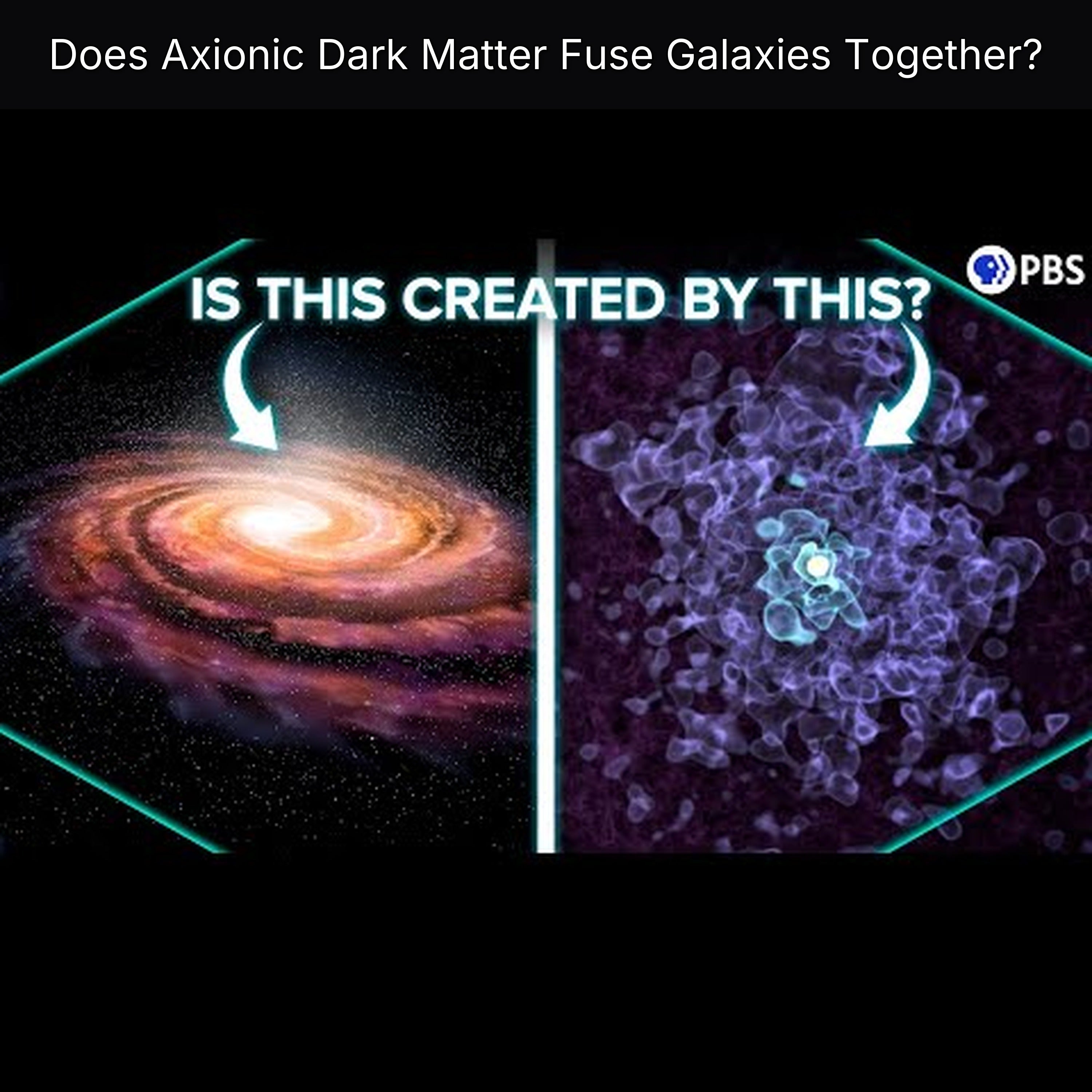
PBS Member Stations rely on viewers like you. To support your local station, go to:http://to.pbs.org/DonateSPACE Sign Up on Patreon to get access to the Space Time Discord! Quantum mechanics is our best theory of the fundamental nature of reality, but it's usually only distinguishable from familiar classical mechanics on the smallest scales. However, there are some fringe cases where its distinct features manifest on scales we can observe—in things like superfluids, or the interiors of collapsed stars. But it’s also possible that our entire galaxy is filled with a reverberating quantum mechanical wave that literally holds the galaxy together—and in fact explains all the dark matter that we see across the universe. And this isn’t even a fringe theory. It’s axionic dark matter. Check out the Space Time Merch Store Sign up for the mailing list to get episode notifications and hear special announcements! Search the Entire Space Time Library Here: https://search.pbsspacetime.com/ Hosted by
AI isn't a bubbleSpreading awareness about the works of some of the leading educators in the AI revolution."Helping humanity shepherd through this transition as we embrace the final invention of mankind: advanced artificial intelligence." David Shapiro aims to provide a pragmatic and optimistic view of the future.Core Ideas:Metamodernism: Narratives and emergence view of realityPostnihilism: The demand for meaning is false, there is only the Great MysteryHeuristic Imperatives: An ethical, moral, and decision framework.- Reduce suffering- Increase prosperity- Increase understandingPost-Labor Economics: Replace humans with machines (better, faster, cheaper, safer)mantra:EXPLORE: Delve into the unknown, driven by curiosity and a quest for discovery. Seek knowledge.ELUCIDATE: Make complex ideas clear, communicating them in an accessible and comprehensible manner.ENUMERATE: Ground insights in concrete data, providing measurable and quantitative evidence.ELABORATE: Add depth and detail to un
First up on the podcast, producer Kevin McLean talks with staff writer Jennie Erin Smith about a new old idea for Alzheimer’s disease. They discuss how the cholinergic hypothesis originally came about, how it fell out of fashion, and why it’s making a comeback now (https://www.science.org/doi/10.1126/science.z91c7ic). Next on the show, the United States can make more power as demand goes up, but moving that increased amount of electricity around the country is proving problematic. Madeline Yozwiak (https://www.madyoz.com/), a postdoctoral scholar in the Engineering and Public Policy Department at Carnegie Mellon University, joins host Sarah Crespi to discuss her Policy Forum article on the barriers to scaling up the country’s electric grid (https://www.science.org/doi/10.1126/science.aeh4460) and some potential solutions. Finally, boosting precision medicine by looking at All of Us (https://www.science.org/doi/10.1126/scitranslmed.adt8040). The National Institutes of Health’s All of Us
First up on the podcast, people are buying consumer-grade brain wave detectors ostensibly to help with sleep, concentration, and meditation. But as freelance investigative journalist Jonathan Moens (https://jonathan-moens.com/) describes, companies are getting more than the price of the devices in the exchange (https://www.science.org/doi/10.1126/science.zp18ht9)—including training data for artificial intelligence models—in many cases without the consent of the user. Next on the show, we delve into the many uses for glucagonlike peptide-1 (GLP-1) agonist drugs beyond reducing obesity. Host Sarah Crespi talks with one of the special issue editors, Yevgeniya Nusinovich, senior editor at Science, about their potential for everything from improving cognition to combating cancer. Then we hear from Nora Volkow (https://nida.nih.gov/about-nida/directors-page/biography-dr-nora-volkow), director of the National Institute on Drug Abuse at the National Institutes of Health, about hopes for using
Predictable working hours are more important than maximum scheduling flexibility.
Share your view, then see how readers voted. No sign-in required. This poll is shared across stories.
Do you agree or disagree?
Common Quandary
A Common Quandary to discuss
Another conversation to explore, separate from this news story.
Scientists can edit mosquitoes until a deadly disease disappears. Who gets to say yes?
Scientists can potentially release modified mosquitoes whose genes would spread through wild populations and sharply reduce a deadly disease. The ecological effects could cross borders and may be impossible to reverse.
Who may authorize an irreversible change intended to save lives?