Parkinson's, depression and the switch that might silence them - Andres Lozano
21 min
Listen through the publisher, then discuss the episode here or arrange an in-person Roundtable. Your city determines where to meet.
Roundtables are designed for groups of four, with a shared subject and room for everyone to speak. Come for discussion, with no dating expectation.
Deep brain stimulation is becoming very precise. This technique allows surgeons to place electrodes in almost any area of the brain, and turn them up or down -- like a radio dial or thermostat -- to correct dysfunction. Andres Lozano offers a dramatic look at emerging techniques, in which a woman with Parkinson's instantly stops shaking and brain areas eroded by Alzheimer's are brought back to life. (Filmed at TEDxCaltech.) Talk by Andres Lozano.
Episode information is provided by the publisher. Listening takes place on the publisher’s service.
Check out the Space Time Merch Store In 1974 we sent the Arecibo radio message towards Messier 13, a globular cluster near the edge of the Milky Way, made up of a few hundred thousand stars. The message was mostly symbolic; we weren’t really expecting a reply. Yet surely other civilisations out there are doing the same thing. So, why haven’t we heard anything? What if the silence from the stars is a hint that we shouldn’t be so outgoing? What if aliens are deliberately keeping quiet for fear that they might be destroyed? Sign Up on Patreon to get access to the Space Time Discord! PBS Member Stations rely on viewers like you. To support your local station, go to:http://to.pbs.org/DonateSPACE Search the Entire Space Time Library Here: https://search.pbsspacetime.com/ Hosted by Matt O'Dowd Written by Richard Dyer & Matt O'Dowd Post Production by Leonardo Scholzer, Yago Ballarini & Stephanie Faria Directed by Andrew Kornhaber Associate Producer: Bahar Gholipour Executive Producers: Eric Br
For all the references and extra details, see the associated StayCurious Metabolism Newsletter: https://staycuriousmetabolism.substack.com/p/creatine-explained-how-one-molecule?r=40ekz2 Momentous Creatine When it comes to reputation, quality, and rigorous third-party testing, you really can’t go wrong with Momentous Creatine Monohydrate. It’s extensively tested for heavy metals and banned substances. My personal preference is their pure, unflavored, no dyes or sweeteners, micronized creatine monohydrate DESCRIPTION: Creatine is one of the most researched supplements in history—yet most people still misunderstand how it works and what it actually does. In this video, I break down creatine from first principles to real-world use. We start with the biochemistry: what creatine is and how it promotes muscle growth—cell hydration, satellite cells, gene expression—and review human randomized controlled trials showing increases in lean mass and even reductions in fat mass. From there, we go be
What is the Apple Vision Pro actually for? THIS… Get better sleep with $200 off your Eight Sleep Pod Cover using my code CLEO: https://www.eightsleep.com/cleo/ If you want to feel more optimistic about the future, consider subscribing. You’ve seen the Apple Vision Pro. But this isn’t a product review. In this video, @mkbhd and I take a dive into what the future might actually look like with this category of tech - and why you should care. (With a cameo from @ryan !) Honestly, with all the jargon and hype (VR! AR! Spatial computing! Metaverse!), I’ve been tuning out the news about these devices for a while. But now, I think it’s time to turn the volume back up and pay attention. There is a deeply optimistic future that’s possible here. Not Ready Player One, but something else entirely. I’m going to try to show you what it might really look and feel like. If the Apple Macintosh helped unlock personal computing, and the iPhone unlocked computers in our pockets, what is this device suppose
We've all heard of the law of attraction – but in this video, Tony Robbins gives a new take on it... one that you might not have heard before. Uploaded 28-07-21 What if instead of it being all about getting the things that you want, it was about becoming the person who would have those things? What does that mean? It means if you want a passionate and loving relationship, you become a passionate and loving person. If you want to grow your business beyond your wildest dreams, you become a person who focuses on growth and learning. If you want to live a long and vital life, you become a person who does that right now, today. So what's it really about? It's about raising your standards. It's about creating the energy in your body, in your mind and in your surroundings that propels you toward the life that you want. This video was originally taken from Tony Robbins' Unleash the Power Within Event. Unleash the Power Within is the signature event designed by entrepreneur, best-selling author
Day In The Life: Becoming A Pro Boxer Episodes created by entrepreneur and masculinity ace Jack Hopkins for his youtube channel, this podcast is dedicated to helping men rediscover their inner strength and confidence in a society that often promotes feminine values over masculine ones.Follow the podcast for valuable insights, inspiring stories, and practical advice on how to embrace your masculinity, build your confidence, and achieve your goals. Whether you're looking to improve your relationships, advance your entrepreneurial career, or simply feel more confident and capable, Jack has valuable insights that can help you achieve your goals.So, if you're ready to reclaim your masculinity and awaken the beast that lives inside you, follow the podcast & turn on notis Follow Jack Hopkins:Insta: @jackhopfitnessYT: @JackhopkinsCEODisclaimer: All content rights belong to @JackhopkinsCEO on YouTube. This is a fan page. ------- Keywords: high frequency living, masculine energy, men's psycholog
Sometimes all you need to identify a bird is a single feather. Because collecting bird feathers is prohibited in the U.S. to protect birds from poachers, start by taking a photo with a common object for scale. Then you can use online resources like the iNaturalist app or Featherbase website to help you solve the mystery. Keep your prime suspect in mind when you’re back where you found the feather and you might get to see the bird itself — feathers and all. More info and transcript at BirdNote.org (https://www.birdnote.org/podcasts/birdnote-daily/what-if-you-only-have-feather). Want more BirdNote? BirdNote is a nonprofit. Hosted by Simplecast, an AdsWizz company.
View full lesson: http://ed.ted.com/lessons/surviving-a-nuclear-attack-irwin-redlener The face of nuclear terror has changed since the Cold War, but disaster-medicine expert Irwin Redlener reminds us the threat is still real. He looks at some of history's farcical countermeasures and offers practical advice on how to survive an attack. Talk by Irwin Redlener.
Explore what makes polio so dangerous, what is causing the 21st century resurgence of cases, and how we can eradicate the disease. -- In 1952, polio was everywhere: killing or paralyzing roughly half a million people annually. Yet just 10 years later, paralytic polio cases in the US dropped by 96% and we were on track to get rid of polio for good. But in recent years, the virus started striking back. So, what’s behind these recent spikes? Explore the dangers of poliovirus and the possibility of eradicating this deadly disease. Directed by Anton Bogaty. This video made possible in collaboration with Gates Ventures Learn more about how TED-Ed partnerships work: https://bit.ly/TEDEdPartner A special thanks to Ananda Bandyopadhyay, Amber Zeddies, and Kathleen O'Reilly who provided information and insights for the development of this video. Support Our Non-Profit Mission ---------------------------------------------- Support us on Patreon: http://bit.ly/TEDEdPatreon Check out our merch: htt
Todd Humphreys forecasts the near-future of geolocation when millimeter-accurate GPS "dots" will enable you to find pin-point locations, index-search your physical possessions ... or to track people without their knowledge. And the response to the sinister side of this technology may have unintended consequences of its own. (Filmed at TEDxAustin.) Uploaded 26-06-13 Talk by Todd Humphreys.
Public institutions should accommodate religious practices when doing so does not unfairly burden others.
Share your view, then see how readers voted. No sign-in required. This poll is shared across stories.
Do you agree or disagree?
Common Quandary
A Common Quandary to discuss
Another conversation to explore, separate from this news story.
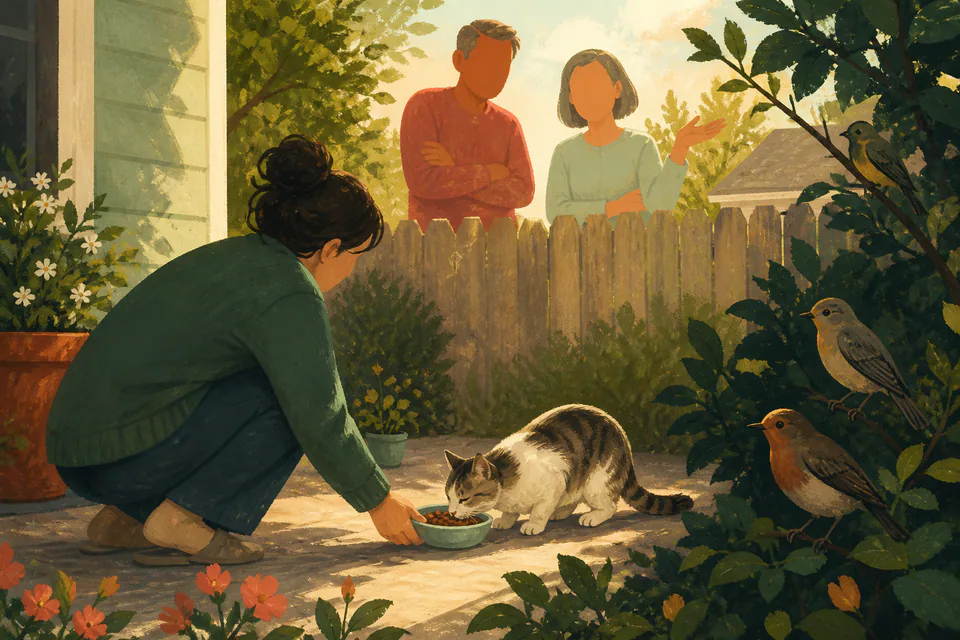
A stray cat adopts you—and starts killing birds. Do you keep feeding it?
A stray cat visits your yard daily and appears to depend on the food you leave out. Neighbors complain that outdoor cats kill birds and say feeding it encourages the problem without taking responsibility for the animal.
Does caring for one visible animal excuse harm to less visible ones?