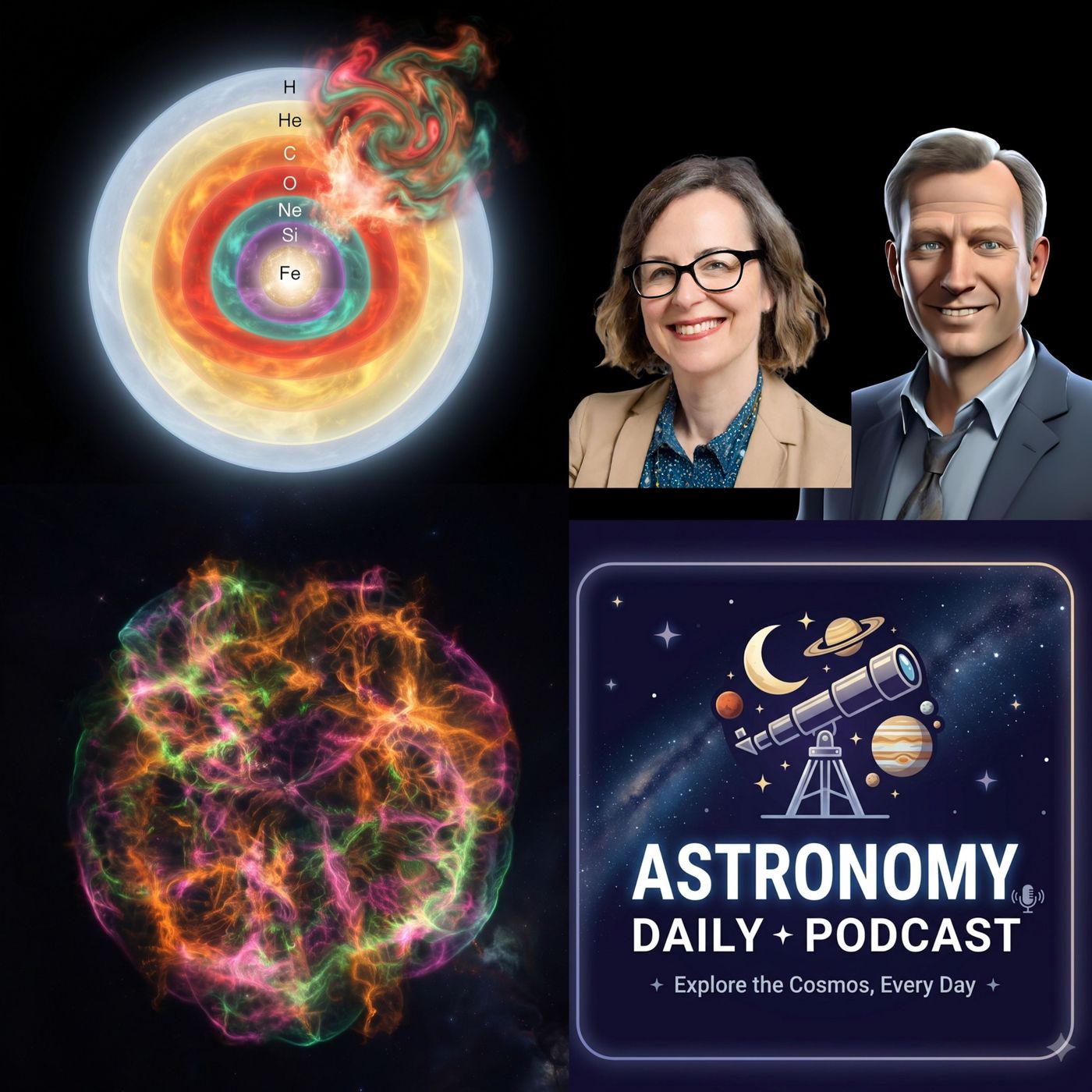
Show notes Webb has read the dust of Cassiopeia A clump by clump, and the chemistry points to the star's inner burning shells merging in its final hours. Plus the week that was, the week ahead, and Venus at its most brilliant. The Star That Rearranged Itself Webb's Mid-Infrared Instrument has resolved the dust in individual, solar-system-sized clumps of Cassiopeia A. Argon-rich debris holds silica; neon- and carbon-monoxide-rich debris holds carbon grains; the 'Green Monster' is magnesium silicate the star shed before it exploded. Only models in which the star's oxygen-burning shell merged with the carbon–neon shell above it reproduce both dust types — independent support for Chandra's 2025 evidence that the star's interior was churned up less than about three hours before collapse. Caveats: dust carries no clock, the models are one-dimensional, an alternative exists, and dust masses are lower limits. Temim, Arendt, Milisavljevic et al., ApJL 1012, published 23 Nov 2026. The Week That
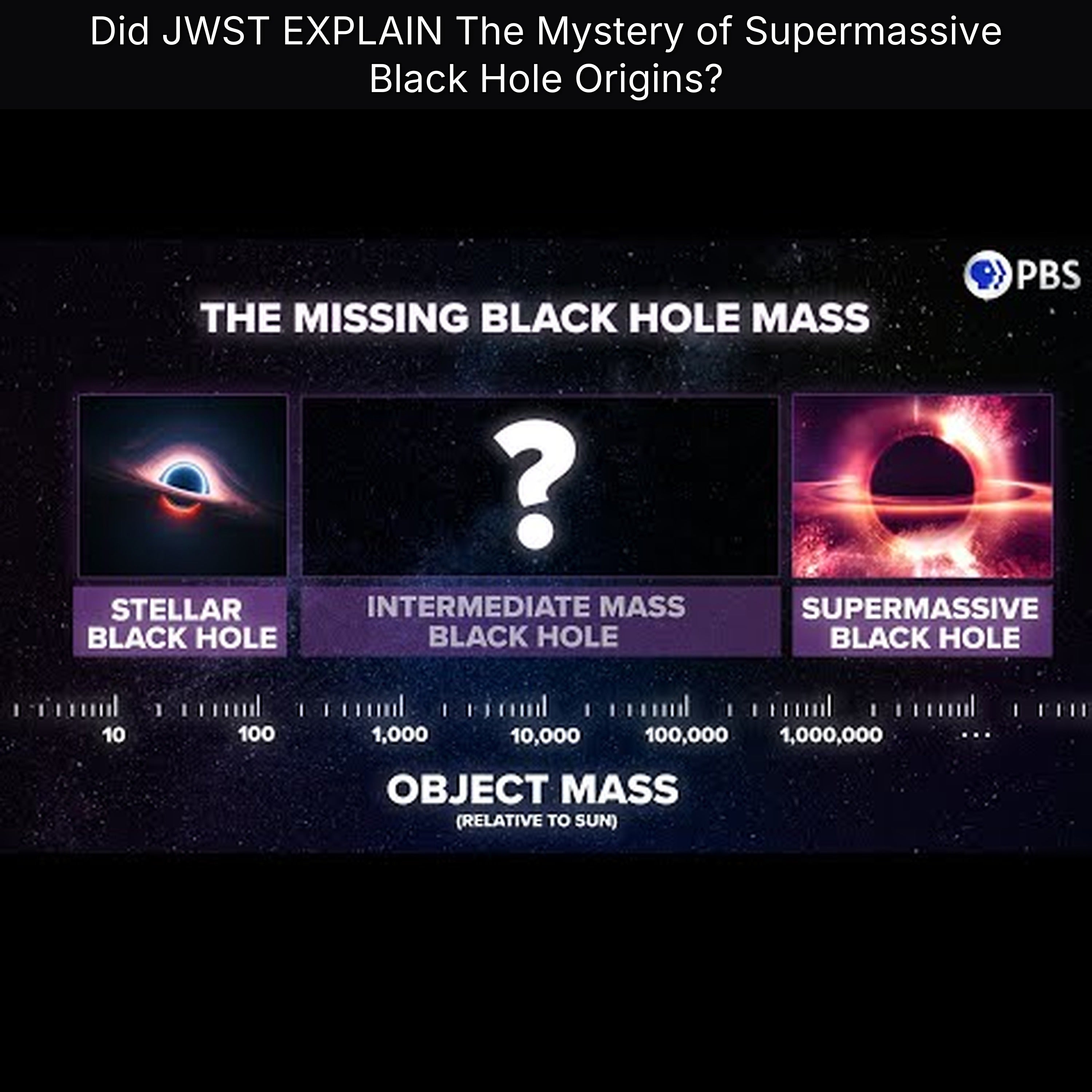
Check Out Fascinating Fails: https://youtu.be/8zMhoj7tFiw?feature=shared Check Out the Space Time Merch Store This is what we astronomers call a blob, or a smudge, if you want to get really technical. It may not look like much from here, but what do you expect for something near the literal edge of the observable universe. If you were there when this light was emitted, you’d A. be at the beginning of time, and B. be looking at an entire galaxy containing an enormous black hole at its heart. It’s the most distant black hole we’ve semi-directly detected. That’s cool enough on its own, but as an added bonus this one smudge may have solved the mystery of the origin of the supermassive black holes in our universe. PBS Member Stations rely on viewers like you. To support your local station, go to:http://to.pbs.org/DonateSPACE Sign Up on Patreon to get access to the Space Time Discord! Sign up for the mailing list to get episode notifications and hear special announcements! Search the Entire
In this calm and sleepy facts episode, we look up into the darkness above and explore everything the night sky has to offer, from the first faint star that appears at dusk to the most distant object the naked eye can see. We begin with why the sky gets dark at all, tracing the stages of twilight as the Sun slips below the horizon and the atmosphere slowly stops scattering its light. We learn why stars twinkle but planets do not, how brightness is measured in a scale of apparent magnitude that stretches from the blazing glow of Sirius all the way down to the faintest smudges visible only on the darkest nights. We wander through the 88 officially recognized constellations, discovering that they are not shapes drawn in the stars but entire regions of sky, and that different cultures across history connected the same stars into entirely different pictures. We spend time with the Moon, following its 29.5 day cycle from thin crescent to full and back again, learning how earthshine softly ill
What’s really happening inside a black hole? Imagine that you’re flying through space, when suddenly you start to get dragged toward a dark abyss. Reality as you know it starts to change. Time begins to warp. And you start to feel this strange sort of sensation of being stretched and squashed… You’re falling into a black hole, one of the most astonishing places in our universe. Some are so big they can fit over 60 of our solar systems across them, with masses up to 100 billion times our Sun. And once you fall into one past a certain point, nothing can escape. ... Or can it? I wanted to know the latest cutting edge research about black holes, so I called up my favorite physicist, Dr. Brian Cox to answer the question: If you fell into a black hole, what would actually happen to you? What would it feel like? And what does our newest science tell us is really happening inside a black hole? Chapters: 0:00 What if you fall into a black hole? 1:20 What is a black hole, really? 2:20 How do we
That’s the sound of the planet Uranus. It was produced from observations made by Voyager 2 when it flew past Uranus in 1986. Scientists used those observations to measure the planet’s rotation – the length of its day. But a decade of work by Hubble Space Telescope has revealed that the Voyager numbers were a little off. Precise timing is important for understanding what’s going on inside Uranus. It’s hard to measure the planet’s day. It doesn’t have a solid surface, so there are no landmarks to rotate in and out of view. The clouds that top the planet rotate at different rates, and they’re pushed by high-speed winds, so they’re no help. The best way to find the rotation rate is by studying the planet’s magnetic field. Hubble’s done that by watching auroras. They’re created by interactions between the magnetic field and the solar wind. As Uranus turns, the auroras change. The timing of those changes reveals how fast the planet’s interior is turning. The new work shows that a day is 17 h
For decades, a technological blind spot has prevented astronomers from fully exploring an important part of the gamma-ray universe. Now, a new analysis of 14 years of data from NASA's Fermi telescope is helping fill that gap. The resulting catalog reveals hundreds of previously difficult-to-detect cosmic sources, offering fresh opportunities to investigate powerful black holes, distant galaxies, and some of the universe's most extreme environments. This episode includes AI-generated content.
BONUS QUESTION STARTS AT 12:42 Watch the video here (with no ads) or on YouTube: https://youtu.be/AYuovVcUYwk What will happen when Webb eventually breaks down or runs out of fuel? Can there be life on Titan? Which is worse, a comet or an asteroid and why? And in Q&A+, can we build a factory for space telescopes? 00:00 Intro 00:26 [@yeswanth80] Can three super massive black hole exist in one young galaxy? 04:47 [@psilocybe6115] Do you think there is a chance there could be life on Titan? 07:21 [@Sasqtch] how is Titan for radiation? 09:26 [@ConspiracyTheoryEnthusiast] Is there a possibility to send a mission to Webb if it were to break? 12:18 [@busybillyb33] What would be more destructive to earth on impact, a 10km diameter asteroid or a 10km diameter comet? 12:42 [@justinkruger] Space telescope factory. When? 16:34 Final thoughts
BONUS QUESTION STARTS AT 22:03 Watch the video here (with no ads) or on YouTube: https://youtu.be/rcj39PJq6ko Scott Manley’s Starship Flight 15 coverage: https://www.youtube.com/watch?v=uwGBBAv8PBI Vote for the best story here: https://www.youtube.com/@frasercain/posts SpaceX finally catches Starship, Euclid’s first big data release is out, a compelling new explanation for Little Red Dots, and a way to rule out a type of dark matter. And on Space Bites+, China is planning on sending a lander to Callisto. 00:00 Intro 00:17 Starship Catch https://www.universetoday.com/articles/baby-shes-back-spacex-catches-a-starship-from-orbit-for-first-time https://www.universetoday.com/articles/spacex-launches-starship-but-passes-up-booster-catch-for-safetys-sake 05:37 Euclid’s First Big Release https://www.universetoday.com/articles/euclids-first-data-release-a-stepping-stone-to-its-3d-map-of-the-sky 08:39 No GPS? No Problem! https://www.universetoday.com/articles/navigating-lunar-orbit-using-nothing
BONUS QUESTION STARTS AT 14:05 Watch the video here (with no ads) or on YouTube: https://youtu.be/29zYt-NR11k How will augmented children grow up? What's the most useful skill one can master right now? Is the cyberpunk already here? And in Q&A+, can you hack starlinks to act as GPS? 00:00 Intro 00:23 [@jeffhans1] Would children born with brainchips giving them language and math without having to learn them be more advanced or harmed by not having to learn those things? 08:33 [@TomSchultz78] what is the most usefullskill for a person at the current age? 11:20 [@HanSolo__] Are we already in cyberpunk? 14:05 [@jeffhans1] Would a Starlink reading be more accurate than GPS? 15:40 Final thoughts
People should receive a clear explanation before consenting to personal-data use.
Share your view, then see how readers voted. No sign-in required. This poll is shared across stories.
Do you agree or disagree?
Common Quandary
A Common Quandary to discuss
Another conversation to explore, separate from this news story.
You wear an expensive outfit once and return it spotless. Clever or dishonest?
You buy an expensive outfit for a single event, keep it spotless, and return it the next day. The store's generous policy allows returns without asking whether an item was worn.
Does exploiting a policy differ from breaking a rule?