This is a Grave Talks CLASSIC EPISODE! In Virginia Beach, Virginia, the Ferry Plantation House stands as one of the area’s most historically rich—and paranormally active—sites. While it’s unclear exactly when reports of spirits first began, stories of unexplained activity have followed the home throughout the 20th century and well into the present day. The house is believed to be occupied by as many as eleven distinct spirits, each tied to different periods of its long history. Among the most well-known are Henry, believed to have been enslaved on the property, and Erik, a young boy said to have died inside the home. Visitors and investigators report footsteps, voices, apparitions, and interactions that suggest the house is anything but empty. Cody Green, Vice President of Friends of the Ferry Plantation House and Paranormal Director, explores the history of Ferry Plantation House and the many spirits believed to remain there. Find out more about the house at ferryplantation.org (https
England has a new bovine TB policy: today the Government formally adopts plans it set out in the summer which aim to eradicate the disease from the country by 2038. All this week we are looking at the way we manage water, and farmers are increasingly keen to save water on farm in the winter to use in the summer. While building small reservoirs is one option, another is to create networks of so-called 'smart ponds', with digital monitoring used to track water levels. And seeing financial opportunities in agricultural tech and carbon markets. Presented by Charlotte Smith and produced by Beatrice Fenton.
When doomsday strikes, should you run straight to your nearest Big House? On this week’s episode of The Poshcast, Sophia Money-Coutts and Cleo Watson react to the government’s ominous new ‘Be Ready’ stockpiling campaign. Forget cyberattacks and empty supermarket shelves—pray for Waitrose!—could Britain’s upper crust actually be naturally primed to endure an apocalypse scenario? From scooping mould off jam to surviving without central heating, toffs have been ‘making do’ for generations. Sophia and Cleo also draft their ultimate Apocalypse Survival Squads, and dissect Nicky Haslam’s new common list tea towel. Plus, they tackle another fantastic listener dilemma: what is the proper etiquette when friends announce the arrival of their newborn, only to withhold the name for six agonising weeks. Email us: [email protected] Instagram: @theposhcast Hosted on Acast.
Two crescents hang out in the twilight the next couple of mornings: the Moon and the planet Venus. They’re quite low in the east at dawn. Venus is the “morning star.” It’s below the Moon tomorrow, but will be closer above the Moon on Saturday. Venus and the Moon appear as crescents for the same reason – both of them are passing between Earth and the Sun. That means their daylit sides are facing the Sun, while we see mainly their nightsides – the Sun is lighting only a sliver of the hemisphere that’s facing Earth. It’s obvious that the Moon is a crescent. But you need strong binoculars or a telescope to see Venus as one. If you take a close look, you’ll notice that Venus and the Moon are almost equally lit up – less than 10 percent of the visible surface is in sunlight tomorrow, with the rest in the dark. Venus and the Moon are headed in opposite directions. The Moon is dropping toward the Sun in our sky. It will cross the line between Sun and Earth on Monday. It’ll be “new” then, begin
Chances are you’ve eaten something ultra-processed already today, but should you be worried? Many of us have a sense that ultra-processed food could be harming our bodies, but what impact does it have on our brains? In this episode of Change Your Mind with New Scientist health Journalists Helen Thomson and Cat de Lange ask whether the food we eat is damaging our mental health, increasing our risk of dementia or even making us age prematurely. With help from doctor, broadcaster and researcher Chris van Tulleken they explore how ultra-processed food really impacts the brain and whether we should be making changes to our own diets. Produced by Emily Bird Get in touch at [email protected] Find out more about Ultra-processed foods at New Scientist: https://www.newscientist.com/article/2519704-how-worried-should-you-be-about-ultra-processed-foods/ Sources: Calories from UPF: https://www.ucl.ac.uk/news/2024/oct/toddlers-get-nearly-half-their-calories-ultra-processed-foods Daniel
“I wasn’t on the Ballot, and if I was, we would have won IN A LANDSLIDE!” So says President Trump, who was “a little bit surprised” by the midterms. The results were unambiguous. Democrats comfortably took the House and the Senate, and won the popular vote by 13 points: the widest margin in a nationwide election in half a century. This week, Christiana Figueres, Tom Rivett-Carnac and Paul Dickinson pick through the Blue-nami. Trump blames fuel prices, pushed up by the war in Iran. Nobody on the campaign trail called that a climate issue, but Christiana doesn’t think they needed to. So is climate now winning elections without ever being named? And with plenty of the new Democrats running on “all of the above” energy, what does the win actually mean for the second-biggest emitter on the planet? From January, Democrats can block Trump’s bills, hold the purse strings and investigate his administration. But he keeps the veto, and he still runs foreign policy - including whatever the US does
Should our government ignore our identities or focus on them? In this episode of Crash Course Political Theory, we’ll explore the role identity plays in politics and government, from affirmative action to white backlash, and ask, “What is fair?” Crash Course Political Theory #3 Introduction: Affirmative Action 00:00 The Social Contract 00:57 Critiques of the Social Contract 2:40 Equal Opportunity 4:39 Critiques of Identity Politics 7:57 A Politics of Difference 9:34 Review & Credits 10:32 Sources: https://docs.google.com/document/d/1u5zJCbVA0xCurLbQwWzcxXEdlqXAPpAyYVS1quwKIis/edit?usp=sharing *** Support us for $5/month on Patreon to keep Crash Course free for everyone forever! https://www.patreon.com/crashcourse Or support us directly: https://complexly.com/support Join our Crash Course email list to get the latest news and highlights: https://mailchi.mp/crashcourse/email Get our special Crash Course Educators newsletter: http://eepurl.com/iBgMhY Thanks to the following patrons for th
In which John Green teaches you about the (English) colonies in what is now the United States. He covers the first permanent English colony at Jamestown, Virginia, the various theocracies in Massachusetts, the feudal kingdom in Maryland, and even a bit about the spooky lost colony at Roanoke Island. What were the English doing in America, anyway? Lots of stuff. In Virginia, the colonists were largely there to make money. In Maryland, the idea was to create a colony for Catholics who wanted to be serfs of the Lords Baltimore. In Massachusetts, the Pilgrims and Puritans came to America to find a place where they could freely persecute those who didn't share their beliefs. But there was a healthy profit motive in Massachusetts as well. Profits were thin at first, and so were the colonists. Trouble growing food and trouble with the Natives kept the early colonies from success. Before long though, the colonists started cultivating tobacco, which was a win for everyone involved if you ignore
Puzzle through the classic game theory challenge, The Prisoner’s Dilemma, and decide: would you choose to spare or sacrifice? Uploaded 27-08-20 -- Two perfectly rational gingerbread men, Crispy and Chewy, are out strolling when they’re caught by a fox. Instead of simply eating them, he decides to put their friendship to the test with a cruel dilemma. He’ll ask each gingerbread man whether he’d opt to Spare or Sacrifice the other. What should they choose? Lucas Husted dives into the classic game theory scenario: the Prisoner's Dilemma. Lesson by Lucas Husted, directed by Ivana Bošnjack and Thomas Johnson. Sign up for our newsletter: http://bit.ly/TEDEdNewsletter Support us on Patreon: http://bit.ly/TEDEdPatreon Find us on Twitter: http://bit.ly/TEDEdTwitter Peep us on Instagram: http://bit.ly/TEDEdInstagram View full lesson: https://ed.ted.com/lessons/how-to-outsmart-the-prisoner-s-dilemma-lucas-husted Thank you so much to our patrons for your support! Without you this video would not b
This week, follow Seán on a heartfelt journey to track the ring ouzel, from the high slopes of Catalonia to the windswept hills of Donegal to record Ireland’s last known breeding pair. Along the way, he reflects on nocturnal migration, the heavy emotional reality of recording a species on the brink of extinction, and how facing this loss can inspire hope and action for our wild spaces. This is a HeadStuff podcast produced by Hilary Barry and Dan Wilcox. Original artwork is by Matt Mahon.
The Long-billed Curlew is perhaps an unexpected symbol of the Great Plains, but it's a fabulous bird whose story is inextricably woven into the fabric of this wonderful landscape. Nature writer Priyanka Kumar's newest book, The Grassland Queen (https://press.princeton.edu/books/hardcover/9781642834550/the-grassland-queen), is a love story to the vast open country in the middle of the continent and, especially, to that bizarre and amazing bird. Also, the AOS supplement is finally out, and with it comes a lot of changes - some expected and some quite less so. (https://www.aba.org/2026-checklist-redux/) We appreciate it!
View full lesson: http://ed.ted.com/lessons/where-did-earth-s-water-come-from-zachary-metz Uploaded 23-03-15 Water covers over 70% of the Earth, cycling from the oceans and rivers to the clouds and back again. It even makes up about 60% of our bodies. But in the rest of the solar system, liquid water is almost impossible to find. So how did our planet end up with so much of this substance? And where did it come from? Zachary Metz outlines the ancient origins of water on Earth. Lesson by Zachary Metz, animation by The Moving Company Animation Studio.
A large proportion of Chinese people believe in a god—yet most report they don’t belong to any religion. In this episode of Crash Course Religions, we’ll learn about two of the Three Teachings of China—Confucianism and Daoism—and explore why Chinese religious practice is much more fluid than the question “What religion do you follow?” Introduction: A Ghostly Unboxing 00:00 The Ghost Festival 1:29 Religion in China 2:43 Confucianism 4:02 Daoism 7:39 Chinese Popular Religion 10:47 Review & Credits 11:44 *** Support us for $5/month on Patreon to keep Crash Course free for everyone forever! https://www.patreon.com/crashcourse Or support us directly: https://complexly.com/support Join our Crash Course email list to get the latest news and highlights: https://mailchi.mp/crashcourse/email Get our special Crash Course Educators newsletter: http://eepurl.com/iBgMhY Thanks to the following patrons for their generous monthly contributions that help keep Crash Course free for everyone forever: Ree
In which John Green kicks off Crash Course US History! Why, you may ask, are we covering US History, and not more World History, or the history of some other country, or the very specific history of your home region? Well, the reasons are many. But, like it or not, the United States has probably meddled in your country to some degree in the last 236 years or so, and that means US History is relevant all over the world. In episode 1, John talks about the Native Americans who lived in what is now the US prior to European contact. This is a history class, not archaeology, so we're mainly going to cover written history. That means we start with the first sustained European settlement in North America, and that means the Spanish. The Spanish have a long history with the natives of the Americas, and not all of it was positive. The Spanish were definitely not peaceful colonizers, but what colonizers are peaceful? Colonization pretty much always results in an antagonistic relationship with the
Get to know the life and works of poet Phillis Wheatley, an enslaved woman who became one of colonial America’s most famous writers. -- In 1775, General George Washington received a poem from one of colonial America’s most famous writers. Its verses praised the burgeoning revolution, invoking the goddess of their new nation to aid the general’s cause. But this ode to liberty wasn’t written by some aloof aristocratic admirer. Its author was a young enslaved Black woman. Charita Gainey details the works of poet Phillis Wheatley. Lesson by Charita Gainey, directed by Gavin Edwards, Movult. Support Our Non-Profit Mission ---------------------------------------------- Support us on Patreon: http://bit.ly/TEDEdPatreon Check out our merch: http://bit.ly/TEDEDShop ---------------------------------------------- Connect With Us ---------------------------------------------- Sign up for our newsletter: http://bit.ly/TEDEdNewsletter Find us on Twitter: http://bit.ly/TEDEdTwitter Peep us on Instagr
Can a 50 minute film change the way we think about climate change? This week, we explore the National Emergency Briefing, a powerful new film bringing together nine experts to explain the scale of the climate and nature crisis. But is focusing on worst-case scenarios the best way to inspire action? Are we overlooking the role of individual choices? And can a film shown at community screenings really reach beyond those who already care about climate change? Plus, are WKD blue kegs rubbish or not, what is the glitter in haircare products, how will carrier bags be used in our dream shop, and have we annoyed Denbighshire council? Timestamps: The film trying to wake us up to climate change - 01:31 Additions and corrections - 25:09 Rubbish or Not: WKD blue kegs - 32:14 Rubbish News - 38:24 What is the glitter found in haircare products? - 44:15 Green Grocer: carrier bags - 48:38 Residual Rubbish - 54:02 Music licence ID: 6WPY8Q4O2RPFIOTL
Atheism is far from new, but the various ways that people say “no thank you” to belief in gods, deities, or particular religions are so diverse that they’ve had a huge impact on world belief systems. In this episode of Crash Course Religions, we break down the different flavors of atheism and nonbelief and ask the question, “Is atheism a religion?” Introduction: Is God Dead? 00:00 The History of Atheism 1:13 Atheism Today 3:17 To Believe or Not to Believe? 4:20 Atheism Around the World 5:29 Atheism as Critique 7:02 Qualities of Religion & Atheism 8:15 Review & Credits 10:17 *** Support us for $5/month on Patreon to keep Crash Course free for everyone forever! https://www.patreon.com/crashcourse Or support us directly: https://complexly.com/support Join our Crash Course email list to get the latest news and highlights: https://mailchi.mp/crashcourse/email Get our special Crash Course Educators newsletter: http://eepurl.com/iBgMhY Thanks to the following patrons for their generous monthl
Clint Smith teaches you about one of the most famous writers, orators, and advocates of the 19th century, Frederick Douglass. Douglass was born in slavery, escaped to the North, and became one of the most influential people of his time. Douglass wrote about the experience of slavery in a way that captured the attention of people throughout the world, and his work and influence helped directly in the struggle to abolish slavery and achieve emancipation. Clint's book, How the Word is Passed is available now! https://bookshop.org/a/3859/9780316492935 Watch our videos and review your learning with the Crash Course App! Download here for Apple Devices: https://apple.co/3d4eyZo Download here for Android Devices: https://bit.ly/2SrDulJ Sources and References -David Blight, Frederick Douglass: Prophet of Freedom (New York: Simon & Schuster, 2018) -Christopher James Bonner, Remaking The Republic: Black Politics and the Creation of American Citizenship (Philadelphia: University of Pennsylvania P
View full lesson: http://ed.ted.com/lessons/how-atoms-bond-george-zaidan-and-charles-morton Uploaded 15-10-13 Atoms can (and do) bond constantly; it's how they form molecules. Sometimes, in an atomic tug-of-war, one atom pulls electrons from another, forming an ionic bond. Atoms can also play nicely and share electrons in a covalent bond. From simple oxygen to complex human chromosome 13, George Zaidan and Charles Morton break down the humble chemical bond. Lesson by George Zaidan and Charles Morton, animation by Bevan Lynch.
Moving day took an unexpected turn when a family with three young children learned that the townhouse they'd chosen was no longer available. With nowhere else to go, they accepted a different unit. But before their first evening was over, the mother experienced something that made her question whether they were alone. Over the following months, all three children began talking about the same imaginary friend. Then the activity became increasingly frightening, including incidents that appeared to physically harm one of the children. Eventually, the family decided they had to leave. But escaping the house wouldn't be quite so simple. A forgotten box of toys sent the father back into the empty townhouse during a thunderstorm, where something seemed determined to keep him from leaving. And when the family finally opened that box, they discovered one last disturbing s #RealGhostStoriesOnline #TrueGhostStories #HauntedTownhouse #DemonicHaunting #ParanormalActivity #ImaginaryFriends #HauntedH
After challenging the entity believed to be tormenting an eleven-year-old boy, Arne Johnson reportedly begins experiencing frightening changes of his own. There are unexplained blackouts, strange behavior, and encounters with the same terrifying figure. Ed and Lorraine Warren become so concerned that they warn local police something terrible may happen. Then, on February 16, 1981, a confrontation at a Connecticut boarding kennel leaves a man dead. Johnson is accused of stabbing Alan Bono, someone he knew and considered a friend. But Johnson claims he cannot remember what happened. Was this a violent confrontation fueled by alcohol, jealousy, and anger? Or had something followed Johnson from the earlier alleged possession, leaving him unable to control his actions? As investigators build their case, Johnson's attorney prepares an extraordinary defense—one that could challenge the very boundaries between criminal responsibility and the supernatural. #TheDevilMadeMeDoIt #RealGhostStoriesO
Episode 135 of Father-Offspring Interviews. This episode discusses why men seem to fall asleep after sex so much faster than women, and how the autonomic nervous system differs between men and women when it comes to arousal. Social & Websites Question Submission: https://ha66meqrpqz.typeform.com/sapolsky Instagram: https://www.instagram.com/robert.sapolsky 00:00 Intro 00:00:14 Question 1 (Why men fall asleep and the autonomic nervous system)
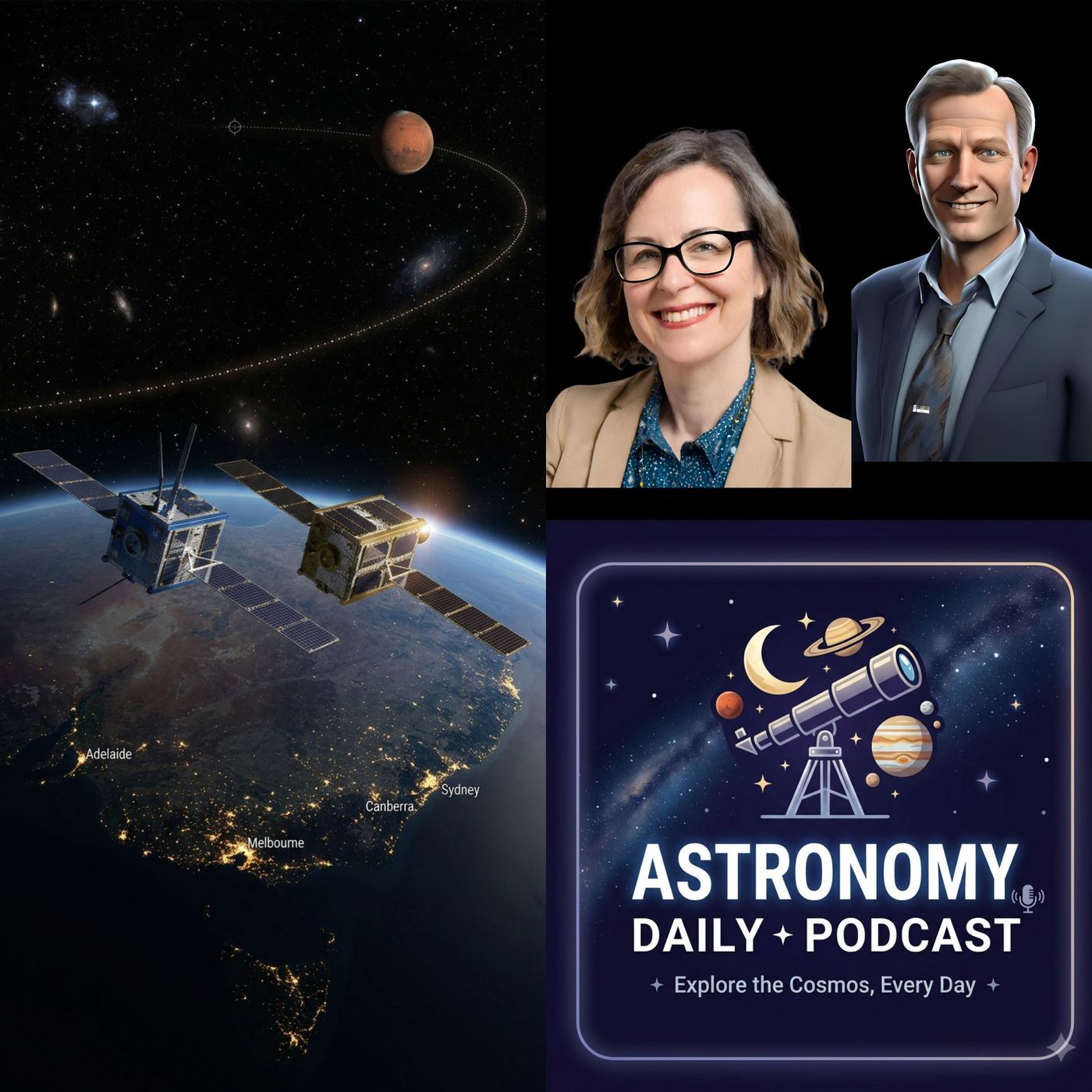
Show notes ESCAPADE's double slingshot over Australia NASA's twin ESCAPADE spacecraft, Blue and Gold, will each fly a powered Earth flyby on their way to Mars: the first around 5 a.m. EST on Saturday 7 November, the second around 6 a.m. EST on Monday 9 November. Each fires its engine for about nine minutes at closest approach, a manoeuvre NASA says no Mars-bound spacecraft has flown successfully before. The burns happen over southern Australia, starting 8:51 p.m. AEDT on the 7th and 9:51 p.m. AEDT on the 9th, and the spacecraft may be visible there through telescopes. Western US observers get their best chance between midnight and 2 a.m. PST. Arrival at Mars: 7 and 9 September 2027. Where did the oxygen go? Hubble's GLOW project (McQuinn et al., The Astrophysical Journal, published 2 November; preprint since August) measured oxygen in 37 nearby dwarf galaxies and found they keep only 4–25% (about 11% on average) of the oxygen their stars made, nearly all of it in gas. Simulations predi
In which John Green teaches you about water! So, we talk about resources a lot on Crash Course, and today is no exception. It turns out people can't live without water, which means it's absolutely necessary for civilization. Today John talks about water in the context of classical civilizations, but not like Greece or Rome or something. We're talking about the Maya civilization in Central America, and the Khmer civilization in what is now Cambodia. So this is an awesome video, OK? Citation 1: Steven J. Mithen - Sue Mithen, Thirst: Water and Power in the Ancient World. Harvard University Press. 2012. p 235 Citation 2: Patrice Bonnafoux, cited in Mithen. p243 Citation 3: Mithen. p 296 Crash Course is on Patreon! Want to find Crash Course elsewhere on the internet? Facebook - http://www.facebook.com/YouTubeCrashCourse Twitter - http://www.twitter.com/TheCrashCourse Instagram - https://www.instagram.com/thecrashcourse/ CC Kids: http://www.youtube.com/crashcoursekids