In which John Green teaches you about the life and death of one of history's great explorers, Captain James Cook of the British Navy. He charted large swaths of the Pacific ocean, laid claim to Australia and New Zealand, and died a bizarre death in the Sandwich Islands, which are now called the Hawaiian Islands. Exactly how and why Captain Cook was killed in Hawaii is a long-running historical debate. John presents two interpretations of the event and talks about what the differing interpretations say about history. It turns out how the story is told depends on who is doing the storytelling, and people from different backgrounds can interpret events in very different ways. Also, there is a celebration and a mustache involved in this episode, so you definitely don't want to miss it. Chapters: Introduction 00:00 Captain James Cook 0:33 An Open Letter to "The White Man's Burden" 2:44 Captain Cook's Controversial Death 3:40 Interpretations of Captain Cook's Death: Makahiki 4:19 Issues with
How fast will AGI be adopted? How can we ensure equitable outcomes? Nations, Businesses, People...Episode release date: 15 Jan 2024Spreading awareness about the works of some of the leading educators in the AI revolution. Core Ideas: Metamodernism: Narratives and emergence view of reality - Reduce suffering - Increase prosperity - Increase understanding mantra: Seek knowledge. ELABORATE: Add depth and detail to understanding, weaving comprehensive and nuanced explanations.DISCLAIMER: This is a community-driven show. -----How fast will AGI be adopted? How can we ensure equitable outcomes? Nations, Businesses, People...Episode release date: 15 Jan 2024Spreading awareness about the works of some of the leading educators in the AI revolution. Core Ideas: Metamodernism: Narratives and emergence view of reality - Reduce suffering - Increase prosperity - Increase understanding mantra: Seek knowledge. ELABORATE: Add depth and detail to understanding, weaving comprehensive and nuanced explanati
View full lesson: http://ed.ted.com/lessons/the-game-changing-amniotic-egg-april-tucker 350 million years ago, eggs could not survive far from water, therefore animals were water-bound. That is, until the amniotic egg, which allowed animals to live a fully terrestrial life. April Tucker peels back each layer of the amniotic egg, revealing how truly extraordinary this evolutionary marvel is. Lesson by April Tucker, animation by Pew36 Animation Studios.
Robot dogs are here. But why? You might think you already know Spot, the robot dog from Boston Dynamics. Maybe you saw a viral video of it opening a door, or dragging a truck, or dancing. But now, this robot has hit a HUGE milestone... Spot got a job! These robots are now out in the real world doing real work, for fire departments, factories, defunct nuclear power plants like Fukushima, ancient ruins like Pompeii, deep mines, and, more controversially, police departments. You might already be starting to see robot dogs walking around, and even if you’re not, they’re starting to affect your life. That’s why we went to visit Boston Dynamics. In this video, we put Spot to the test, to show you what it’s really capable of, and how our future could be even better with robot dogs. Chapters: 00:00 What is Boston Dynamics robot dog? 1:33 What does Boston Dynamics robot dog do? 2:50 Why robot dogs? 3:32 Taking Spot on an obstacle course 4:33 When Spot falls down 5:34 How Spot protects itself an
New research is challenging how scientists understand superconductivity, revealing that electron pairs can remain stable even at room temperature. The discovery suggests that a different quantum process may be the real obstacle to achieving resistance-free electricity under ordinary conditions. Understanding this hidden challenge could bring scientists closer to technologies that transform energy transmission, quantum computing, and magnetic levitation. This episode includes AI-generated content.
Why do black hole jets glow along their edges? New plasma simulations reveal how magnetic fields shape the mysterious jets of Centaurus A, bringing scientists closer to understanding cosmic particle accelerators and the extreme physics surrounding supermassive black holes. This episode includes AI-generated content.
Earth’s magnetic shield is weakening over the South Atlantic. This mysterious “Bermuda Triangle of Space” is a place where satellites glitch, cosmic radiation spikes, and astronauts see strange flashes of light. But what’s causing this growing hole in the magnetosphere isn’t something in space - it’s coming from inside the planet. Using seismic tomography and ancient volcanic lava, scientists have traced the disturbance back to a continent-sized “blob” sitting on top of the Earth’s core that may be the buried remains of an alien planet… and it might even explain how Hawaii formed… ▀▀▀▀▀▀ ▀▀▀▀▀▀ The Astrum book is still available in the US!
To hear an ad-free version of this episode, join our Patreon (https://www.patreon.com/cw/outsideinradio)! While fishing the rainy shores of Juneau, Alaska, host Nate Hegyi starts questioning the origins of the salmon filling his freezer. A behind-the-scenes tour of a salmon hatchery reveals a surprising truth: many "wild-caught" Pacific salmon actually begin their lives inside cold, dark warehouses. Through a decades-old practice known as ocean ranching, workers mix eggs and milt in five-gallon buckets, shelter the hatchlings from predators, and release them into the sea—giving these "silver-spoon" fish a massive survival boost before they're caught by commercial fleets or lured back up concrete fish ladders. Even though ocean-ranched salmon spend most of their lives in the open ocean, they occupy a murky middle ground between truly wild fish and industrial aquaculture. Featuring Ryley Oliver and Ian Urbina Produced by Nate Hegyi. For full credits and transcript, visit outsideinradio.o
Dig into the three key phases of developing a new vaccine: exploratory research, clinical testing, and manufacturing. Uploaded 15-06-20 -- When a new pathogen emerges, our bodies and healthcare systems are left vulnerable. And when this pathogen causes the outbreak of a pandemic, there’s an urgent need for a vaccine to create widespread immunity with minimal loss of life. So how quickly can we develop vaccines when we need them most? Dan Kwartler describes the three phases of vaccine development. Lesson by Dan Kwartler, directed by Good Bad Habits. Animator's website: https://www.goodbadhabits.ca/ Sign up for our newsletter: http://bit.ly/TEDEdNewsletter Support us on Patreon: http://bit.ly/TEDEdPatreon Find us on Twitter: http://bit.ly/TEDEdTwitter Peep us on Instagram: http://bit.ly/TEDEdInstagram View full lesson: https://ed.ted.com/lessons/how-fast-can-a-vaccine-be-made-dan-kwartler Thank you so much to our patrons for your support! Without you this video would not be possible! Der
What happens when European politics goes digital? Behind the scenes in European Union institutions, a quiet transformation is reshaping the way power works. Based on long-term ethnographic research, The Brussels Bubble: Inside the European Union in the Digital Age (https://bookshop.org/a/12343/9781009756808)(Cambridge University Press, 2026) by Dr. Rebecca Adler-Nissen & Dr. Kristin Anabel Eggeling follows diplomats, civil servants, spokespersons, and interpreters through the corridors, meeting rooms, cafés, and smartphone screens of Brussels' European Quarter. Against the backdrop of Brexit, the COVID-19 pandemic, and Russia's war on Ukraine, it reveals how digital technologies have become inseparable from the practice of international politics—reshaping trust, tact, and authority in unexpected ways. Far from a tale of technological revolution, The Brussels Bubble exposes digitalisation as a messy, human negotiation about what diplomacy and Europe itself mean today. Combining vivid na
In which John Green teaches you about Mary Shelley's novel, Frankenstein. Sure, you know Frankenstein the cultural phenomenon, but how much do you know about the novel that started it all? You'll learn about the Romantic movement in English lit, of which Frankenstein is a GREAT example, and you'll learn that Frankenstein might just be the first SciFi novel. Once again, literature comes down to just what it means to be human. John will review the plot, take you through a couple of different critical readings of the novel, and will discuss the final disposition of Percy Shelley's heart. Consider supporting local bookstores by purchasing your books through our Bookshop affiliate link https://bookshop.org/shop/complexly or at your local bookseller. Crash Course is on Patreon! Want to find Crash Course elsewhere on the internet? Facebook - http://www.facebook.com/YouTubeCrashCourse Twitter - http://www.twitter.com/TheCrashCourse Instagram - https://www.instagram.com/thecrashcourse/ CC Kids:
We’re in our self-determination era! In this episode of Crash Course Native American History, we’ll explore the activism that led to the biggest change in modern federal Indian policy, and how it affects Native nations today. Introduction: Alcatraz 00:00 Indians of All Tribes 0:36 The Self-determination Era 1:56 Effects of Self-determination 3:58 The Indian Child Welfare Act 6:37 Problems with Self-determination 7:23 Self-determination Today 8:55 Review & Credits 9:49 Sources: Want to know more about how this series was made? Learn more here: https://docs.google.com/document/d/17yp3u28s40TdjyrJniIf4U9YA8wPtvQ1g1B-HSHQ2Q4/edit?tab=t.0#heading=h.6vtzps565m2 (https://docs.google.com/document/d/17yp3u28s40TdjyrJniIf4U9YA8wPtvQ1g1B-HSHQ2Q4/edit?tab=t.0) *** Support us for $5/month on Patreon to keep Crash Course free for everyone forever! https://www.patreon.com/crashcourse Or support us directly: https://complexly.com/support Join our Crash Course email list to get the latest news and high
Proposing a ROBOT Tax: Decoupling Economic Growth from Human LaborEpisode release date: 21 Feb 2023Spreading awareness about the works of some of the leading educators in the AI revolution. Core Ideas: Metamodernism: Narratives and emergence view of reality - Reduce suffering - Increase prosperity - Increase understanding mantra: Seek knowledge. ELABORATE: Add depth and detail to understanding, weaving comprehensive and nuanced explanations.DISCLAIMER: This is a community-driven show. ----------------Proposing a ROBOT Tax: Decoupling Economic Growth from Human LaborEpisode release date: 21 Feb 2023Spreading awareness about the works of some of the leading educators in the AI revolution. Core Ideas: Metamodernism: Narratives and emergence view of reality - Reduce suffering - Increase prosperity - Increase understanding mantra: Seek knowledge. ELABORATE: Add depth and detail to understanding, weaving comprehensive and nuanced explanations.DISCLAIMER: This is a community-driven show. ----
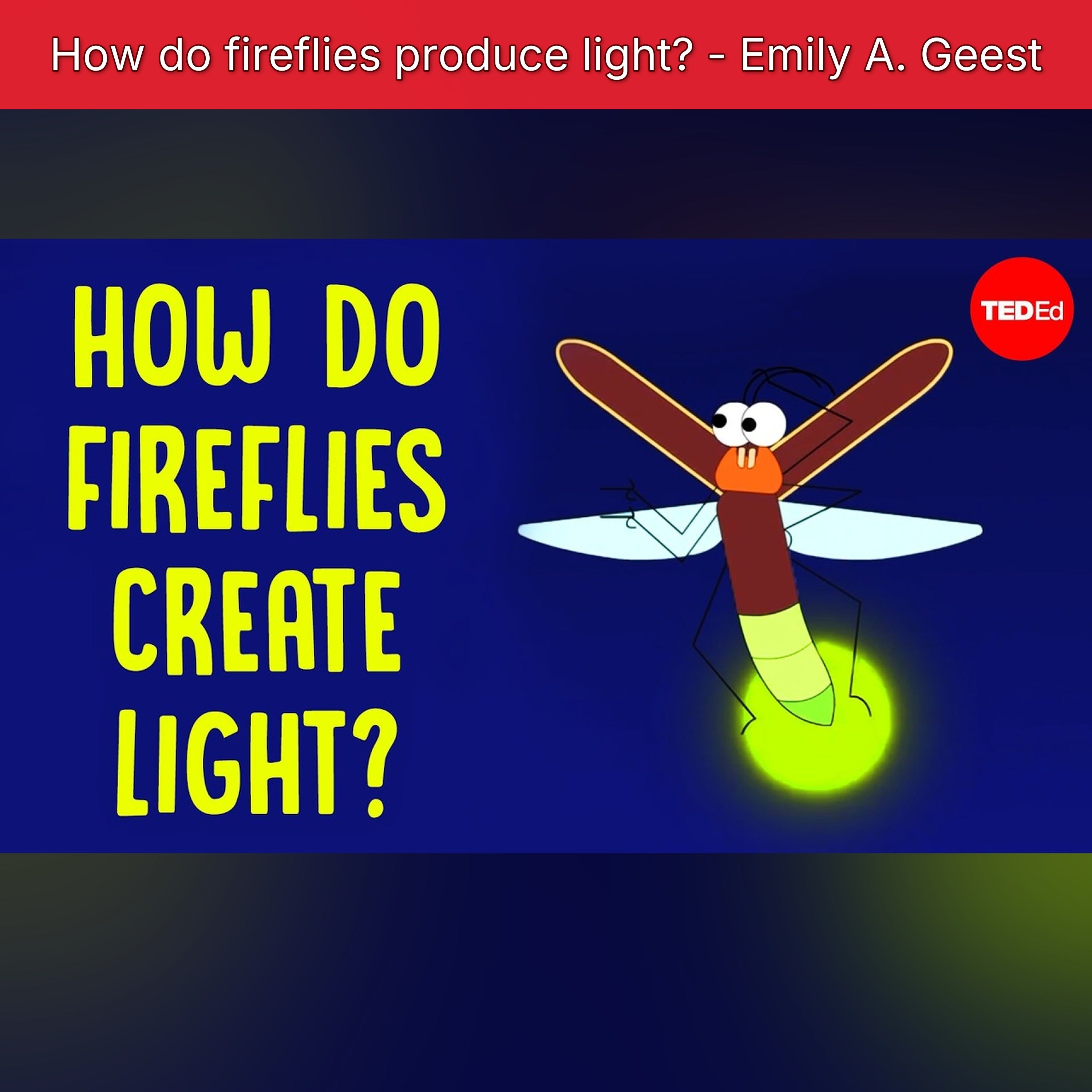
Dig into the science of how and why fireflies glow, and how their bioluminescent signals differ between males and females. -- The first firefly is thought to have lived over 100 million years ago, illuminating the night with a glowing green light. And today, there are around 2,000 firefly species, found all over the world, from forests and grasslands to marshes and deserts. So, why do these insects glow? Emily A. Geest digs into the bioluminescent signals of fireflies. Lesson by Emily A. Geest, directed by Lou Morton. Support Our Non-Profit Mission ---------------------------------------------- Support us on Patreon: http://bit.ly/TEDEdPatreon Check out our merch: http://bit.ly/TEDEDShop ---------------------------------------------- Connect With Us ---------------------------------------------- Sign up for our newsletter: http://bit.ly/TEDEdNewsletter Find us on Twitter: http://bit.ly/TEDEdTwitter Peep us on Instagram: http://bit.ly/TEDEdInstagram -------------------------------------
View full lesson: http://ed.ted.com/lessons/how-to-grow-a-bone-nina-tandon Uploaded 25-06-15 Can you grow a human bone outside the human body? The answer may soon be yes. Nina Tandon explores the possibility by examining how bones naturally grow inside the body, and illuminating how scientists are hoping to replicate that process in a lab. Lesson by Nina Tandon, animation by Giant Animation Studios.
Why do butterflies get all the attention? Which bees need our help? How can you foster more love for bugs? And how do we fight fire with … more fire? The wonderful Cheyenne Reuben-Thomas is a PhD candidate in Cornell University’s Ecology & Evolutionary Biology department and an enrolled member of the Oneida Nation of Wisconsin and the Tonawanda Seneca Nation and yes, an insect nerd. She chats all about orchards, bumblebees, broods, invasive vs. introduced species, habitat restoration, settler guilt, cultural burns, salamander etymology, maintaining your identity in academia, the upside of bloodsuckers, and how to see bugs as your kin. Visit Cheyenne’s website (https://www.cheyennethomas.com/) and follow her on Instagram (https://www.instagram.com/kanyunhtowan) and Bluesky (https://bsky.app/profile/cheyennethomas.bsky.social) A donation went to Ukwakhwa (https://www.ukwakhwa.org/) More episode sources and links (https://www.alieward.com/ologies/indigenousentomology) Other episodes you m
With the advent of AI, scams are increasingly difficult to recognize — and more costly than ever. Stacey Wood, PhD, a professor of psychology at Scripps College, discusses how scammers exploit our vulnerabilities; why some life circumstances can make us more susceptible to fraud; the psychological toll scams can take on victims; and what you can do to protect yourself and others.
We're still leading up to World War II, but first we gotta talk about the rise of the dictators. Today we talk about the rise of militaristic dictatorships in Germany, the Soviet Union, Japan, and Spain, and the economic depression that set the stage for their rise. Sources -Hunt, Lynn et al. Making of the West: Peoples and Cultures. 6th ed. Boston: Bedford St. Martins, 2019. -Kershaw, Ian. Hitler, A Biography. New York: W. W. Norton, 2010. -Kotkin, Stephen. Stalin: Waiting for Hitler, 1929-1941. New York: Penguin, 2017. -Slezkine, Yuri. The House of Government: A Saga of the Russian Revolution. Princeton: Princeton University Press, 2017. -Smith, Bonnie G. Europe in the Contemporary World, 1900 to the Present. 2nd ed. London: Bloomsbury, 2020. Crash Course is on Patreon! Thanks to the following patrons for their generous monthly contributions that help keep Crash Course free for everyone forever: Eric Prestemon, Sam Buck, Mark Brouwer, William McGraw, Siobhan Sabino, Jason Saslow, Jen
In which John Green, Hank Green, and Emily Graslie teach you about the Anthropocene, an unofficial geological era that covers the last century or so, in which humanity has made massive progress. We've discovered the Higgs-Boson particle, and awesome electric cars, and amazing smartphones. So all this collective learning and progress has been good for everyone, right? Maybe not. We'll look at some of the pros and cons of all this "progress," including environmental impact, changes in the way people live and work, and political changes and wars that come along with the modern world. We've come a long way, but there's a long way to go. Crash Course will also take a look at what's going to happen in the near future. If we manage to make our way through the coming bottlenecks, we could be OK in coming centuries. Don't get too hopeful, though. The Sun will eventually die, and the Earth will be destroyed, and later the universe will eventually experience heat death. But we won't talk about th
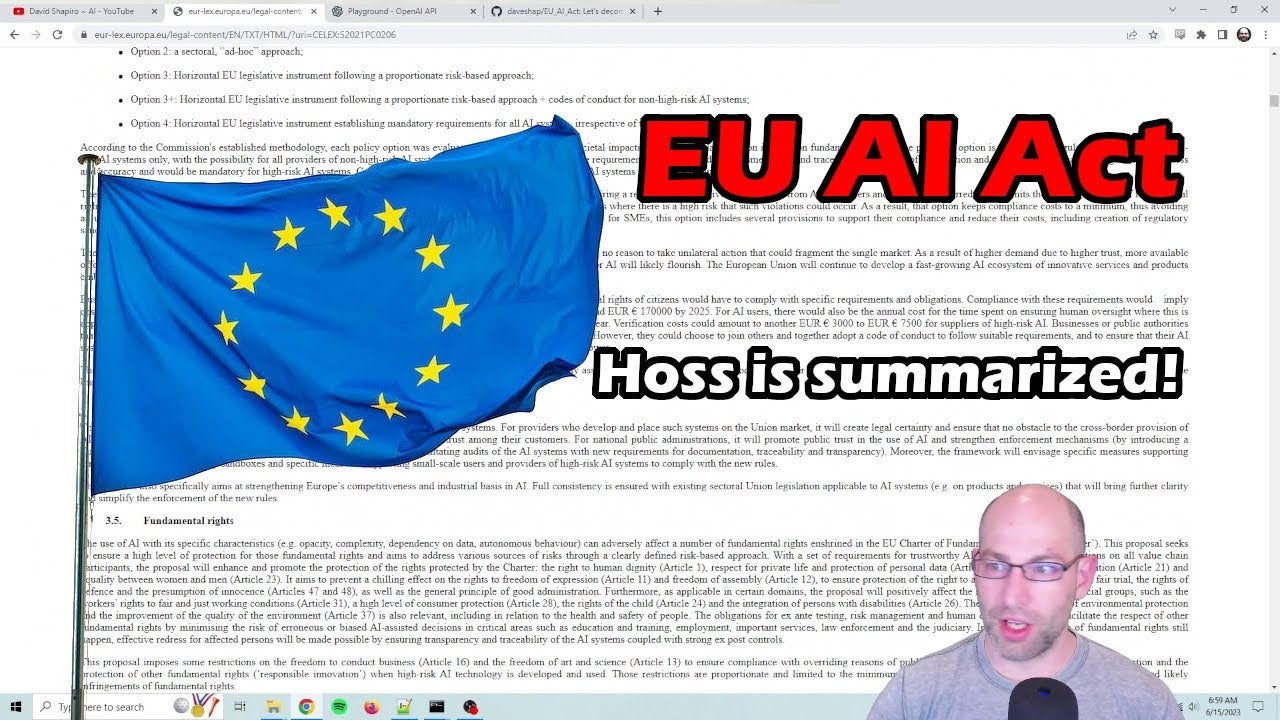
I summarized the EU AI Act so you can ask ChatGPT about it easily Episode release date: 15 Jun 2023 Core Ideas: Metamodernism: Narratives and emergence view of reality - Reduce suffering - Increase prosperity - Increase understanding mantra: Seek knowledge. DISCLAIMER: This is a community-driven show. ----------- Keywords: openai, ai safety, ai ethics, ai innovation, artificial intelligence, chatbots, future technology, ai agents
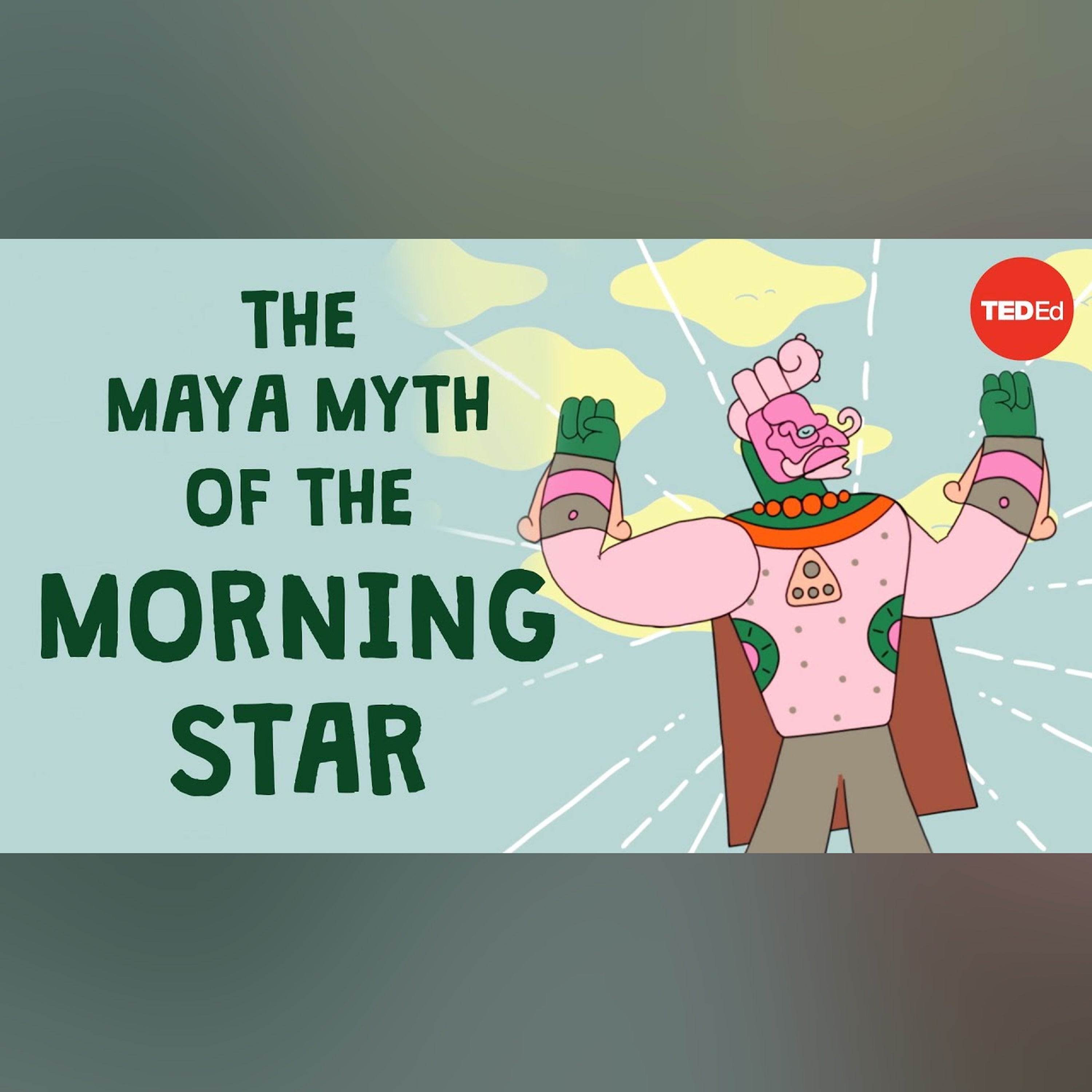
Discover the Maya myth of Venus, the morning star plotting revenge on his brother, the sun, and his allies. Uploaded 21-10-19 -- Chak Ek’, the morning star, rose from the underworld to the surface of the eastern sea and on into the heavens. His brother K’in Ahaw, the sun, followed. Though Chak Ek’ had risen first, K’in Ahaw outshone him, and the resentful Chak Ek’ descended back to the underworld to plot against his brother and his allies. Gabrielle Vail details the Maya myth of the morning star. Lesson by Gabrielle Vail, directed by Basa. Animator's website: https://www.basaestudio.com (https://www.basaestudio.com/) Sign up for our newsletter: http://bit.ly/TEDEdNewsletter Support us on Patreon: http://bit.ly/TEDEdPatreon Find us on Twitter: http://bit.ly/TEDEdTwitter Peep us on Instagram: http://bit.ly/TEDEdInstagram View full lesson: https://ed.ted.com/lessons/the-mayan-myth-of-the-morning-star Thank you so much to our patrons for your support! Without you this video would not be po
Explore the science of bioprinting, a type of 3D printing that uses bioink, a printable material that contains living cells. Uploaded 17-10-19 -- There are currently hundreds of thousands of people on transplant lists, waiting for critical organs like kidneys, hearts and livers that could save their lives. Unfortunately, there aren’t enough donor organs available to fill that demand. What if, instead of waiting, we could create new, customized organs from scratch? Taneka Jones explores bioprinting, a new branch of regenerative medicine. Lesson by Taneka Jones, directed by Hype CG. Animator's website: https://www.hype.cg (https://www.hype.cg/) Sign up for our newsletter: http://bit.ly/TEDEdNewsletter Support us on Patreon: http://bit.ly/TEDEdPatreon Find us on Twitter: http://bit.ly/TEDEdTwitter Peep us on Instagram: http://bit.ly/TEDEdInstagram View full lesson: https://ed.ted.com/lessons/how-to-3d-print-human-tissue-taneka-jones Thank you so much to our patrons for your support! Witho
Angie speaks with U.S. Congressman Maxwell Frost about what happened at Orlando’s Sloth World, where more than 50 sloths died before the attraction opened. Frost explains how gaps in oversight left the animals vulnerable and how the bipartisan SLOTHS Act, which he co-leads with Rep. Laurel Lee, would restrict sloth imports. He also shares how listeners can urge Congress to act. Timeline 00:00 Welcome and Guest Intro 01:06 Meet Congressman Frost 02:08 Favorite Animals and Florida Wildlife 05:23 Sloth World Tragedy Explained 10:27 Current Sloth Ownership Laws 12:59 What the SLOTHS Act Does 16:08 How a Bill Becomes Law 18:17 Protecting Sloths Already Here 20:31 Ethical Wildlife Encounters 22:12 How You Can Help Pass It 23:49 Advice for Future Advocates 25:31 Wrap Up and Where to Follow == Another thank you to all our Patreon supporters. You too can join for one cup of "good" coffee a month. Please considering supporting us at Patreon HERE. We also want to thank you to all our listeners. P
Using the underwater KM3NeT neutrino telescope, researchers have tested one of the fundamental principles behind Einstein's theory of relativity. By studying thousands of atmospheric neutrinos, the team searched for subtle signs that the laws of physics might behave differently at microscopic scales. The findings place new constraints on possible deviations and open the door to even more precise tests of fundamental physics. This episode includes AI-generated content.