Welcome to Crash Course Religions! Over the next 24 episodes, John Green will explore the history and culture of religions and how they offer frameworks for making sense of our lives — while being incredibly slippery things to pin down. We’ll discover how we define, debate, and contest what religion means, whether we’re personally religious or not. Episode 1 premieres on September 10, 2024. This content is based on an introductory university-level curriculum and the input of an advisory board of religious scholars. By the end of this course, you should be able to: *Use tools and concepts in the study of religion to understand religious practices and worldviews. *Unpack the history and culture of several major and minoritized religious traditions. *Analyze inter-religious and intra-religious connections, influences, and frictions. *Develop an informed historical perspective on contemporary religious issues and debates. *** Support us for $5/month on Patreon to keep Crash Course free for
Can quantum interference disappear and then return? Researchers have demonstrated that quantum coherence can revive in a small environment but becomes harder to recover as the system grows. By exploring how decoherence spreads through systems of up to eight qubits, the experiment offers new insights into quantum physics and the challenges of building reliable quantum computers. This episode includes AI-generated content.
Scientists at Columbia University have detected a subtle temperature pattern in the cosmic microwave background that reveals how gas moves inside galaxy clusters. By combining observations from 25 clusters, researchers uncovered new evidence linked to rotation and cosmic mergers, opening a promising way to investigate the dynamics of these enormous structures. This episode includes AI-generated content.
For this bonus episode, we’re sharing a favorite from No Small Endeavor, hosted by Lee C. Camp, a podcast exploring what it means to live a good life. Lee sat down with Real Organic Project co-director Linley Dixon to talk about the path that took her from academia into farming and activism, and why healthy soil became central to the way she thinks about food, community, and human flourishing. Linley also shares the story behind the Real Organic Project and why protecting the meaning of organic requires farmers and eaters to keep asking difficult questions about the food system. We hope you enjoy A Good Life Grows in Healthy Soil. To find a Real Organic farm near you, please visit: We believe that the organic standards, with their focus on soil health, biodiversity, and animal welfare were written as they should be, but that the current lack of enforcement of those standards is jeopardizing the ability for small farms who adhere to the law to stay in business. To read our weekly newsle
Venus fly traps, bladderworts and sundews, oh my! Learn about carnivorous plants and their predatory antics to lure, trap and digest prey. Uploaded 11-04-19 -- Around the world there are more than 600 plant species that supplement a regular diet of sunlight, water and soil with insects, frogs and even rats. Flies, tadpoles and beetles fall prey to the remarkable, predatory antics of carnivorous plants. What exactly are carnivorous plants and how do they trap their prey? Kenny Coogan dives into the world of these flesh-eating tricksters. Lesson by Kenny Coogan, directed by Lisa LaBracio. Sign up for our newsletter: http://bit.ly/TEDEdNewsletter Support us on Patreon: http://bit.ly/TEDEdPatreon Find us on Twitter: http://bit.ly/TEDEdTwitter Peep us on Instagram: http://bit.ly/TEDEdInstagram View full lesson: https://ed.ted.com/lessons/the-wild-world-of-flesh-eating-plants-kenny-coogan Thank you so much to our patrons for your support! Without you this video would not be possible! Antony
View full lesson: http://ed.ted.com/lessons/a-new-way-to-diagnose-autism-ami-klin Early diagnosis of autism spectrum disorder can improve the lives of everyone affected, but the complex network of causes make it incredibly difficult to predict. At TEDxPeachtree, Ami Klin describes a new early detection method that uses eye-tracking technologies to gauge babies' social engagement skills and reliably measure their risk of developing autism. (Filmed at TEDxPeachTree.) Talk by Ami Klin.
A Christmas tree farmer with dementia named Jay Hickey vanishes from his small town in rural New Hampshire. Jay's wife Patty never reports him missing. A tipster claims "a lot of strangeness is starting to emerge" – and they're right. From our colleagues on the Document team at New Hampshire Public Radio, the season three premiere of Bear Brook, A Private Matter, tells a story about family estrangement, the growing dementia crisis, and the legal gaps that leave vulnerable people behind. To listen to more of the new season, follow Bear Brook here:https://podcasts.apple.com/us/podcast/redhanded/id1250599915https://play.megaphone.fm/3gfaxmufro-bjytd5eobrg Visit the Bear Brook website (https://www.bearbrookpodcast.com/season-three) to find photos from Jason's reporting and transcripts of each episode. CONNECT WITH US Outside/In is made possible with listener support. Click here (http://patreon.com/cw/outsideinradio) to join our Patreon and get ad-free episodes of the podcast. No question i
Why do we find the young of other species cute? Finding baby humans adorable makes evolutionary sense, ensuring that we care for them properly. But what about babies of other species? Hannah and Dara go down a fluffy rabbithole of cuteness: pondering the science behind things that make us go 'ahhhh'; exploring the phenomenon of 'cute aggression'; and discovering there can be such a thing as cuteness overload. We also discover what Dara would look like as an elf, and what happens when you make Hannah scientifically less cute. Brace yourselves... If you have a scientific mystery for the team to investigate, contact them on [email protected]. Contributors: Anthony Little – Reader in Psychology at the University of Bath Daniel Mills – Emeritus Professor of Veterinary Behavioural Medicine at the University of Lincoln Chris Holliday – Senior Lecturer in Liberal Arts and Visual Cultures Education at King's College London Producer: Lucy Taylor Executive Producer: Sasha Feachem A BBC Studi
ulie Lokun shares how Barbie play shaped her confidence, career, and creativity, and how to reclaim the joy you had as a kid. What toy made you who you are? Primary Keywords: reclaim your inner child, imaginative play, personal growth, creative confidence, Julie Lokun, Get Obsessed Podcast, how to find joy again Secondary Keywords: Barbie and self-discovery, childhood play and identity, reinvention, women and ambition, career change confidence, creative burnout, personal development podcast, living your best life Episode Description Before she had a microphone, a law degree, or a single listener, Julie Lokun, JD had a shag carpet and a shoebox full of Barbies. She’d beg for five more minutes before dinner because Barbie was mid-scene: a board meeting, a breakup, and a gala, all on the same Saturday. Nobody understood the stakes like she did. In this solo episode of Get Obsessed, Julie goes back to that girl on the floor and finds something bigger than playtime. The bathtub became Malib
All the magic that we know is in the transfer of electrons. Reduction (gaining electrons) and oxidation (the loss of electrons) combine to form Redox chemistry, which contains the majority of chemical reactions. As electrons jump from atom to atom, they carry energy with them, and that transfer of energy is what makes all life on Earth possible. Watch this video in Spanish on our Crash Course en Español channel! https://youtu.be/B-2h7u665AM Thank you to the following chemistry teachers for their assistance: James Sarbinoff Rachel Wentz Edi González Lucas Moore Chris Conley Addie Clark Julia Rosinski Special Thanks to Matt Young at the University of Montana (Geosciences Department, Environmental Biogeochemistry Lab) who helped with the chemical demonstrations. Pssst... we made flashcards to help you review the content in this episode! Find them on the free Crash Course App! Download it here for Apple Devices: https://apple.co/3d4eyZo Download it here for Android Devices: https://bit.ly/
Learn more about TED-Ed Clubs here: https://ed.ted.com/clubs Uploaded 10-05-18 Check out the TED-Ed Clubs YouTube channel: https://www.youtube.com/channel/UCskU_g7t6b5ecsA1CTS3y9Q View full lesson: https://ed.ted.com/lessons/when-will-the-next-ice-age-happen-lorraine-lisiecki Throughout Earth’s history, climate has varied greatly. For hundreds of millions of years, the planet had no polar ice caps. Without this ice, the sea level was 70 meters higher. At the other extreme, about 700 million years ago, Earth became almost entirely covered in ice, during an event known as “Snowball Earth.” What causes these swings in the planet’s climate? Lorraine Lisiecki investigates. Lesson by Lorraine Lisiecki, animation by CUB Animation. Thank you so much to our patrons for your support! Without you this video would not be possible! Rishi Pasham, Jhuval , SookKwan Loong, Daniel Day, Nick Johnson, Bruno Pinho, Javier Aldavaz, Rodrigo Carballo, Marc Veale, Boytsov Ilya, Bozhidar Karaargirov, maxi kobi
In addition to just being beautiful one-of-a-kind panoramas in the sky, clouds can tell us so much about how energy and weather patterns flow around the globe. Today, we'll talk about how clouds form, the three main types (cirrus, status, and cumulus), explain how and why we get rain, and end with a discussion on humidity and how high humidity can feel hot and sticky on a warm day but comfortable on a cold day. So join us and countless people throughout history and look up -- at the clouds! Watch our videos and review your learning with the Crash Course App! Download here for Apple Devices: https://apple.co/3d4eyZo Download here for Android Devices: https://bit.ly/2SrDulJ Crash Course is on Patreon! Thanks to the following patrons for their generous monthly contributions that help keep Crash Course free for everyone forever: Aziz, Christine Phelan, Nick, DAVID MORTON HUDSON, Perry Joyce, Scott Harrison, Mark & Susan Billian, Junrong Eric Zhu, Alan Bridgeman, Jennifer Smith, Matt Curls,
What makes a painting worth millions of dollars? In this episode of Crash Course Art History, we’re looking at the history behind today’s art industry and how we determine an artwork’s financial value. We’ll also learn how the big business of buying and selling art runs on imperialism, and how people in the art world are fighting back. Crash Course Art History: Episode #19 Introduction: Million-Dollar Paintings 00:00 Patronage 00:53 The Free Market 01:55 Appraisal 03:59 Colonialism & Art 06:17 The Gallery Industrial Complex 08:10 Review & Credits 10:07 Image Descriptions: https://docs.google.com/document/d/1ETiCxe4GrVzFii7dBhF42oHx1EUCCh5y12wbtUjsH8A/edit Sources: https://docs.google.com/document/d/1GW2NKzhpMNMmRyAFJVhFJG9cSfUOMRL-QrcWuHcWcIA/edit?usp=sharing *** Support us for $5/month on Patreon to keep Crash Course free for everyone forever! https://www.patreon.com/crashcourse Or support us directly: https://complexly.com/support Join our Crash Course email list to get the latest ne
Common climate wisdom used to be that buying solar panels was one of the smartest long-term investments an individual could make – pay once up front for decades of carbon-free electricity. But it turns out layers of red tape make that process slower – and much more expensive – than it needs to be. And with federal rollback of longstanding tax credits and stiff competition from China, the U.S. solar industry is facing new headwinds. Still, the future could be bright: More states are looking at allowing plug-in or balcony solar. Energy affordability nonprofits like Permit Power are helping state governments reduce red tape and costs for home solar. And solar developers see new potential in the millions of acres of commercial rooftops. Plus, researchers continue to work on new ways to maximize the power a solar cell can produce. This week we take a look at what the next era of solar power might look like. Guests: Bernadette del Chiaro (https://www.climateone.org/people/bernadette-del-chia
The Vera C. Rubin Observatory in Chile has already uncovered two previously unknown Milky Way companions using early test data: an extremely faint galaxy and a star cluster hidden by dust. These discoveries offer an early glimpse of what the observatory’s ambitious decade-long sky survey could reveal about our galaxy’s history, its formation, and the mysteries of dark matter. This episode includes AI-generated content.
Could a simple change in heating sequence make nuclear fusion easier to achieve? Researchers at Princeton Plasma Physics Laboratory have refined the Lawson criterion, suggesting that heating plasma before increasing its density could reduce the energy needed for fusion ignition. Their model also accounts for real-world reactor challenges, potentially helping scientists design more efficient fusion power plants. This episode includes AI-generated content.
View full lesson: http://ed.ted.com/lessons/how-do-you-decide-where-to-go-in-a-zombie-apocalypse-david-hunter Can geography save your life in case of, say, a zombie apocalypse? Understanding the push and pull factors that create geographic movement -- or how people, resources, and even ideas travel -- might help you determine the location that's best for survival. David Hunter playfully analyzes the geography skills that you'd need to escape the zombies. Lesson by David Hunter, animation by Provincia Studio.
Explore William Golding’s timeless satire, “Lord of the Flies,” which follows a group of shipwrecked boys as they descend into anarchy. Uploaded 12-12-19 -- After witnessing the atrocities of his fellow man in World War II, William Golding was losing his faith in humanity. Later, during the Cold War, as superpowers began threatening one another with nuclear annihilation, he was forced to interrogate the very roots of human nature and violence. These musings would inspire his first novel: “Lord of the Flies.” Jill Dash dives into the timeless satire. Lesson by Jill Dash, directed by Lucy Animation Studio. Animator's website: https://www.silviaprietov.com (https://www.silviaprietov.com/) Sign up for our newsletter: http://bit.ly/TEDEdNewsletter Support us on Patreon: http://bit.ly/TEDEdPatreon Find us on Twitter: http://bit.ly/TEDEdTwitter Peep us on Instagram: http://bit.ly/TEDEdInstagram View full lesson: https://ed.ted.com/lessons/why-should-you-read-lord-of-the-flies-by-william-goldi
On March 17, 2015, tens of thousands of Mexican farmworkers went on strike in San Quintin, Baja California, to protest horrible working conditions on the farms that produce most of the fresh fruits and vegetables you consume. Calling themselves the "slaves of the twenty-first century," these mostly Indigenous men, women, and children rose up in defiance of the conditions of modern slavery, forced labor, sexual harassment, and "hunger wages." This ethnography provides an in-depth look into how Indigenous farmworkers organize in the fields and their communities to improve wages and working conditions. Since the strike, the farmworkers have organized a union to fight for justice in the fields. In this work, author James Daria accompanies these farmworkers as they struggle for dignity. Daria also charts the tensions inside the farmworker movement as women struggle to gain greater power in the home as well as at work. In an era of complex global integration, Daria shows us how what we eat i
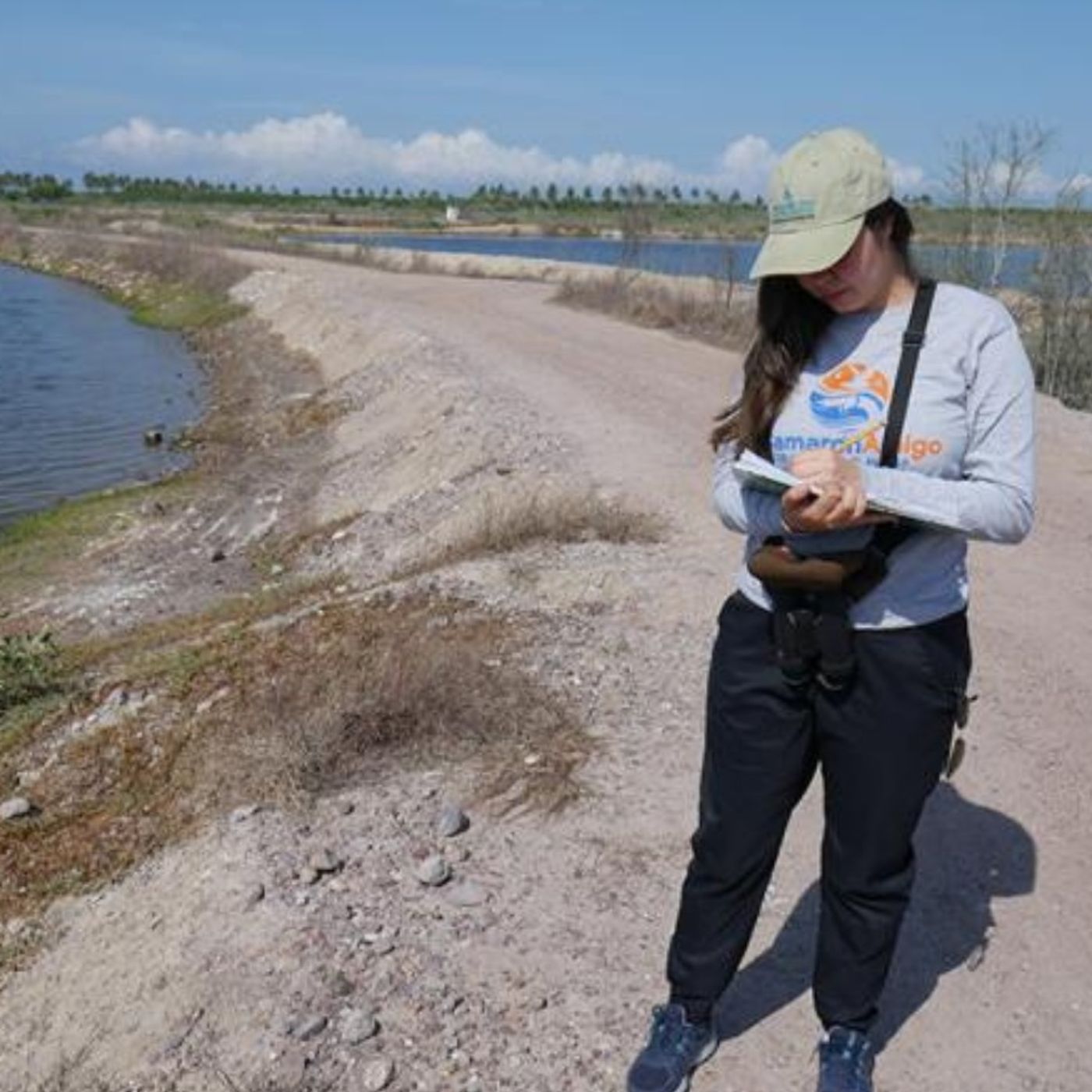
Along the coast of Sinaloa in México, there are species of shorebirds with one of the longest migrations in the Western Hemisphere. One such species is the Western Sandpiper, here known as el playerito occidental, wants to eat. But wetland habitats where they find their food are affected by the shrimp farming industry. Juanita Fonseca works with the Western Hemisphere Shorebird Reserve Network and with Manomet, creating guidelines that help shrimp farmers share the coastline with shorebirds. Listen to this episode in Spanish here (https://www.birdnote.org/podcasts/birdnote-en-espanol/la-migracion-invernal-del-playerito-occidental). More info and transcript at BirdNote.org (https://www.birdnote.org/podcasts/birdnote-daily/western-sandpipers-winter-migration). Want more BirdNote? BirdNote is a nonprofit. Hosted by Simplecast, an AdsWizz company.
What revolutionary disability politics look like today, with lessons for larger liberatory movements. In recent political times, disability identity has been mobilized in ways that paradoxically compound bodily injury and disability. This single-issue approach obscures the oppression of disabled people and prevents solidarity across difference. In Disability, Revolution (https://bookshop.org/a/12343/9780520388178) (U California Press, 2026), Robert McRuer introduces alternatives to "one-dimensional disability," providing an accessible overview of disability justice movements and their relevance to larger emancipatory coalitions. Exploring the most prominent examples from the past several decades, the book focuses on the convergence of queer and crip movements, mad pride, intersectional disability justice work, neurodiversity, and the globalization of disability alliances. Essential for anyone interested in disability politics, this book shows how these multivalent movements help us ima
SpaceX Daily SpaceX targets the first upper-stage catch on Starship Flight 15 for November 13, advancing full rapid reuse of both stages. Top News SpaceX sets November 13 target for first Starship upper-stage catch SpaceX Vice President of Launch Kiko Dontchev announced the November 13 target for Flight 15 at the UP.Summit. The mission will attempt to catch both the Super Heavy booster and the Ship with the tower arms. ... Sources: keeptrack.space (https://keeptrack.space/x-report/spacex-brief-2026-11-06) · teslarati.com (https://www.teslarati.com/spacex-starship-catch-nov-13) · nasaspaceflight.com (https://www.nasaspaceflight.com/2026/11/blue-origin-new-glenn-gs3-northstar-engine/) · actionnews5.com (https://www.actionnews5.com/2026/11/06/spacexai-build-2-more-ai-data-centers-southaven/) · cursor.com (https://cursor.com/changelog) · hromadske.ua (https://hromadske.ua/en/amp/war/273886-ukraine-seeks-new-starshield-deal-with-us-as-contract-nears-expiration-in-2027) · breakingdefense.com
Love won over your skeptical dad, but his adult kids still treat you like an interloper. Is it about you, or the inheritance? Welcome to Feedback Friday! And in case you didn't already know it, Jordan Harbinger (@JordanHarbinger (https://twitter.com/JordanHarbinger)) and Gabriel Mizrahi (@GabeMizrahi (https://twitter.com/GabeMizrahi)) banter and take your comments and questions for Feedback Friday right here every week! If you want us to answer your question, register your feedback, or tell your story on one of our upcoming weekly Feedback Friday episodes, drop us a line at [email protected]. Now let's dive in! Full show notes and resources can be found here: jordanharbinger.com/1410 (https://jordanharbinger.com/1410) On This Week's Feedback Friday: A year and a half ago, you were torn between your older Australian boyfriend and a family convinced it was all daddy issues, so you wrote us for some advice (episode 1187 (https://www.jordanharbinger.com/family-under-threat-thanks-
In which John Green teaches you about the War of 1812. The War of 1812 was fought between the United States and its former colonial overlord England. It started in, you guessed it 1812. The war lasted until 1815, and it resolved very little. John will take you through the causes of the war, tell you a little bit about the fighting itself, and get into just why the US Army couldn't manage to make any progress invading Canada. And yes, Canadians, we're going to talk about the White House getting burned down. The upshot: no territory changed hands, and most of the other bones of contention were solved prior to the actual war. Although nothing much changed for the US and England, the Native Americans were the big losers. Tecumseh was killed, and the Indian tribes lost a lot of their territory. Watch as John lays it all out for you. Chapters: Introduction: The War of 1812 00:00 Causes for The War of 1812 - British Impressment of American Sailors 0:44 Henry Clay and the Warhawks 2:13 America