28/11/26 Farming Today This Week: Wales bovine TB strategy; restoration row; warmer waters; Western Isles fish; whelks.
24 min
Listen through the publisher, then discuss the episode here or arrange an in-person Roundtable. Your city determines where to meet.
Roundtables are designed for groups of four, with a shared subject and room for everyone to speak. Come for discussion, with no dating expectation.
The Welsh government has ruled out a mass badger cull as part of updated plans to tackle bovine TB. It follows months of speculation over the intentions of the new Plaid Cymru-led administration. As part of what's described as a ‘new and pragmatic' approach ministers say targeted wildlife interventions will be developed. These could include trapping, testing and euthanising some badgers, though there's no timescale for this. A group of Welsh farmers and farming organisations are calling on the National Trust to halt nature restoration plans in an area of the Eryri National Park. The Trust says it aims to restore and protect "a patchwork of more than 4000 acres of habitats" in the Nant Ffrancon valley in Snowdonia, now called Eryri. However local farmers say they knew nothing of the Trust's plans until they read about it in the press. They say the Trust has already reduced tenant and sheep numbers in the area, and this new project will lead to further losses of both farmers and hefted flocks of Welsh mountain sheep. All week we've been looking at warming seas, and how that's affecting fisheries around Britain. Whelks have long been a traditional seaside snack but they are still an important catch in some English ports as they're now exported, mainly to South Korea and are worth as much as £20 million a year to the UK. Recent marine heatwaves however, have been devastating to stocks. In Scotland's Western Isles, fishing is a key occupation and shellfish in particular are still exported to prestige markets around the world, but here too there are clear signs that species are adapting to changing conditions. We speak to a fish merchant in Stornaway about how it's affecting what he stocks in his shop. Presenter = Charlotte Smith Producer = Rebecca Rooney
Episode information is provided by the publisher. Listening takes place on the publisher’s service.
Coastal Louisiana is losing land at an unprecedented rate, and in response, scientists and policymakers have turned to massive restoration projects to slow the erosion. Good Sediment enters this charged landscape, where the promise of ecological renewal collides with the lived realities of Black coastal communities in Plaquemines Parish. At the center ofGood Sediment: Black Ecologies and the Politics of Restoration in Coastal Louisiana (https://bookshop.org/a/12343/9780295754673) (University of Washington Press, 2026) is the Mid-Barataria Sediment Diversion, the state’s most ambitious and controversial project: a $2 billion engineering feat that would redirect the Mississippi River’s mud and silt into disappearing wetlands. For policymakers, the river’s sediment is salvation. For the Parish’s multigenerational Black communities, however, this “good sediment” carries profound risks, including flooding homes and undermining fishing livelihoods. Through ethnographic research, Monica Patri
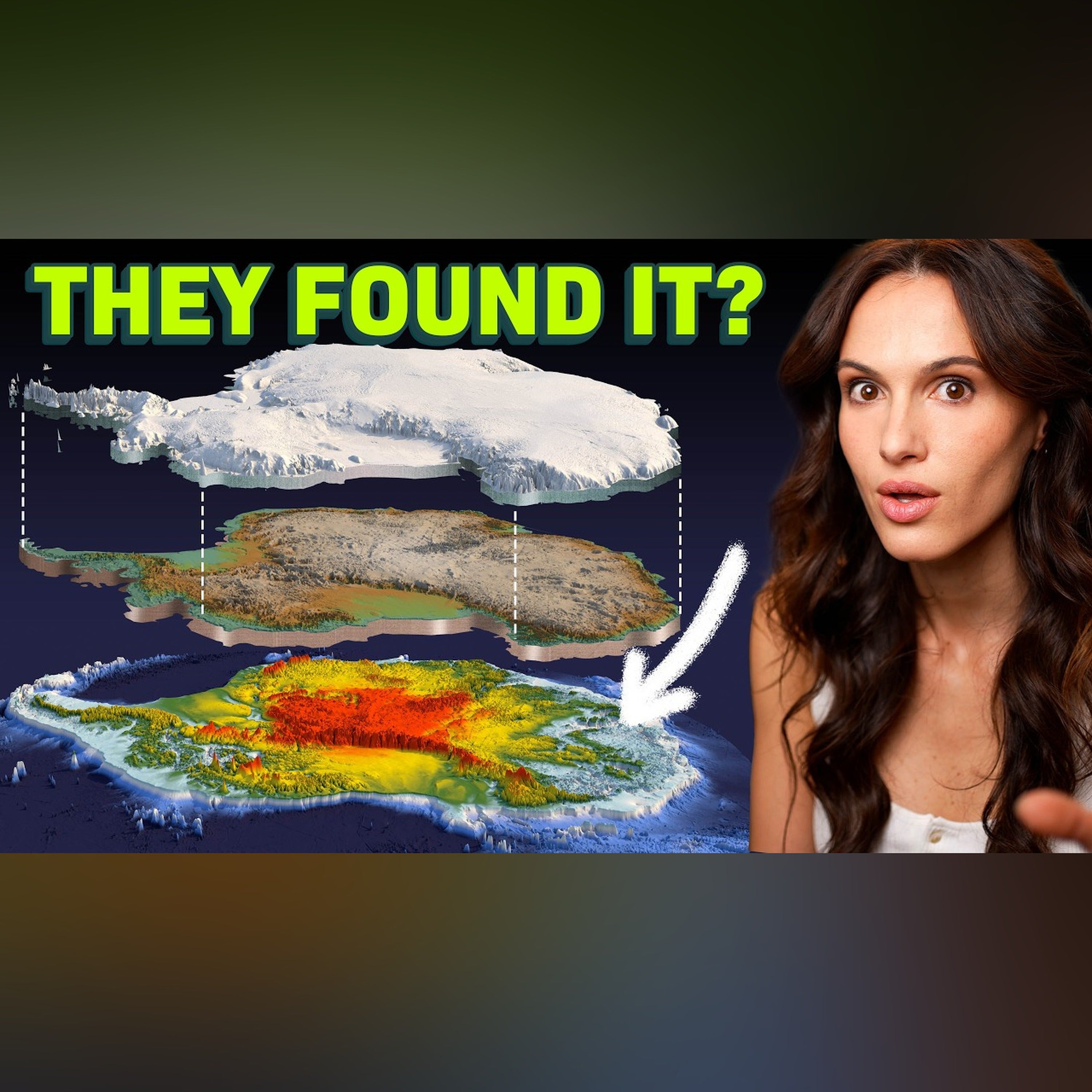
Something's hiding below the ice in Antarctica…. For optimistic science and tech stories, subscribe! In 1970, a team of Soviet scientists started drilling. For 28 years, they kept going… until after nearly 4,000 meters… they suddenly stopped. Because they’d found something unimaginable: Liquid water. A secret lake, down below all this ice, that had been completely sealed off from the rest of the world for 15 million years. How? And… is there something alive in there? Creatures that have been evolving separately from the rest of the planet for 15 million years? Scientists started searching for more of these secret lakes, and as they did, they realized there is way more going on under Antarctica than we ever thought. I needed to know the truth about Earth’s most remote continent. So I've come all the way to Antarctica to show you what's really happening down below this ice. And exactly what they discovered when they finally broke inside… Chapters: 00:00 What’s hiding under Antarctica? 01
Viewers like you help make PBS (Thank you ) . Support your local PBS Member Station here: https://to.pbs.org/DonateSPACE Uploaded 25-10-17 For years, astronomers have been unable to find up to half of the baryonic matter in the universe. We may just have solved this problem. You can further support us on Patreon at https://www.patreon.com/pbsspacetime Get your own Space Time tshirt at http://bit.ly/1QlzoBi Tweet at us! @pbsspacetime Facebook: facebook.com/pbsspacetime Email us! pbsspacetime [at] gmail [dot] com Comment on Reddit: http://www.reddit.com/r/pbsspacetime Help translate our videos! https://www.youtube.com/timedtext_cs_panel?tab=2&c=UC7_gcs09iThXybpVgjHZ_7g (https://www.youtube.com/timedtext_cs_panel?c=UC7_gcs09iThXybpVgjHZ_7g&tab=2) Previous Episode: The Nature of Nothing | Space Time https://www.youtube.com/watch?v=X5rAGfjPSWE&t=55s (https://www.youtube.com/watch?t=55s&v=X5rAGfjPSWE) Dark Matter! Dark Energy Playlist We’ve known for some time that around 95% of the energy
What do immigration, AI safety and a free press teach us about how the economy works? Justin Wolfers marks six months of Diving In with three stories about the half of an economic argument you might not see at first glance. Immigrants aren't just workers competing for jobs—they're customers helping create them. Justin examines why White House advisers lowered their monthly jobs benchmark from about 200,000 to 50,000 as immigration slowed, and what that reveals about the claim that newcomers take your job. For artificial intelligence, the question isn't only how much richer it could make you. It's whether paying more for safety is worth the cost—and how potential medical breakthroughs change that trade-off. Justin explains why powerful technology needs independent scrutiny, not just assurances from the people building it. That same logic applies to government. Research shows how independent reporting changes officials' incentives, exposes corruption and helps voters hold politicians acc
Show notes Webb has read the dust of Cassiopeia A clump by clump, and the chemistry points to the star's inner burning shells merging in its final hours. Plus the week that was, the week ahead, and Venus at its most brilliant. The Star That Rearranged Itself Webb's Mid-Infrared Instrument has resolved the dust in individual, solar-system-sized clumps of Cassiopeia A. Argon-rich debris holds silica; neon- and carbon-monoxide-rich debris holds carbon grains; the 'Green Monster' is magnesium silicate the star shed before it exploded. Only models in which the star's oxygen-burning shell merged with the carbon–neon shell above it reproduce both dust types — independent support for Chandra's 2025 evidence that the star's interior was churned up less than about three hours before collapse. Caveats: dust carries no clock, the models are one-dimensional, an alternative exists, and dust masses are lower limits. Temim, Arendt, Milisavljevic et al., ApJL 1012, published 23 Nov 2026. The Week That
In this episode of Let’s Get Freaky, we sit down with Si Eades, better known as Si in the Shire. Through his Instagram account, @strangespookythings, Si explores unusual events, high strangeness, local folklore and ancient sites in and around Worcestershire. A lifelong paranormal enthusiast, Si is drawn to everything from ghosts and cryptids to UFOs. He has a particular interest in Britain’s mystery big cats. His own sightings, along with those reported by family members in Worcestershire, have convinced him that these elusive animals are real and closer than many realise. Whilst working in a garden in his hometown, Si saw what appeared to be the ghost of a German prisoner of war. It was only after the encounter that he discovered the town had once been home to a prisoner-of-war camp. Si also describes a profound message he received from the other side. Join us as we go further down the rabbit hole of high strangeness, from recent blackout reports to the conspiracy theories making head
A group of Welsh farmers and farming organisations are calling on the National Trust to halt nature restoration plans in an area of the Eryri National Park. The Trust says it aims to restore and protect "a patchwork of more than 4000 acres of habitats" in the Nant Ffrancon valley in Snowdonia, now called Eryri. But local farmers say they knew nothing of the Trust's plans until they read about it in the press. They say the Trust has already reduced tenant and sheep numbers in the area, and this new project will lead to further losses of both farmers and hefted flocks of welsh mountain sheep. How trout farming is being put under pressure during heatwaves and drought. Should we see human poo less as waste and more as a resource? Presented by Charlotte Smith and produced by Beatrice Fenton.
Whelks have long been a traditional seaside snack but they are still an important catch in some English ports as they're now exported, mainly to South Korea and are worth as much as £20 million a year to the UK. However, whelks are adapted to live in cold water and in the UK are at the southern limit of their temperature range. Recent marine heatwaves have been devastating to stocks. This week we are looking at the impact that our warming waters are having and today we report from Whitstable in Kent. A new report warns that the UK risks missing targets on climate, nature and food production unless rival visions for the countryside find common ground. In a paper published in the Land Use Journal Professor Sir Charles Godfray, Director of the Oxford Martin School, says that without changes to the way we use land and what we eat the UK would need an extra 4.5 million hectares of land by 2050 to meet net zero and biodiversity targets. We are all supposed to be eating more pulses and farmer
We've spent the week trying to work on what the UK-EU deal on closer alignment will mean for food and farming. From gene edited crops to pesticides and red tape we discussed challenges and opportunities. Yesterday the Prime Minister hailed 'a really significant agreement' which he said 'will begin to reduce red tape for business.' What does that means for UK food producers? Bird flu is ramping up, as are measures to protect farmed poultry. From Monday kept birds in Wales will have to be inside, a measure introduced in Northern Ireland earlier this week and in England last week. In Scotland prevention zones have been brought in, meaning enhanced biosecurity but not housing orders. When the disease is found birds are culled, which is obviously devastating, but what does keeping birds inside mean on farms where hens or turkeys roam around in free range systems? Campaigners are urging the Government to invest in British tree production after recent government figures revealed the UK import
Patients should be able to compare expected treatment costs before choosing care.
Share your view, then see how readers voted. No sign-in required. This poll is shared across stories.
Do you agree or disagree?
Common Quandary
A Common Quandary to discuss
Another conversation to explore, separate from this news story.
You know the relationship is over, but the vacation is nonrefundable. Do you wait to break up?
You have decided to end a year-long relationship. In five days, you are both leaving on an expensive vacation that cannot be refunded or transferred. Your partner is excited and believes the relationship is thriving.
Can avoiding financial waste justify delaying a painful truth?