Guide To Space - Universe Today News: Are Uranus & Neptune Secretly "Rock Giants"?
8 min
Listen through the publisher, then discuss the episode here or arrange an in-person Roundtable. Your city determines where to meet.
Roundtables are designed for groups of four, with a shared subject and room for everyone to speak. Come for discussion, with no dating expectation.
Written by Andy Tomaswick (https://www.universetoday.com/authors/andy-tomaswick.html) - November 18, 2026. Recorded by Richard Drumm, our editor. For decades, astronomers have divided the planets in the outer solar system into two distinct camps. Jupiter and Saturn were the "gas giants" made up primarily of hydrogen and helium. Uranus and Neptune were the "ice giants", and were much smaller but were packed with heavier elements. A new paper from Olivier Mousis of SwRI, the Southwest Research Institute and his co-authors, available in The Planetary Science Journal, explores whether we can use an isotope of a noble gas - argon-40 - to determine whether there are hidden mountains of rock under the ice giants' thick atmospheres. Scientists are getting excited because there has been an ongoing debate that these distant worlds are actually covered in rock and not as much ice. Southwest Research Institute press release: SwRI team studies interior composition, origins of ice giants (https://www.swri.org/newsroom/press-releases/swri-team-studies-interior-composition-origins-of-ice-giants) O. Mousis et al scientific paper: Primordial and Radiogenic Argon 40 in Uranus and Neptune (https://iopscience.iop.org/article/10.3847/PSJ/aeb2ee/meta) Fraser talks to Dr. Amy Simon about how to plan a mission to Uranus: Fraser talks about efforts to go back to visit the ice giants of the solar system: Every bit helps! Thank you! ------------------------------------ Thank you! (Haven't donated? It's not too late! Just click (http://cosmoquest.org/Donate)!) ------------------------------------
Episode information is provided by the publisher. Listening takes place on the publisher’s service.
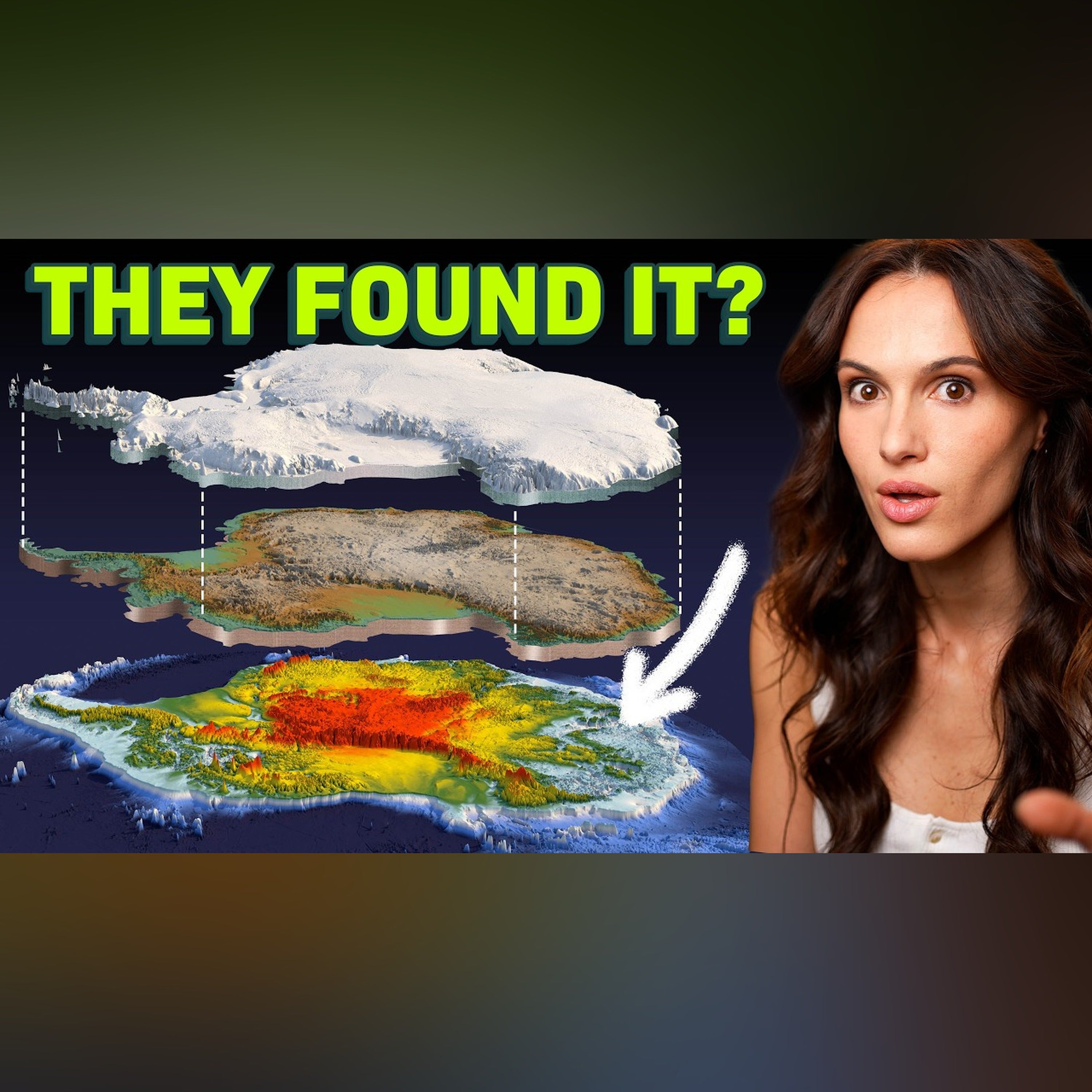
Something's hiding below the ice in Antarctica…. For optimistic science and tech stories, subscribe! In 1970, a team of Soviet scientists started drilling. For 28 years, they kept going… until after nearly 4,000 meters… they suddenly stopped. Because they’d found something unimaginable: Liquid water. A secret lake, down below all this ice, that had been completely sealed off from the rest of the world for 15 million years. How? And… is there something alive in there? Creatures that have been evolving separately from the rest of the planet for 15 million years? Scientists started searching for more of these secret lakes, and as they did, they realized there is way more going on under Antarctica than we ever thought. I needed to know the truth about Earth’s most remote continent. So I've come all the way to Antarctica to show you what's really happening down below this ice. And exactly what they discovered when they finally broke inside… Chapters: 00:00 What’s hiding under Antarctica? 01
Learn More About 80,000 Hours at: https://www.80000hours.org/spacetime PBS Member Stations rely on viewers like you. To support your local station, go to:http://to.pbs.org/DonateSPACE Sign Up on Patreon to get access to the Space Time Discord! From hoverboards to flying cars to cloud cities, anti-gravity is a staple of science fiction and our dream of a less Earth-bound future. But in the real universe gravity appears to be a purely attractive force. Feels like its main MO is keeping us stuck to the surface of this lonely rock. But maybe if we science hard enough we can remove the fiction from science fiction. For the sake of our flying cars we should at least try. And for many years, physicists have wondered whether a certain well-known exotic material may experience gravitational repulsion from the Earth. That material is antimatter, and physicists at CERN have just completed a very long and very difficult experiment to answer a seemingly simple question: does antimatter fall down, o
Eight hours of calm, slow facts about space to help you fall asleep and stay asleep. Tonight we drift through the greatest mysteries of the universe, the planets of our solar system, black holes and the Big Bang. There is nothing to remember and nothing to follow. Just a quiet voice and the night sky. Settle in, get comfortable and let the universe carry you to sleep.
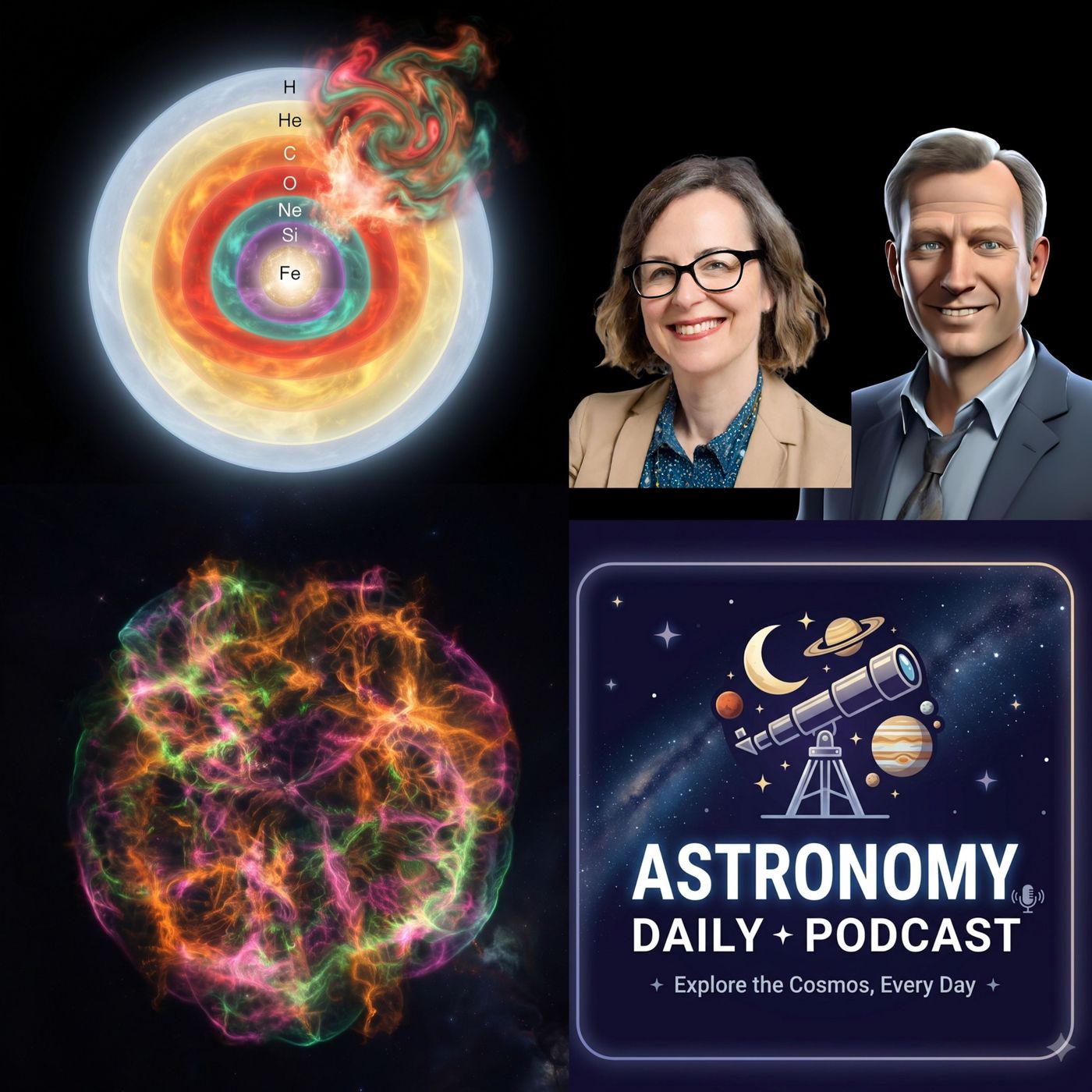
Show notes Webb has read the dust of Cassiopeia A clump by clump, and the chemistry points to the star's inner burning shells merging in its final hours. Plus the week that was, the week ahead, and Venus at its most brilliant. The Star That Rearranged Itself Webb's Mid-Infrared Instrument has resolved the dust in individual, solar-system-sized clumps of Cassiopeia A. Argon-rich debris holds silica; neon- and carbon-monoxide-rich debris holds carbon grains; the 'Green Monster' is magnesium silicate the star shed before it exploded. Only models in which the star's oxygen-burning shell merged with the carbon–neon shell above it reproduce both dust types — independent support for Chandra's 2025 evidence that the star's interior was churned up less than about three hours before collapse. Caveats: dust carries no clock, the models are one-dimensional, an alternative exists, and dust masses are lower limits. Temim, Arendt, Milisavljevic et al., ApJL 1012, published 23 Nov 2026. The Week That
To order Suicidal Empathy: https://lnk.to/SuicidalEmpathy _______________________________________ If you appreciate my work and would like to support it: _______________________________________ This clip was posted on November 28, 2026 on my YouTube channel as THE SAAD TRUTH_2136: https://youtu.be/PkFP1Kyi1ZA _______________________________________ I count on my fans to support my efforts. You can donate via Patreon, PayPal, and/or SubscribeStar. _______________________________________ Dr. In addition to his scientific work, Dr. _______________________________________
Coastal Louisiana is losing land at an unprecedented rate, and in response, scientists and policymakers have turned to massive restoration projects to slow the erosion. Good Sediment enters this charged landscape, where the promise of ecological renewal collides with the lived realities of Black coastal communities in Plaquemines Parish. At the center ofGood Sediment: Black Ecologies and the Politics of Restoration in Coastal Louisiana (https://bookshop.org/a/12343/9780295754673) (University of Washington Press, 2026) is the Mid-Barataria Sediment Diversion, the state’s most ambitious and controversial project: a $2 billion engineering feat that would redirect the Mississippi River’s mud and silt into disappearing wetlands. For policymakers, the river’s sediment is salvation. For the Parish’s multigenerational Black communities, however, this “good sediment” carries profound risks, including flooding homes and undermining fishing livelihoods. Through ethnographic research, Monica Patri
Hosted by Dr. Pamela L. Gay (@CosmoQuest (https://www.youtube.com/@CosmoQuest)) From November 21, 2026. This week we're going to look at all the new things to come out of space and astronomy. Every bit helps! Thank you! ------------------------------------ Thank you! (Haven't donated? It's not too late! Just click (http://cosmoquest.org/Donate)!) ------------------------------------
Tyco Brahe's supernova & Voyager 1's distance milestone are today's topics! H'ad astra historia is the official podcast for the Historical Astronomy Division of the American Astronomical Society. We're here to share stories from and about the people who study the stars, planets, and the cosmos. We'll be hearing from individuals who not only study the history of astronomy, but also those who lived it, who were "in the room" during pivotal events within the last 50 years or so. podcast theme music: "Frost Waltz" Kevin MacLeod (incompetech.com), licensed under creative commons: by attribution 4.0 license (http://creativecommons.org/licenses/by/4.0/) Loretta Cannon (an AAS affiliate via Rose City Astronomers) is a science-and-word-nerd who really likes outer space and the people who study it. She quite enjoys working as HAD's podcaster, sharing astronomy stories to you. Every bit helps! Thank you! ------------------------------------ Thank you! (Haven't donated? It's not too late! Just cli
Hosted by: Avivah Yamani, our Director. Today we explore the story of Galileo's telescope, how telescopes collect light, and how these instruments help astronomers explore the Universe. Every bit helps! Thank you! ------------------------------------ Thank you! (Haven't donated? It's not too late! Just click (http://cosmoquest.org/Donate)!) ------------------------------------
Waste-reduction policies should make responsible choices easy for households.
Share your view, then see how readers voted. No sign-in required. This poll is shared across stories.
Do you agree or disagree?
Common Quandary
A Common Quandary to discuss
Another conversation to explore, separate from this news story.
You are not sick—you just cannot face work today. Do you call in sick?
Your employer offers sick leave but no personal days. You are not physically ill, yet you feel exhausted and know a day away would help. Saying you are sick is the only way to take paid time off without explanation.
Do unjust workplace rules change the duty to be truthful?