Listen through the publisher, then discuss the episode here or arrange an in-person Roundtable. Your city determines where to meet.
Roundtables are designed for groups of four, with a shared subject and room for everyone to speak. Come for discussion, with no dating expectation.
We encourage you to check out It Turns Out, a podcast hosted by award-winning journalist Kara Miller that explores surprising research and the big questions behind how our world really works. We hope you enjoy it as much as we do!
Episode information is provided by the publisher. Listening takes place on the publisher’s service.
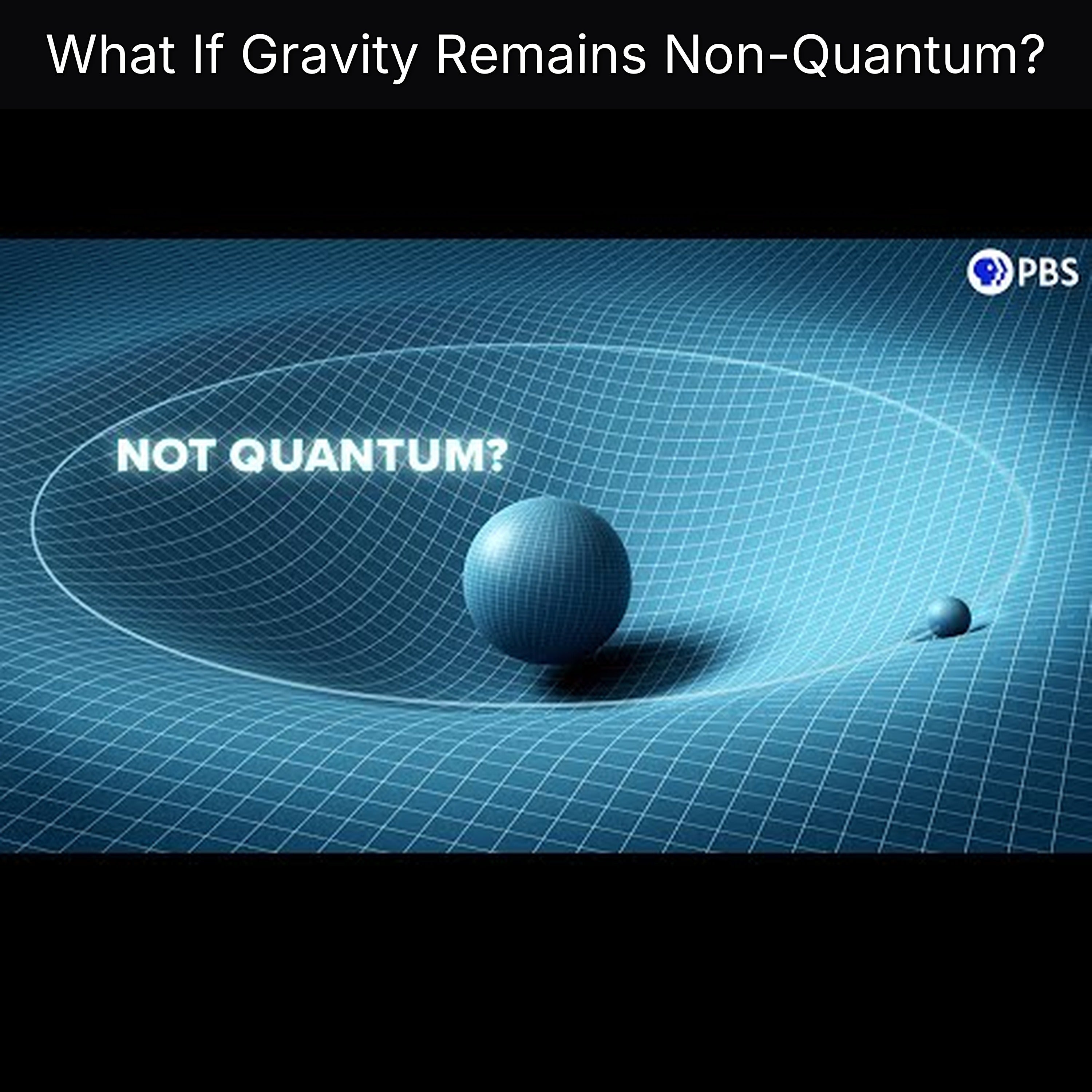
Take the PBS Annual Fan Survey: https://to.pbs.org/pbssurvey2023d PBS Member Stations rely on viewers like you. To support your local station, go to:http://to.pbs.org/DonateSPACE Sign Up on Patreon to get access to the Space Time Discord! The holy grail of theoretical physics is to come up with a quantum theory of gravity. But after a century of trying we really have no idea how close we are, or it it's even possible. But we shouldn't feel bad because it turns out that the universe is doing everything it its power to make this as difficult as possible. Or it's telling us that it isn't. Should we take the hint? Check out the Space Time Merch Store Sign up for the mailing list to get episode notifications and hear special announcements! Search the Entire Space Time Library Here: https://search.pbsspacetime.com/ Hosted by Matt O'Dowd Written by Christopher Pollack & Matt O'Dowd Post Production by Leonardo Scholzer, Yago Ballarini & Stephanie Faria Directed by Andrew Kornhaber Associate Pr
Dinosaurs were not like I thought... Check out https://groundnews.com/Cleo for a data-driven, balanced approach to staying informed. Use my link to save 50 percent on the Vantage plan and see how current events are framed from every perspective. I’m finally learning the truth about dinosaurs. I’ve loved dinosaurs since I was a kid, but it turns out a lot of what I thought I knew is wrong… or at the least outdated. So, in this video, I’m gonna show you the cutting edge of dinosaur discovery. I’ll give you rare access into a warehouse full of dinosaur bones, try to find my own fossil, and show you something new these scientists just discovered… Chapters: 00:00 What were dinosaurs really like? 01:08 Why is today a big deal for dinosaur discovery? 03:31 How big were dinosaurs, really? 05:49 When did dinosaurs actually live? 08:20 How many dinosaurs have we found? 09:26 What was the T-Rex like? 10:39 Did I find a bone?? 11:55 What IS a dinosaur? 14:31 What did dinosaur skin feel like? 15:06
In Brought to You By: How Corporations Warped the Truth, Conned the Public, and Broke Democracy (https://bookshop.org/a/12343/9781639736331), Amy Westervelt exposes the plot hidden within the familiar story of science denial. Over the last century, Big Industry has built a vast apparatus of think tanks, lobbyists, sponsored university labs, and obliging news networks to con the public and fool decision-makers, poisoning the informational ecosystem and warping the nature of truth along the way. With her signature wit and incisiveness, Westervelt introduces the masterminds of corporate misinformation: Herb Schmertz, the public relations pioneer who made Mobil “the thinking man's oil company;” Richard Edelman, the PR guy who helped the dairy industry vilify oat milk; David Petraeus, the disgraced spy chief using counter-insurgency tactics to discredit climate science; and many more. She shows how these company men have worked to usher in an era of unprecedented corporate control. Only by
I Ate 1000 Sardines in a Month, Video: https://youtu.be/_Th54GWd8WY How Sardines Supercharged my Metabolism, Letter: https://staycuriousmetabolism.substack.com/p/the-weird-anti-insulin-hormone-that?r=40ekz2 Omega-6/3 Ratio Can Be Misleading, Letter: https://staycuriousmetabolism.substack.com/p/how-we-got-omega-fat-wrong-this-will?r=40ekz2 Best Omega-3 for the Brain, Letter: https://staycuriousmetabolism.substack.com/p/why-omega-3-supplements-dont-work?r=40ekz2 If you want to get your Omega-3 via Omega Quant, click on this link: https://omegaquant.com/ref/864 Fatty Acid Research Institute: https://www.faresinst.org (https://www.faresinst.org/) Description: In this conversation, I sit down with Professor William Harris, one of the world’s leading experts on omega-3 and omega-6 fatty acids, to cut through confusion around fish oil, seed oils, cardiovascular health, and brain health. We break down what omega-3 and omega-6 fats actually are, why their chemistry matters, and how they’re conv
In this 360° animation, explore the vibrant world of neon signs and learn the science of what makes them glow. Uploaded 19-09-19 -- When the Hoover Dam was completed, it created a huge source of hydroelectric power and zapped a sleepy desert town to life: Las Vegas, Nevada. With the power supply from the dam, Las Vegas soon exploded with vibrant displays. The source of these dazzling lights was electrified neon gas. In this special 360° animation, explore the colorful world of neon signs as Lippy shares what makes them glow. -- How to view this TED-Ed animated 360° video: If you have access to a Google Cardboard viewer and a smart phone: 1. Open this video in the YouTube app on your phone. 2. Hit pause on the video. 3. Tap the 3 vertical dots on the top right corner of the view window. This will slide up a sub-menu where you will choose the quality setting of your video stream. Choose "2160s." Note that if you are not streaming over Wifi, YouTube will only allow "720s" quality. 4. Tap
☀️ HARNESSING THE POWER OF THE SUN — THE SCIENCE BEHIND C60 EVO! What happens when scientists recreate extraordinary, sun-like temperatures inside a laboratory to produce one of the most fascinating carbon molecules ever studied? Michael Jaco welcomes Patty Greer and Chris Burres back to Unleashing Intuition for a fascinating behind-the-scenes look at C60 Evo, the technology used to produce ESS60, and the science behind this unique carbon molecule. Chris takes us inside the laboratory to explain the intense temperatures, specialized production methods, and purification processes involved in creating ESS60 — C60 Evo's proprietary form of Carbon 60. The conversation explores the relationship between antioxidants, mitochondria, cellular energy, and oxidative stress, along with why C60 Evo combines ESS60 with carefully selected extra virgin olive oil. Patty and Chris also share their perspectives on wellness, personal experiences, and the growing interest in carbon-based technology. Inside
It’s Nobel Prize season here on Curiosity Weekly, and we are ready to break down the science behind this year’s winners! This episode, host Dr. Samantha Yammine digs into what research received the prize for medicine and physiology, physics, and chemistry. Joining her is neuroscientist and pain specialist Dr. Lindsay Ejoh. Together, they discuss how optogenetics has shifted how we study the brain and why it was so deserving of this year’s award. Link to Show Notes HERE (https://docs.google.com/document/d/1Xw1EvHb9D-OYMi1A8HM8c7U01G9MD-eVv1aJFFd0ge8/edit?usp=sharing) Still curious? Terms apply. Hosted on Acast.
Cases of Lyme disease have increased year by year due to climate change and expanding tick habitats. Unfortunately, this also means an increase in a condition known as post-treatment Lyme disease, where the illness persists after the initial infection is gone. Not a lot is known about post-treatment Lyme, but there is headway being made on how to treat it. To discuss his work in the field, host Dr. Samantha Yammine speaks with Dr. John Aucott, the director of the Johns Hopkins Lyme Disease Research Center. Before that, Sam looks into a study that explores a unique way of treating cancer in a hard-to-reach part of the eye. Later, she explores new research explaining why Mercury is much smaller than previously thought and why it’s still shrinking. Link to Show Notes HERE (https://docs.google.com/document/d/16JMsjmwjTEWYzffBhgSZQcZelwrLmAWlrl_LM9wJCHI/edit?usp=sharing) Still curious? Terms apply. Hosted on Acast.
For millenia, curious minds have been trying to find a universal piece of evidence that tells us someone is lying. From polygraph tests to studies examining eye contact and body language - it seems like science has come close, but decoding lies from truth remains complicated. This episode, host Dr. Samantha Yammine welcomes Dr. Leanne ten Brinke who runs the Truth and Trust Lab and specializes in research about lies and deception. Sam also responds to a listener request to explain why this years’ El Niño is set to cause intense weather across the planet and she breaks down a new study showing how neuroplasticity leads to an increased level of eyesight for those who are profoundly deaf. Link to Show Notes HERE (https://docs.google.com/document/d/1BMoQRTyUFRi4YCa0HoPPaDracVLQhzmE9p18Z7PcDc0/edit?usp=sharing) Still curious? Terms apply. Hosted on Acast.
Institutions should publicly explain how they respond to research misconduct.
Share your view, then see how readers voted. No sign-in required. This poll is shared across stories.
Do you agree or disagree?
Common Quandary
A Common Quandary to discuss
Another conversation to explore, separate from this news story.
Your teenager locks you out of their phone. When is it okay to look?
Your usually outgoing sixteen-year-old has withdrawn and stopped seeing friends. They insist they are fine and refuse to talk. You know their phone passcode and could read their messages without being discovered.
How serious must a fear be before protection outranks privacy?