Less Is Not Enough: Minimalist Desires and Postgrowth Politics with Miriam Meissner (Bloomsbury, 2026)
54 min
Listen through the publisher, then discuss the episode here or arrange an in-person Roundtable. Your city determines where to meet.
Roundtables are designed for groups of four, with a shared subject and room for everyone to speak. Come for discussion, with no dating expectation.
Less Is Not Enough: Minimalist Desires and Postgrowth Politics (https://bookshop.org/a/12343/9781350587793) (Bloomsbury, 2026) examines the rise of minimalist self-help, showing how it depoliticizes middle-class frustrations with capitalist exploitation, and proposes a cultural strategy to channel minimalist desires into a more radical, postgrowth politics. In the past decade minimalist self-help has exploded, from tidying guides to media detoxes which promise to help affluent middle classes navigate a world of excess-too much clutter, stress, and distraction. Here, Miriam Meissner exposes the limits of minimalism in addressing both middle-class overload and the environmental crisis. Through a critical analysis of self-help books, TV shows, and online communities, she argues that while minimalism is well-intended, it ultimately distracts from the root causes of the very problems it seeks to alleviate. Trends like decluttering and mindfulness depoliticize middle-class frustrations with the capitalist exploitation of labour, attention, and ecology for profit. In an era where climate justice and class struggle are inseparable, this book proposes an eco-political strategy that refuses to pit middle-class interests against the demands of a just green transition. Hosted by Simplecast, an AdsWizz company.
Episode information is provided by the publisher. Listening takes place on the publisher’s service.
We are in the ecological crisis, and not just as victims of an environmental devastation that is unequally distributed along intersecting hierarchies of class, ‘race’ and gender. We are part of the crisis because, in our society, the vast majority of us rely on work to pay for the things we need to survive. This means we also depend on the infinite growth of commodity production that defines capitalism and drives the ecological crisis. Nonetheless, workers’ insertion in capital accumulation also has an antagonistic face, rooted in their very separation from the means of production. Therefore, labour is also a crucial collective actor against the ecological crisis. In Workers and the World: Fighting Ecological Crisis from Within with Lorenzo Feltrin (https://bookshop.org/a/12343/9781804297827) (Verso Books, 2026), Lorenzo Feltrin explores the relationship between workers and nature by bringing Italian operaismo into a dialogue with a broad range of traditions, from dependency theory to
Learn More About 80,000 Hours at: https://www.80000hours.org/spacetime PBS Member Stations rely on viewers like you. To support your local station, go to:http://to.pbs.org/DonateSPACE Sign Up on Patreon to get access to the Space Time Discord! From hoverboards to flying cars to cloud cities, anti-gravity is a staple of science fiction and our dream of a less Earth-bound future. But in the real universe gravity appears to be a purely attractive force. Feels like its main MO is keeping us stuck to the surface of this lonely rock. But maybe if we science hard enough we can remove the fiction from science fiction. For the sake of our flying cars we should at least try. And for many years, physicists have wondered whether a certain well-known exotic material may experience gravitational repulsion from the Earth. That material is antimatter, and physicists at CERN have just completed a very long and very difficult experiment to answer a seemingly simple question: does antimatter fall down, o
Why is reading nonverbal behavior more practical in games like poker than in real-world, non-game situations? In this episode, originally recorded for the "No Way Out" podcast, I, Zach Elwood, talk about what my poker tells work has taught me about human behavior and decision-making. We discuss what makes some behavioral patterns surprisingly reliable, the importance of situational context, and what’s behind our intuitive reads of people. We also explore why the allure of reading people has spawned an industry of questionable and irresponsible “behavior experts,” how influential figures like Malcolm Gladwell and popular podcasters have helped spread faulty ideas about behavior, and the potential uses and limitations of AI for deception detection. We talk about the legacy of Paul Ekman, who is still perceived by many as an expert on human behavior, but who is the source of many bad ideas in this area. We also discuss what poker can teach us about navigating uncertainty, appreciating the
What do immigration, AI safety and a free press teach us about how the economy works? Justin Wolfers marks six months of Diving In with three stories about the half of an economic argument you might not see at first glance. Immigrants aren't just workers competing for jobs—they're customers helping create them. Justin examines why White House advisers lowered their monthly jobs benchmark from about 200,000 to 50,000 as immigration slowed, and what that reveals about the claim that newcomers take your job. For artificial intelligence, the question isn't only how much richer it could make you. It's whether paying more for safety is worth the cost—and how potential medical breakthroughs change that trade-off. Justin explains why powerful technology needs independent scrutiny, not just assurances from the people building it. That same logic applies to government. Research shows how independent reporting changes officials' incentives, exposes corruption and helps voters hold politicians acc
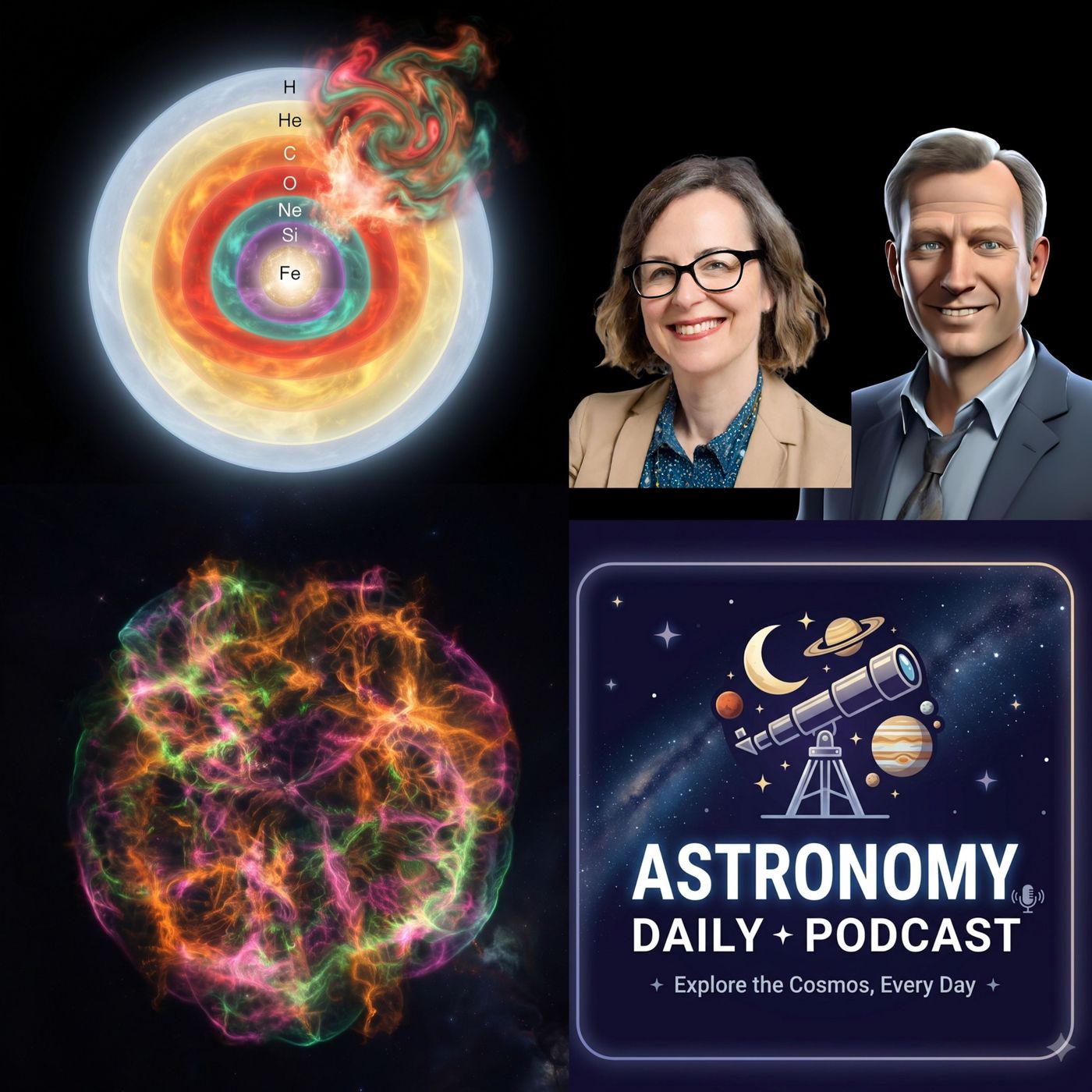
Show notes Webb has read the dust of Cassiopeia A clump by clump, and the chemistry points to the star's inner burning shells merging in its final hours. Plus the week that was, the week ahead, and Venus at its most brilliant. The Star That Rearranged Itself Webb's Mid-Infrared Instrument has resolved the dust in individual, solar-system-sized clumps of Cassiopeia A. Argon-rich debris holds silica; neon- and carbon-monoxide-rich debris holds carbon grains; the 'Green Monster' is magnesium silicate the star shed before it exploded. Only models in which the star's oxygen-burning shell merged with the carbon–neon shell above it reproduce both dust types — independent support for Chandra's 2025 evidence that the star's interior was churned up less than about three hours before collapse. Caveats: dust carries no clock, the models are one-dimensional, an alternative exists, and dust masses are lower limits. Temim, Arendt, Milisavljevic et al., ApJL 1012, published 23 Nov 2026. The Week That
Artificial wombs are coming. That's a good thing. Artificial wombs are the stuff of science fiction, the scary kind. I think of The Matrix, when Neo wakes up in the real world, covered in goo. But in recent years, researchers have taken enormous leaps in helping embryos survive and grow outside a uterus. Artificial wombs are becoming more science, less fiction. Any conversation about this topic gets heated, fast. Some people HATE the idea of an artificial womb. They feel that this technology could be used in terrible ways, like to control how people have kids or breed babies. Or that pregnancy is an important, special connection that we can never replicate with technology. Or that it’s a useless distraction, because there’s way more important stuff we should be investing in right now to make life easier for parents (parental leave, affordable childcare) and in the US at least, we don’t. But others LOVE the idea. They feel that artificial wombs could help reduce the risks of pregnancy,
Since the internet’s earliest days, people have died and mourned online. In quiet corners of past iterations of the web, the dead linger. But attempts at preserving the data of the dead are often ill-fated, for websites and devices decay and die, just as people do. Death disrupts technologists’ plans for platforms. It reveals how digital production is always collaborative, undermining the entrepreneurial platform economy and highlighting the flaws of techno-solutionism. Big Tech has authority not only over people’s lives but over their experiences of death as well. Ordinary users and workers, though, advocate for changes to tech companies’ policies around death. Drawing on internet histories along with interviews with founders of digital afterlife startups, caretakers of illness blogs, and transhumanist tinkerers, in Death Glitch: How Techno-Solutionism Fails Us in This Life and Beyond (https://bookshop.org/a/12343/9780300248272)(Yale University Press, 2023), Dr. Tamara Kneese takes re
Coastal Louisiana is losing land at an unprecedented rate, and in response, scientists and policymakers have turned to massive restoration projects to slow the erosion. Good Sediment enters this charged landscape, where the promise of ecological renewal collides with the lived realities of Black coastal communities in Plaquemines Parish. At the center ofGood Sediment: Black Ecologies and the Politics of Restoration in Coastal Louisiana (https://bookshop.org/a/12343/9780295754673) (University of Washington Press, 2026) is the Mid-Barataria Sediment Diversion, the state’s most ambitious and controversial project: a $2 billion engineering feat that would redirect the Mississippi River’s mud and silt into disappearing wetlands. For policymakers, the river’s sediment is salvation. For the Parish’s multigenerational Black communities, however, this “good sediment” carries profound risks, including flooding homes and undermining fishing livelihoods. Through ethnographic research, Monica Patri
In Gurus, Hucksters, Entertainers: How Influencers Reshaped Social Media (https://bookshop.org/a/12343/9780226830940)(University of Chicago Press, 2026), digital studies scholar Dr. Angèle Christin demystifies the content creator economy, explaining its long history and the pitfalls of its professionalization. Drawing on in-depth fieldwork with digital creators as varied as vegan YouTubers, dads of Instagram, and self-described drama commentators, Dr. Christin shows how individuals enter social media creation, how they make money, and how their online environments shape their content. Aspiring creators often dream of a better life in social media careers. Yet these dreams soon turn into exhaustion as influencers try to meet the contradictory demands of platforms, brands, and audiences. Over time, Dr. Christin shows, creators cluster into three types: hucksters, who work on behalf of brands; entertainers, who chase virality and platform payments; and gurus, who monetize the loyalty of t
Landscape restoration needs funding commitments that extend beyond normal political terms.
Share your view, then see how readers voted. No sign-in required. This poll is shared across stories.
Do you agree or disagree?
Common Quandary
A Common Quandary to discuss
Another conversation to explore, separate from this news story.
You find a rare library book your father kept for forty years. Do you return it anonymously?
While clearing your father's attic, you find a rare book stamped by the local library and due in 1986. The library would be thrilled to recover it, but returning it openly would expose a secret he apparently kept for decades—and might produce a spectacular overdue fine.
Does making an old wrong right require admitting who did it?