Paper: https://www.cell.com/cell/fulltext/S0092-8674(24)00779-7 How does stress impact gut health? New science reveals a pathway whereby an emotion regulation center in the brain, the amygdala, signals to intestinal glands in the gut that feed particular good gut bacteria to improve gut health. Stress inhibits this pathway, leading to changes in the microbiome and “tummy troubles.” These new data provide mechanistic insights into how certain stress reduction practices, including those reviewed in this video, may help to improve gut health and reduce unpleasant symptoms – bloating, diarrhea, and constipation – plagues many of us. What’s good for the mind is good for the gut, and what good for the gut is good for the brain. #guthealth #mentalhealth #anxietyrelief Chapters 0:00 – How Does Stress Impact Gut Health? 0:57 – New Paper in Cell 2:40 – Lactobacillus are Fed by Brunner’s Glands 3:29 – Vagus Nerve Controls Brunner’s Glands 4:35 – Bloating. Yikes! 5:04 – The Amygdala controls the M
On this week’s episode, Graig Suvannavejh, Tim Opler, BrianSkorney, Chris Garabedian, and Matt Gline opened with a look at the biotech market, with the XBI up roughly 17% to 18% year to date, though the group noted that AI-driven demand for capital and the possibility of an AI bubble are weighing on sentiment. The co-hosts then discussed expectations for 2027 as a significant M&A year, following conversations with pharma M&A leaders at the Jefferies Global Healthcare Conference. The group also covered the withdrawal of Heidi Overton’s FDA Commissioner nomination and what the uncertainty could mean for agency stability and volatility. Next, they discussed market rumors of a potential Sanofi acquisition of Insmed, including Brinsupri’s performance and raised guidance, and what a deal of that size could signal for the broader M&A landscape. The group also covered Lilly’s oncology deals with Stipple Bio and Calytrix, and the growing opacity of biobucks headlines and undisclosed upfront pay
Explore the science of why opioids are addictive and what can be done to reverse the growing rates of addiction and overdose. If you or someone you know is struggling with opioid use in the United States, the Department of Health and Human Services operates a helpline (800-662-4357) and has a database of treatment facilities: https://www.hhs.gov/opioids/ Uploaded 07-05-20 -- In the 1980s and 90s, pharmaceutical companies began to market opioid painkillers aggressively, while actively downplaying their addictive potential. The number of prescriptions skyrocketed, and so did cases of addiction, beginning a crisis that continues today. What makes opioids so addictive? Mike Davis explains what we can do to reverse the skyrocketing rates of addiction and overdose. Lesson by Mike Davis, directed by Good Bad Habits. Animator's website: https://www.goodbadhabits.ca/ Sign up for our newsletter: http://bit.ly/TEDEdNewsletter Support us on Patreon: http://bit.ly/TEDEdPatreon Find us on Twitter: h
Check out the Space Time Merch Store Sign Up on Patreon to get access to the Space Time Discord! Nobel laureate Roger Penrose is widely held to be one of the most brilliant living physicists for his wide-ranging work from black holes to cosmology. And then there’s his idea about how consciousness is caused by quantum processes. Most scientists have dismissed this as a cute eccentricity—a guy like Roger gets to have at least one crazy theory without being demoted from the supersmartypants club. The most common argument for this dismissal is that quantum effects can’t survive long enough in an environment as warm and chaotic as the brain. Well, a new study has revealed that Penrose’s prime candidate molecule for this quantum activity does indeed exhibit large scale quantum activity. So was Penrose right after all? Are you a quantum entity? PBS Member Stations rely on viewers like you. To support your local station, go to:http://to.pbs.org/DonateSPACE Sign up for the mailing list to get e
A kiss can be wonderful. It can create an instant connection, spark romance, or make you feel closer to someone. But a kiss can also have the opposite effect — and sometimes ruin everything. So what makes kissing so powerful, and why can one kiss make such a difference? There's some fascinating science behind it. https://www.scientificamerican.com/article/why-we-kiss/ We spend an enormous amount of time worrying about what's going to change. What's next? What's coming? How do we prepare? But what if we're paying attention to the wrong things? Some of the most important forces shaping our lives never change, and understanding them may be far more valuable than trying to predict the future — something humans are notoriously bad at. Morgan Housel, partner at The Collaborative Fund and author of Same as Ever: A Guide to What Never Changes (https://amzn.to/3SwWn6u) (https://amzn.to/3SwWn6u)), joins me to explain why the things that stay the same may be the most important things to understan
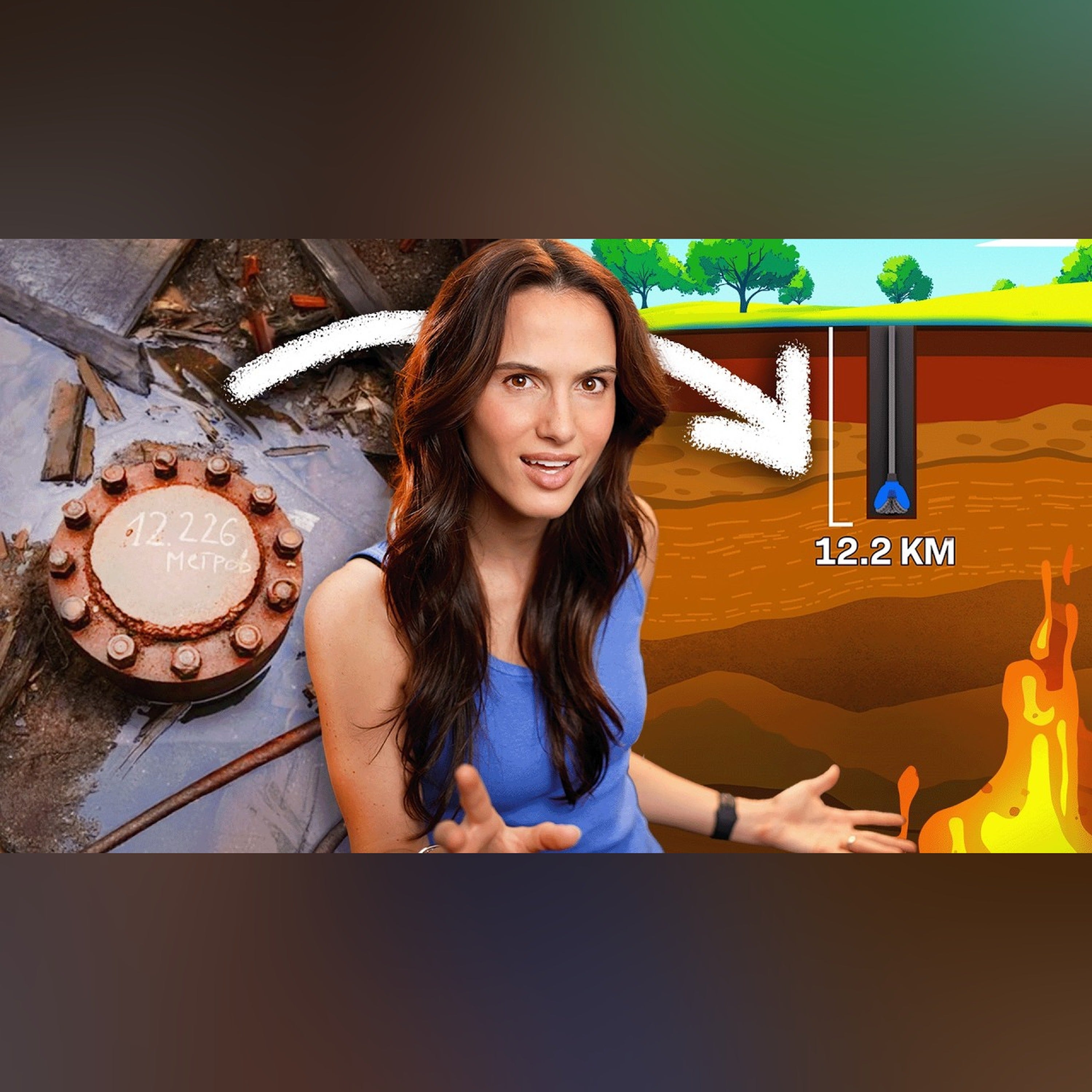
What's really down in the deep Earth? Have you ever thought, “what if I just dug a really really deep hole?” Well, the USSR actually did. The hole they dug is deeper than the deepest part of the ocean. It’s deeper than Mt. Everest is tall! They began digging it in the 1970s as part of a space race, but down. The United States only got to 600 ft before pulling funding. But the USSR kept going for 20 years. They made it about a third of the way through the Earth’s crust and then STOPPED. But what if… you just… kept... digging? If you dug a hole to the center of the Earth, what would you find? What would happen to you? And what does our newest tech tell us is REALLY down below your feet? In this video, we’re going on a journey to the center of the Earth… Chapters: 0:00 What if you dug a hole to Earth’s core? 1:05 What happens when I start digging? 1:36 What are the deepest made-made things? 2:25 What is the deepest hole humans ever dug? 3:03 What happens in the mantle? 3:45 Why is the Ear
In his weekly clinical update, Daniel Griffin and Vincent Racaniello discuss the identification of a type 1 poliovirus outbreak in Syria, the loss of US measles elimination status, use of the influenza vaccine against melanoma, death in Florida from dengue virus infection and return of the virus to the US, wider use of the Ebola ERVEBO vaccine, before Dr. Griffin deep dives into recent statistics on RSV, influenza, SARS-CoV-2 infections and measles, the FDA-approved package inserts for the RSV biologic products, and the magnitude and durability of the immune response following administration of the COVID-19 vaccine in children. Links for this episode Syrian Arab Republic (https://www.emro.who.int/media/news/syrian-arab-republic-launches-coordinated-public-health-response-following-poliovirus-detection-in-deir-ezzor.html) launches coordinated public health response following poliovirus detection in Deir Ezzor (WHO) The U.S. Has Lost (https://www.nytimes.com/2026/11/10/health/measles-uni
Vincent travels to the 8th Measles Mini Symposium at the Mayo Clinic in Rochester, MN where he meets with Paul Rota and Patrick Sinn to discuss their careers and their work on measles virus. Host: Vincent Racaniello (https://en.wikipedia.org/wiki/Vincent_Racaniello) Guests: Paul Rota and Patrick Sinn Become a patron (https://www.microbe.tv/contribute) of TWiV! Intro music is by Ronald Jenkees (http://www.ronaldjenkees.com/)
TWiV explains results of a dengue virus human challenge which reveals that preexisting immunity shapes viral replication and broadly protective responses, and how influenza virus antagonizes self-sensing by RIG-I to enhance viral replication. Hosts: Vincent Racaniello (https://en.wikipedia.org/wiki/Vincent_Racaniello), Alan Dove (http://www.alandove.com/), Kathy Spindler (https://medschool.umich.edu/profile/879/katherine-spindler), and Brianne Barker (http://bioprofbarker.com/) Subscribe (free): Apple Podcasts (https://podcasts.apple.com/us/podcast/this-week-in-virology/id1176779065), RSS (http://twiv.microbeworld.libsynpro.com/twiv), email (http://eepurl.com/Gcw59) Become a patron (https://www.microbe.tv/contribute) of TWiV! Links for this episode Support science education (https://www.microbe.tv/contribute) at MicrobeTV Democratic doctors (https://www.cidrap.umn.edu/public-health/democratic-doctors-win-big-2026-midterm-elections) win big in 2026 midterm elections (CIDRAP) Florida's d
People should always be told when they are communicating with a machine.
Share your view, then see how readers voted. No sign-in required. This poll is shared across stories.
Do you agree or disagree?
Common Quandary
A Common Quandary to discuss
Another conversation to explore, separate from this news story.
A pricey AI tutor can turn B students into A students. Should schools let them use it?
An effective AI tutor adapts to each student and dramatically improves performance, but its subscription is expensive. A public school cannot provide it to everyone and worries that allowing its use will deepen existing inequality.
Should access be limited when a beneficial tool cannot yet be shared fairly?