In Britain at the end of the nineteenth century, the new sexual sciences—from anthropological accounts of religion as rooted in ancient fertility cults to psychoanalytic theories that explained religious experience in terms of psychosexual development—characterized religion as closely connected to the sexual. The outcome, as Joy Dixon argues in Sexual Heresies: Religion, Science, and Sexuality in Modern Britain (https://bookshop.org/a/12343/9781503646681), was a new sense that religion itself could be sexually suspect. One result was an increasing concern to police "sexual heresies" to produce a supposedly normal (healthy, monogamous, and heterosexual) religiosity. The overall effect was a narrowing of the sexual possibilities inside "orthodox" religion and the association of alternative forms of religion with dissident sexualities that continues to shape both religion and secularism today. Drawing on a wide range of materials from diverse elements of British society, this book emphasi
Historians of political thought interested in partisanship have long privileged the perspective of male canonical thinkers. Scholars have turned to Thucydides and Plato for insights on stasis, Aristotle on civic friendship, Niccolò Machiavelli on tumults, David Hume and Edmund Burke on political parties, and The Federalist on faction. Even political theorists who are primarily concerned with contemporary theories of partisanship often turn to these “usual suspects” to strengthen their otherwise largely non-historical arguments. Yet this narrow focus on canonical men has led scholars to neglect an important if counterintuitive perspective on partisanship which we find in the political thought of eighteenth-century women, for whom partisanship offered an unexpected but essential means to political inclusion. Partisan Virtue: The Politics of Inclusion in Eighteenth-Century Women’s Political Thought (https://bookshop.org/a/12343/9780198989349)(Oxford UP, 2026) by Dr. Geertje Bol focuses on
Inspired by the humanist and Catholic martyr Thomas More, David Albertson and Jason Blakely imagine a new politics of hope In Thomas More's Utopia, a traveler from the New World delivers a shocking message: on a lost island beyond the horizon, people live far better lives than in Europe. A leading intellectual of his day, More was murdered by Henry VIII in 1535 for refusing to sign a loyalty oath, but his utopian vision inspired some of the most consequential movements in the modern world. In their provocative manifesto Utopia for Our Century: A Manifesto of Hope (https://bookshop.org/a/12343/9780300278088) (Yale UP, 2026), David Albertson and Jason Blakely retrieve More's insights and apply them to our moment. Amid the decline of liberalism and the rise of authoritarianism, Albertson and Blakely resist the dystopian fears taking root in the twenty-first century. Utopian politics, they argue, can help us break free of today's entrenched polarities and recast what is possible. They retu
The Trump administration has spent much of the past two years pulling federal support from clean energy. It cut wind and solar tax credits, slowed permitting on public lands and canceled major transmission corridors. But not everything is on the chopping block. Geothermal leases are being auctioned across the West, federal agencies are approving and fast-tracking some transmission lines, and advanced nuclear and critical minerals projects have strong backing in Washington. So which clean energy projects still have federal support, and what does that say about where the energy transition is headed? Guests: Caroline Spears (https://www.climateone.org/people/caroline-spears), Executive Director, Climate Cabinet Jonathan Thompson (https://www.climateone.org/people/jonathan-thompson), Journalist and author; Editor, the Land Desk Jonathan Tan (https://www.climateone.org/people/jonathan-tan), CEO, Coreshell Technologies For show notes, transcripts, and related links, visit our episode page. (
Voyager 1 has just reached a major milestone: one light-day from Earth. It’s the furthest a man-made object has ever travelled, crossing the boundary at the edge of our Solar System and venturing out into interstellar space. In this video, we explore what Voyager 1 has found so far, the discoveries it’s still making, and the hazards it faces out there in deep space. Where is it heading next?▀▀▀▀▀▀ Take your fascination for space to a new level with Black Friday offers coming to DWARFLAB. Scan the QR code or follow the link https://bit.ly/astrum_dwarflab to check the offer available in your market.▀▀▀▀▀▀ The Astrum book is still available in the US!
Build your dream business for today for Free https://shopify.pxf.io/gONBP0 "Straight lines on a logarithmic scale"―All evidence points to an intelligence explosion Spreading awareness about the works of some of the leading educators in the AI revolution. Core Ideas: Metamodernism: Narratives and emergence view of reality - Reduce suffering - Increase prosperity - Increase understanding mantra: Seek knowledge. DISCLAIMER: This is a community-driven show.
Sign up for new Bing AI in less than 60 seconds Episode release date: 10 Feb 2023 Core Ideas: Metamodernism: Narratives and emergence view of reality - Reduce suffering - Increase prosperity - Increase understanding mantra: Seek knowledge. DISCLAIMER: This is a community-driven show. ---------------------- -------- Keywords: ai research, ai agents, machine autonomy, post labor economics, ai development, artificial intelligence
Why do we fill pauses in speech with words like “um,” “uh,” and “like”? Dig into the hesitation phenomenon to find out their linguistic significance. Uploaded 18-02-21 -- For as long as we’ve had language, some people have tried to control it. And some of the most frequent targets of this communication regulation are the ums, ers, and likes that pepper our conversations. These linguistic fillers occur roughly 2 to 3 times per minute in natural speech. So are ums and uhs just a habit we can’t break? Or is there more to them? Lorenzo García-Amaya investigates. Lesson by Lorenzo García-Amaya, directed by Yael Reisfeld. Support Our Non-Profit Mission ---------------------------------------------- Support us on Patreon: http://bit.ly/TEDEdPatreon Check out our merch: http://bit.ly/TEDEDShop ---------------------------------------------- Connect With Us ---------------------------------------------- Sign up for our newsletter: http://bit.ly/TEDEdNewsletter Find us on Twitter: http://bit.ly/T
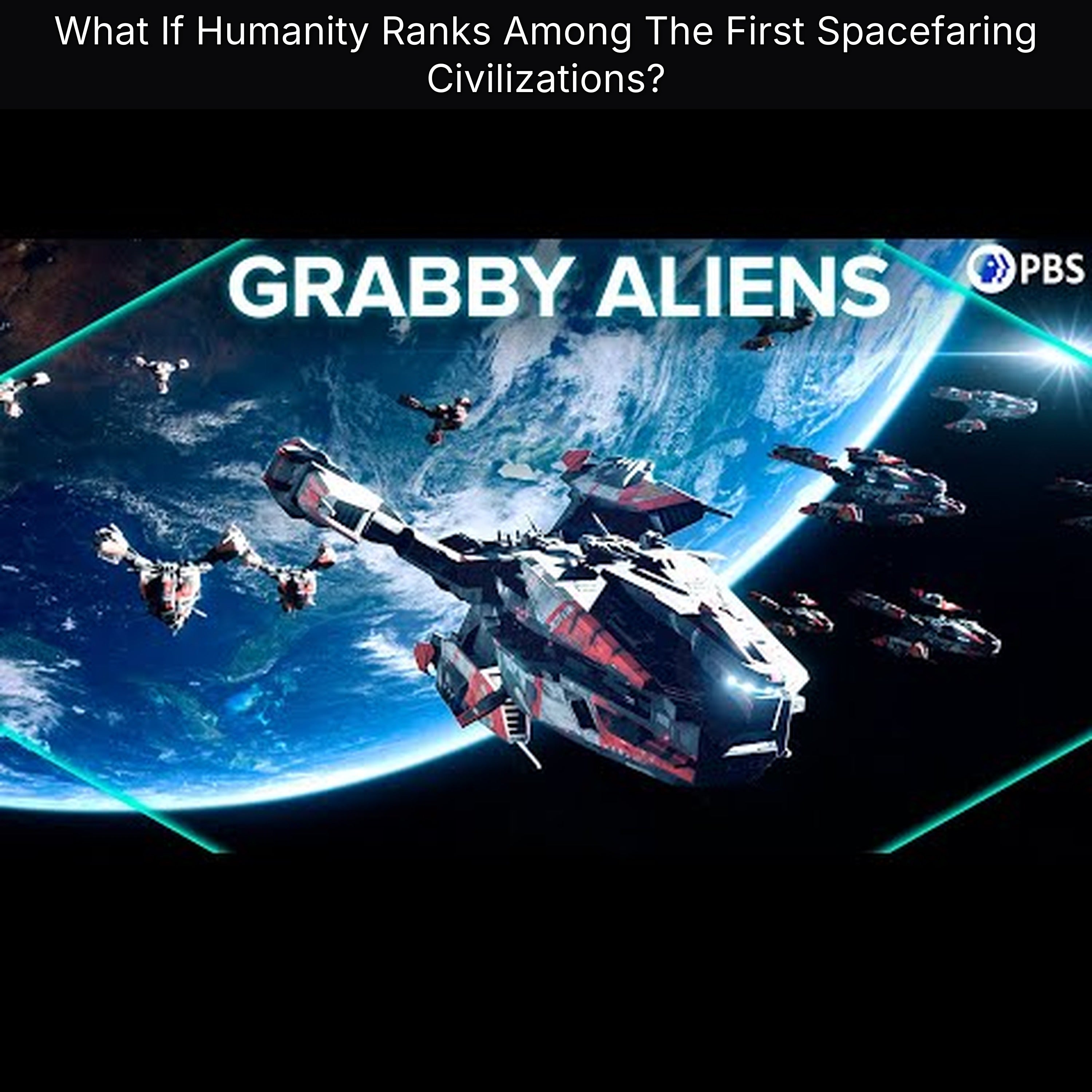
Thank you to Squarespace for supporting PBS. PBS Member Stations rely on viewers like you. To support your local station, go to:http://to.pbs.org/DonateSPACE Sign Up on Patreon to get access to the Space Time Discord! Half of the universe is filled with expansionist alien civilizations, and it’s only a matter of time before they’ll reach us. OK, that sounded a little sensationalist. But it’s also the conclusion of a recent astrophysics paper. Let’s see how they figure this, and whether we should take it seriously. Check out the Space Time Merch Store Sign up for the mailing list to get episode notifications and hear special announcements! Search the Entire Space Time Library Here: https://search.pbsspacetime.com/ Hosted by Matt O'Dowd Written by Euan McLean & Matt O'Dowd Post Production by Leonardo Scholzer, Yago Ballarini, Pedro Osinski, Caique Oliveira, Adriano Leal & Stephanie Faria Directed by Andrew Kornhaber Associate Producer: Bahar Gholipour Executive Producers: Eric Brown & An
View full lesson: http://ed.ted.com/lessons/why-tragedies-are-alluring-david-e-rivas Uploaded 09-07-15 The story goes something like this: A royal, rich, or righteous individual — who is otherwise a lot like us — makes a mistake that sends his or her life spiraling into ruin. It's the classic story arc for a Greek tragedy, and we love it so much that we continue to use it today. David E. Rivas shares three critical story components, influenced by Aristotle’s “Poetics,” to help illustrate the allure. Lesson by David E. Rivas, animation by Globizco.
Explore the classic poem, “Beowulf,” which follows a heroic prince as he fights to free a kingdom from the monster Grendel. -- An epic written in Old English, “Beowulf” is known for its haunting monsters, dream-like language, and paranoid perspective, where violent threats are always waiting on the fringes of society. The action follows Beowulf, a prince of Geats, who travels to aid a kingdom in freeing itself from a monster’s reign of terror. Why is this poem considered a classic? Iseult Gillespie traces the hero’s tale. Lesson by Iseult Gillespie, directed by Raghav Arumugam, Jagriti Khirwar. Support Our Non-Profit Mission ---------------------------------------------- Support us on Patreon: http://bit.ly/TEDEdPatreon Check out our merch: http://bit.ly/TEDEDShop ---------------------------------------------- Connect With Us ---------------------------------------------- Sign up for our newsletter: http://bit.ly/TEDEdNewsletter Find us on Twitter: http://bit.ly/TEDEdTwitter Peep us on
Viewers like you help make PBS (Thank you ) . Support your local PBS Member Station here: https://to.pbs.org/DonateSPACE Uploaded 16-05-18 To learn more about Brilliant, you can go to https://brilliant.org/spacetime/ Conservation laws are among the most important tools in physics. They feel as fundamental as you can get. And yet they’re wrong - or at least they’re only right sometimes. These laws are consequences of a much deeper, more fundamental principle: Noether’s theorem. You can further support us on Patreon at https://www.patreon.com/pbsspacetime Get your own Space Time t-shirt at http://bit.ly/1QlzoBi Tweet at us! @pbsspacetime Facebook: facebook.com/pbsspacetime Email us! pbsspacetime [at] gmail [dot] com Comment on Reddit: http://www.reddit.com/r/pbsspacetime Help translate our videos! Previous Episode: How Gaia Changed Astronomy Forever Conservation laws are the cheat codes of physics. They make it possible to solve physics problems that would otherwise be painfully difficu
Dig into two testing techniques for viruses: PCR tests to diagnose an infection and immunoassays to detect antibodies. Uploaded 18-05-20 -- A new virus emerges and spreads like wildfire. In order to contain it, researchers must first collect data about who’s been infected. Two main viral testing techniques are critical: one tells you if you have the virus and the other shows if you’ve already had it. So, how exactly do these tests work? Cella Wright explores the science of PCR tests and immunoassays. Lesson by Cella Wright, directed by Hype CG. Animator's website: https://www.hype.cg/ and https://www.luisacopetti.com/ Sign up for our newsletter: http://bit.ly/TEDEdNewsletter Support us on Patreon: http://bit.ly/TEDEdPatreon Find us on Twitter: http://bit.ly/TEDEdTwitter Peep us on Instagram: http://bit.ly/TEDEdInstagram View full lesson: https://ed.ted.com/lessons/how-do-virus-tests-actually-work-cella-wright Thank you so much to our patrons for your support! Without you this video wou
PBS Member Stations rely on viewers like you. To support your local station, go to: http://to.pbs.org/DonateSPACE ↓ More info below ↓ Uploaded 14-11-18 With the large hadron collider running out of places to look for clues to a deeper theory of physics, we need a bigger particle accelerator. We have one - the galaxy. Watch Two Cents here! You can further support us on Patreon at https://www.patreon.com/pbsspacetime Get your own Space Time t-shirt at http://bit.ly/1QlzoBi Tweet at us! @pbsspacetime Facebook: facebook.com/pbsspacetime Email us! pbsspacetime [at] gmail [dot] com Comment on Reddit: http://www.reddit.com/r/pbsspacetime Physics is currently in a weird place. Historically, no matter how crazy our theories got, there were always new ways to test them. Your theory predicts a new particle? Build a particle accelerator big enough to see it. But once your collider spans entire countries – like the Large Hadron Collider in Switzerland – there’s only so much larger you can go - at
I trained a DALLE chatbot to help you craft DALLE prompts! Episode release date: 18 Jul 2022 Core Ideas: Metamodernism: Narratives and emergence view of reality - Reduce suffering - Increase prosperity - Increase understanding mantra: Seek knowledge. DISCLAIMER: This is a community-driven show. ---- Keywords: ai safety, ai agents, artificial general intelligence, ai future, ai philosophy
Delayed edition for Thursday, November 19, 2026. Celldex says it is ending barzolvolimab development in atopic dermatitis after its Phase 2 trial missed the primary itch endpoint. Revolution Medicines reports single-arm data for Rasonque (daraxonrasib) plus chemotherapy in first-line metastatic pancreatic cancer; a separate randomized study is designed to show what the drug adds. The roundup covers Pyxis Oncology’s Phase 1 micvotabart pelidotin data in head and neck cancer, the AbbVie–DISCO oncology discovery deal and Recursion’s proposed REC-4881 trial in familial adenomatous polyposis. Johnson & Johnson files to expand Caplyta (lumateperone) to manic or mixed episodes in bipolar I disorder, Novartis raises three peak sales forecasts, and a US biotech commission assesses China’s pharma competitiveness. Alex Mercer and Maya Patel host. Get the daily rundown in your inbox — subscribe at thepharmacloseout.com (https://thepharmacloseout.com/).
View full lesson: http://ed.ted.com/lessons/the-true-story-of-true-gina-cooke Uploaded 16-12-13 The older the word, the longer (and more fascinating) the story. With roots in Old English, 'true' shares etymological ancestors with words like betroth and truce...but also with the word tree. In fact, trees have been metaphors for steadfastness and faithfulness for as long as the word true has defined the same qualities. Gina Cooke describes the poetic relationship between 'tree' and 'true.' Lesson by Gina Cooke, animation by Brad Purnell.
Viewers like you help make PBS (Thank you ) . Support your local PBS Member Station here: https://to.pbs.org/DonateSPACE Uploaded 21-12-16 Are aliens watching Earth TV? We'd like to credit the SKA Organization for the image used in the thumbnail. Support us on Patreon! https://www.patreon.com/pbsspacetime Get your own Space Time tshirt at http://bit.ly/1QlzoBi Tweet at us! @pbsspacetime Facebook: facebook.com/pbsspacetime Email us! pbsspacetime [at] gmail [dot] com Comment on Reddit: http://www.reddit.com/r/pbsspacetime Help tranlate our videos! https://www.youtube.com/timedtext_cs_panel?tab=2&c=UC7_gcs09iThXybpVgjHZ_7g (https://www.youtube.com/timedtext_cs_panel?c=UC7_gcs09iThXybpVgjHZ_7g&tab=2) Sources and further reading: The Square Kilometer Array Eavesdropping on Radio Broadcasts from Galactic Civilizations with Upcoming Observatories for Redshifted 21cm Radiation Loeb and Zaldarriaga 2007, Journal of Cosmology and Astroparticle Physics, 1, 20 Costs and Difficulties of Large-Scal
For references and a written breakdown, see the associated newsletter: https://staycuriousmetabolism.substack.com/p/weve-been-prescribing-statins-wrong?r=40ekz2 For a consolidated resource on prior StayCurious Heart Health Content, check out our Heart Health Map! https://open.substack.com/pub/staycuriousmetabolism/p/the-intricate-metabolic-web-of-heart?r=40ekz2&utm_campaign=post&utm_medium=web&showWelcomeOnShare=true (https://open.substack.com/pub/staycuriousmetabolism/p/the-intricate-metabolic-web-of-heart?r=40ekz2&showWelcomeOnShare=true) Statins are among the most prescribed and profitable drugs in the world, but new research is forcing us to rethink what they actually do — and for whom. In this video, Dr. Nick Norwitz MD PhD breaks down the latest data showing that statins only reduce cardiovascular risk in people with existing heart disease, while showing little or no benefit for those without. Nick walks through, not one, but 4 major studies and explains why LDL cholesterol and A
SpaceX Daily Orbital AI satellites launching on New Glenn in 2029 will test whether solar arrays can sustain rack-scale TPU workloads without terrestrial grid ties. Top News Google selects New Glenn for first dedicated Project Suncatcher launch Google booked Blue Origin’s New Glenn rocket for the first heavy-lift launch under Project Suncatcher, scheduled for the first quarter of 2029. ... Sources: silicon.co.uk (https://www.silicon.co.uk/cloud/ai/google-blue-origin-ai-632448) · teslanorth.com (https://teslanorth.com/2026/11/19/google-blue-origin-suncatcher-launch/) · ft.com (https://www.ft.com/content/33b5643c-2957-4d42-9116-5e34a3c54e29?syn-25a6b1a6=1) · ksby.com (https://www.ksby.com/news/launch-tracker/spacex-targets-thursday-night-for-falcon-9-rocket-launch) · spaceflightnow.com (https://spaceflightnow.com/2026/11/19/live-coverage-spacex-to-launch-classified-payload-for-the-u-s-space-force-2/) · t.co (https://t.co/ALNcWBQinC) · nasaspaceflight.com (https://www.nasaspaceflight.com/
Northern Cardinals are known for their iconic red feathers, yet that scarlet hue is actually derived from yellow pigments in their food. Most cardinals’ bodies transform those yellow pigments into their signature shade of red, but some lack this ability — resulting in a bright yellow bird. House Finches, Red-bellied Woodpeckers, and other notably red species can also develop an unexpectedly golden complexion. So keep an eye out for all the shades of variation in well-known birds. More info and transcript at BirdNote.org (https://www.birdnote.org/podcasts/birdnote-daily/bright-yellow-northern-cardinals). Want more BirdNote? BirdNote is a nonprofit. Hosted by Simplecast, an AdsWizz company.
You’re worried your sister-in-law’s weight loss has gone too far. Is it your place to say something, and if so, how? Welcome to Feedback Friday! And in case you didn't already know it, Jordan Harbinger (@JordanHarbinger (https://twitter.com/JordanHarbinger)) and Gabriel Mizrahi (@GabeMizrahi (https://twitter.com/GabeMizrahi)) banter and take your comments and questions for Feedback Friday right here every week! If you want us to answer your question, register your feedback, or tell your story on one of our upcoming weekly Feedback Friday episodes, drop us a line at [email protected]. Now let's dive in! Full show notes and resources can be found here: jordanharbinger.com/1417 (https://jordanharbinger.com/1417) On This Week's Feedback Friday: Your sister-in-law started a weight loss journey with strength training, macros, and a brief stint on a GLP-1. A year later, she’s still shrinking — and looking frail rather than fit. Knowing her past struggles with food, you want to help w
Are we heading towards war in outer space? The increased crowding of orbit and the development of anti-satellite and space based weapons systems could be putting the world’s superpowers on a collision course beyond earth’s atmosphere. This week on Giant Leap we explore the potential dangers of, and ways we might prevent, conflict in outer space. With guest astrophysicist Jonathan McDowell. Featuring: Jonathan McDowell Taylor Wilson Joey Lovato Hosted on Acast.
The shape, contents and future of the universe are all intricately related. We know that it's mostly flat; we know that it's made up of baryonic matter (like stars and planets), but mostly dark matter and dark energy; and we know that it's expanding constantly, so that all stars will eventually burn out into a cold nothingness. But is there any beauty in this dark ending? Uploaded 12-12-13 Animation by Giant Animation Studios.