Listen through the publisher, then discuss the episode here or arrange an in-person Roundtable. Your city determines where to meet.
Roundtables are designed for groups of four, with a shared subject and room for everyone to speak. Come for discussion, with no dating expectation.
Journalist and filmmaker Hannes Sarv discusses his documentary No Boiling Planet, inspired by UN Secretary General António Guterres’s “global boiling” remark, and says his interviews with scientists (including William Happer, Richard Lindzen, and Judith Curry) found no evidence of a climate crisis. He argues media coverage is biased and labels dissenting scientists as “deniers,” and says the film’s second half critiques net-zero energy policies, citing experts Lars Schernikau and former EU official Samuel Furfari on why wind, solar, and batteries are costly and impractical. Sarv also links climate politics to broader concerns about socialism, censorship, and digital surveillance, noting freer speech conditions in Estonia than in parts of Europe. 00:00 Meet Hannes Sarv 00:25 Why No Boiling Planet 01:54 Hunting for Evidence 03:47 Media Bias and Deniers 05:02 Energy Policy Reality Check 11:21 Film Experts and Highlights 15:14 From Skeptic to Investigator 19:20 CO2 and Climate Education 23:04 Pushback Politics and Socialism 28:38 Freedom Versus Mandates 34:21 Digital Dystopia Surveillance 41:29 Free Speech Voices to Follow 45:50 Estonia UK and Online Censorship 50:59 Funding Freedom Research 52:06 Final Thoughts on Freedom No Boiling Planet – A ClimatJe of False Alarm | Full Documentary: https://youtu.be/ktDqDAskd9c X: https://x.com/freedom_rsrch Linktree: https://linktr.ee/freedomresearch ========= My Linktree: https://linktr.ee/tomanelson1
Episode information is provided by the publisher. Listening takes place on the publisher’s service.
Less Is Not Enough: Minimalist Desires and Postgrowth Politics (https://bookshop.org/a/12343/9781350587793) (Bloomsbury, 2026) examines the rise of minimalist self-help, showing how it depoliticizes middle-class frustrations with capitalist exploitation, and proposes a cultural strategy to channel minimalist desires into a more radical, postgrowth politics. In the past decade minimalist self-help has exploded, from tidying guides to media detoxes which promise to help affluent middle classes navigate a world of excess-too much clutter, stress, and distraction. Here, Miriam Meissner exposes the limits of minimalism in addressing both middle-class overload and the environmental crisis. Through a critical analysis of self-help books, TV shows, and online communities, she argues that while minimalism is well-intended, it ultimately distracts from the root causes of the very problems it seeks to alleviate. Trends like decluttering and mindfulness depoliticize middle-class frustrations with
Check Out All PBS Earth Episodes: https://www.youtube.com/playlist?list=PLnNZYWyBGJ1F8ofFm4H9UTrHxqU8zngK4 Planet Earth is the jewel of the solar system—the shimmery blue oceans, the verdant green forests, the wispy whimsical cloud formations. Saturn is the only competitor for most gorgeous planet with that giant ring system. Hmm… what if we could put the jewel of the Earth in its own ring? Then no contest. Well, there’s an extremely good chance that Earth once DID have a ring system. At least, that’s the proposal by a recent study that has evidence that a mysterious burst in meteor activity nearly half a billion years ago was actually caused by that ancient ring system collapsing onto the Earth. And, you know, if we had a ring once maybe we can have one again. Check Out Joe Scott’s: What Would Happen If The Earth Had Rings? Sign Up on Patreon to get access to this Month’s Livestream Interview with Dr. Matt Caplan! Check out the Space Time Merch Store Sign up for the mailing list to ge
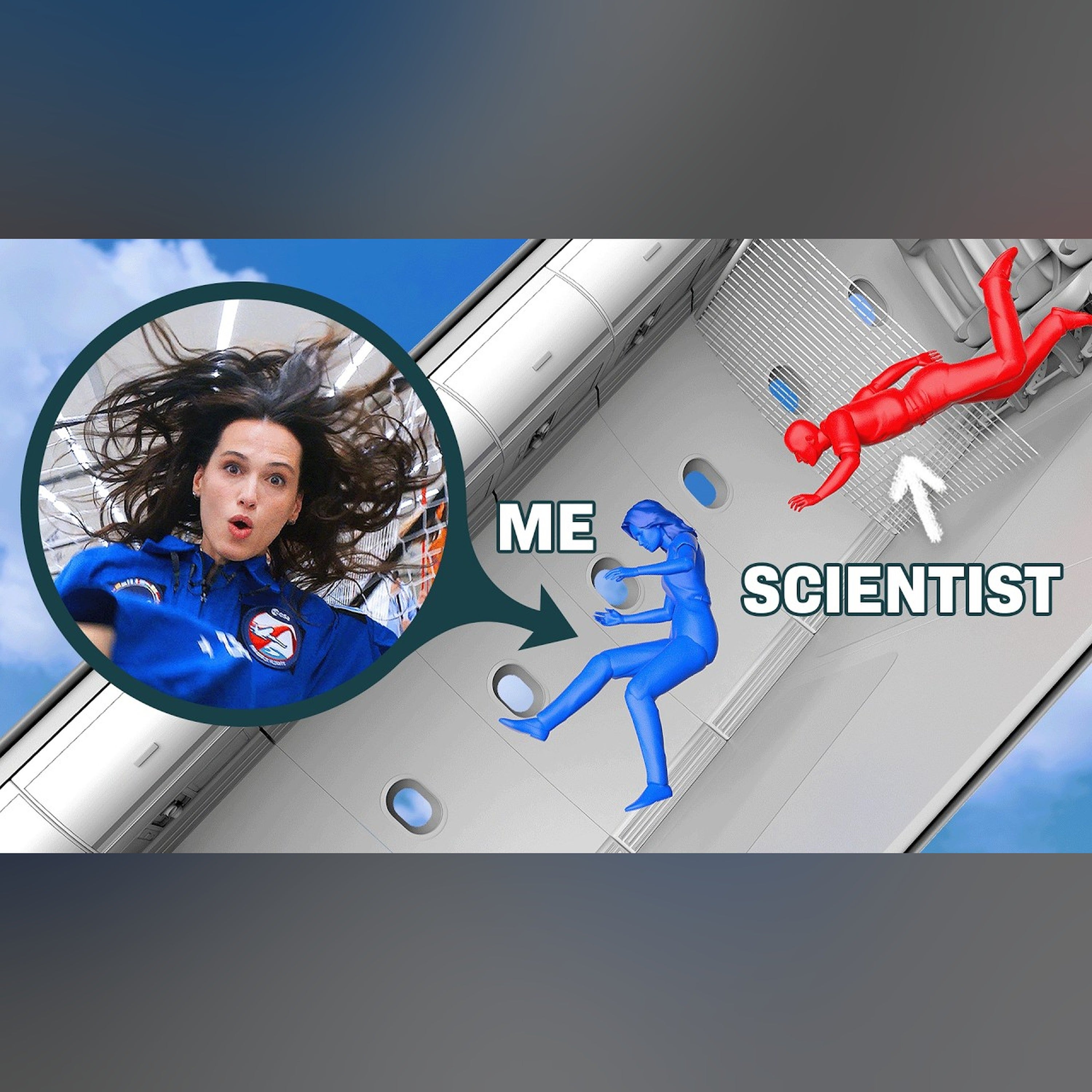
I tested 5 wild experiments in a zero gravity plane... Listen with me on Audible at https://www.audible.com/cleo I'm scanning my brain inside a plane that’s about to DIVE toward the ground… to test how weightlessness helps or hurts your brain. And it’s just one of the 5 crazy science experiments I got to test inside a Zero G plane. I recently went on this Zero G plane to explain a big debate about gravity, and while I was there, I also got exclusive access to experiments that can ONLY happen in zero gravity. I just knew you’d love to see it. So, in this extended cut, I’m going to give you a rare glimpse inside this falling laboratory and show you how the experiments they’re doing could be huge if true… Chapters: 0:00 What happens to your brain in space? 0:32 Why scientists want to fall from the sky 1:10 How do zero gravity planes work? 1:56 Experiment 1 3:58 Experiment 2 5:28 Experiment 3 7:23 Experiment 4 8:50 Experiment 5 10:27 Why these experiments are huge if true You can find me o
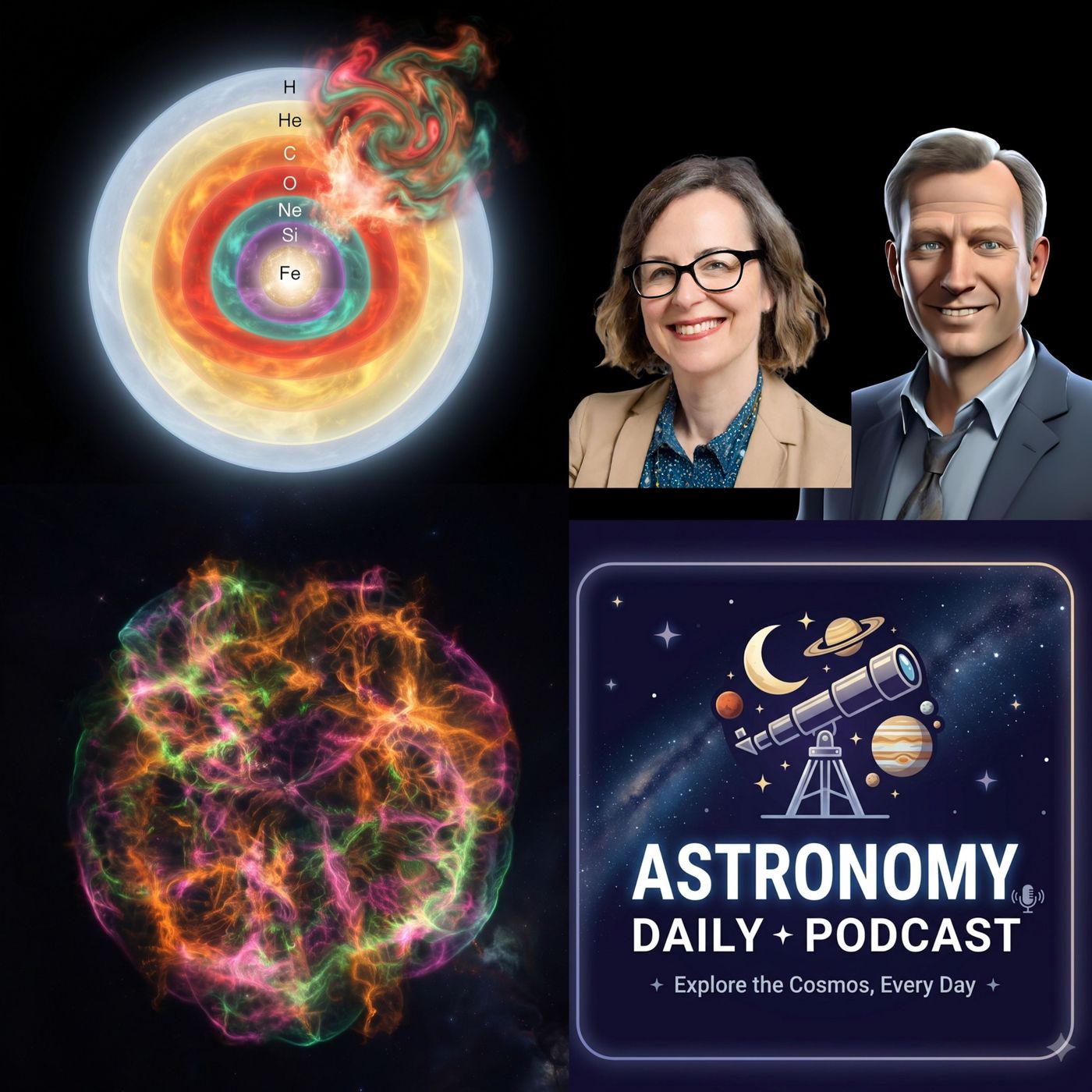
Show notes Webb has read the dust of Cassiopeia A clump by clump, and the chemistry points to the star's inner burning shells merging in its final hours. Plus the week that was, the week ahead, and Venus at its most brilliant. The Star That Rearranged Itself Webb's Mid-Infrared Instrument has resolved the dust in individual, solar-system-sized clumps of Cassiopeia A. Argon-rich debris holds silica; neon- and carbon-monoxide-rich debris holds carbon grains; the 'Green Monster' is magnesium silicate the star shed before it exploded. Only models in which the star's oxygen-burning shell merged with the carbon–neon shell above it reproduce both dust types — independent support for Chandra's 2025 evidence that the star's interior was churned up less than about three hours before collapse. Caveats: dust carries no clock, the models are one-dimensional, an alternative exists, and dust masses are lower limits. Temim, Arendt, Milisavljevic et al., ApJL 1012, published 23 Nov 2026. The Week That
What do immigration, AI safety and a free press teach us about how the economy works? Justin Wolfers marks six months of Diving In with three stories about the half of an economic argument you might not see at first glance. Immigrants aren't just workers competing for jobs—they're customers helping create them. Justin examines why White House advisers lowered their monthly jobs benchmark from about 200,000 to 50,000 as immigration slowed, and what that reveals about the claim that newcomers take your job. For artificial intelligence, the question isn't only how much richer it could make you. It's whether paying more for safety is worth the cost—and how potential medical breakthroughs change that trade-off. Justin explains why powerful technology needs independent scrutiny, not just assurances from the people building it. That same logic applies to government. Research shows how independent reporting changes officials' incentives, exposes corruption and helps voters hold politicians acc
DeepMind, OpenAI, Microsoft, Oxford: Global AI Research & Regulation is Coming Episode release date: 12 Jul 2023 Core Ideas: Metamodernism: Narratives and emergence view of reality - Reduce suffering - Increase prosperity - Increase understanding mantra: Seek knowledge. DISCLAIMER: This is a community-driven show. ------ Keywords: ai agents, ai education, cognitive ai, tech singularity, machine learning, openai, ai consciousness
Ed Hoskins recounts his engineering/software background and says his interest in climate grew after a London air-pollution paper angered greens. He argues climate change is a hoax, claiming CO2’s warming effect diminishes logarithmically and is near saturation, with water vapor dominating; he cites IPCC technical chapters, William Happer, Richard Lindzen, and disputes methane and nitrous oxide impacts. He stresses plants need ~150 ppm CO2, notes global “greening” and higher crop yields, and highlights small Holocene temperature variation, solar-cycle risks of cooling, and critiques the hockey stick. He condemns COP, renewables’ cost/unreliability, Germany’s nuclear exit, and frames green policy as economic self-harm. 00:00 Meet Ed Hoskins 00:27 Career and Tech Background 02:10 Why He Questioned Climate Claims 04:18 CO2 Saturation Key Graph 06:27 IPCC Omits Diminishing Returns 07:36 Happer Chart Explained 09:37 Other Greenhouse Gases Context 11:21 CO2 Levels and Plant Survival 14:21 Wat
Tom interviews Chris Morrison about his October-released book Implausible, which argues that mainstream climate, politics, and media narratives over the past 15 years relied heavily on the IPCC’s RCP8.5 “worst case” pathway, later deemed implausible, producing sensational claims such as Gulf Stream collapse and coral reef extinction. Morrison says the issue is political, tied to promoting net zero, and criticizes figures like David Attenborough and institutions like the BBC for amplifying fear without debate, citing Ofcom-related complaint pressures. He discusses organized activist funding, including groups like the Good Law Project and DeSmog, and warns about UK policy efforts to drastically cut hydrocarbons. Morrison also raises concerns about Met Office temperature measurement methods, renewable-grid instability, and potential winter blackouts, and invites public debate on the science and net zero. 00:00 Meet Chris Morrison 00:47 What Implausible Argues 02:10 RCP8.5 Implausibility D
Host Tom interviews Peter Ridd about the Great Barrier Reef, coral bleaching, global coral statistics, and ocean acidification. Ridd describes the reef’s size, protection, and natural variability from cyclones, starfish plagues, and sea-level change. Using Australian Institute of Marine Science data he compiles, he says coral cover hit lows around 2012 but reached record levels in 2022–2024 despite reported bleaching events; he argues scientists now call it “wrong” coral (Acropora) and cites a 2018 Nature letter predicting catastrophic, permanent change. He alleges global and Great Barrier Reef datasets were adjusted to look worse and calls for science audits. On acidification, he says corals use bicarbonate, which increases with CO2, and can regulate pH, making projected pH changes benign. 00:00 Reef Talk Preview 00:43 Where The Reef Is 01:38 Reef Scale And Protection 02:13 How Reefs Form 03:59 Coral Cover Trends 06:21 Bleaching Explained 09:03 Wrong Coral Claim 10:39 Doom Quotes Chal
Health technologies should demonstrate better patient outcomes before widespread adoption.
Share your view, then see how readers voted. No sign-in required. This poll is shared across stories.
Do you agree or disagree?
Common Quandary
A Common Quandary to discuss
Another conversation to explore, separate from this news story.
You make a hilarious deepfake of a friend for their birthday. Must you ask first?
For a private birthday party, someone creates a convincing video of a mutual friend delivering an absurd speech. Everyone, including the subject, will immediately understand that it is fake.
Does obvious fiction eliminate the need for consent?