View full lesson: http://ed.ted.com/lessons/why-do-we-have-to-wear-sunscreen-kevin-p-boyd Uploaded 06-08-13 You already know that a trip to the beach can give you a nasty sunburn, but the nitty gritty of sun safety is actually much more complex. Wrinkle-causing UVA rays and burn-inducing UVB's can pose a serious risk to your health (and good looks). So what can you do? Kevin P. Boyd makes the case to slap on some physical or chemical SPF daily. Lesson by Kevin P. Boyd, animation by Andrew Foerster.
PBS Member Stations rely on viewers like you. To support your local station, go to: http://to.pbs.org/DonateSPACE ↓ More info below ↓ Uploaded 16-01-19 Check out the new Space Time Merch Store! Support Space Time on Patreon The foundations of quantum theory rests on its symmetries. For example, it should be impossible to distinguish our universe from one that is that is the perfect mirror opposite in charge, handedness, and the direction of time. But one by one these symmetries were found to be broken, threatening to break all of physics along with them. Tweet at us! @pbsspacetime Facebook: facebook.com/pbsspacetime Email us! pbsspacetime [at] gmail [dot] com Comment on Reddit: http://www.reddit.com/r/pbsspacetime Help translate our videos! Previous Episode: Why String Theory Is Wrong Hosted by Matt O'Dowd Written by Graeme Gossel and Matt O'Dowd Graphics by Luke Maroldi Assistant Editing and Sound Design by Linda Huang In his famous lectures on physics, Richard Feynman talks about wha
As a top spy trained in infiltration and safecracking, it’s up to you to steal the competition’s secret sauce recipe. Can you figure out where it's hidden? Uploaded 16-09-19 -- One of the top chefs from Pasta Palace has been kidnapped by operatives from Burger Bazaar hoping to learn the location of their secret sauce recipe. Little do they know that a third party— Sausage Saloon— has sent you, their top spy, to take advantage of the situation. Can you figure out the location of the secret recipe and steal it for yourself? Alex Gendler shows how. Lesson by Alex Gendler, directed by Artrake Studio. This riddle is adapted from a puzzle that originally appeared in Puzzles for Pleasure, by E.R. Emmet. Sign up for our newsletter: http://bit.ly/TEDEdNewsletter Support us on Patreon: http://bit.ly/TEDEdPatreon Find us on Twitter: http://bit.ly/TEDEdTwitter Peep us on Instagram: http://bit.ly/TEDEdInstagram View full lesson: https://ed.ted.com/lessons/can-you-solve-the-secret-sauce-riddle-alex-
Thank you to Brilliant for Supporting PBS. To learn more go to https://brilliant.org/SpaceTime/ PBS Member Stations rely on viewers like you. To support your local station, go to:http://to.pbs.org/DonateSPACE Sign Up on Patreon to get access to the Space Time Discord! There’s an absolute limit to our access to the universe beyond our own galaxy. There’s a limit to what we can ever hope to explore or send signals to, and a very different limit to what we can ever hope to witness. Today we’re going to explore the latter. We’re going to figure out the absolute limit of our future view of the universe, and of the universe’s ability to influence us. Next time we’ll turn it around and ask: how much of the external universe can WE potentially influence, and even explore? Check out the Space Time Merch Store Sign up for the mailing list to get episode notifications and hear special announcements! Search the Entire Space Time Library Here: https://search.pbsspacetime.com/ Hosted by Matt O'Dowd
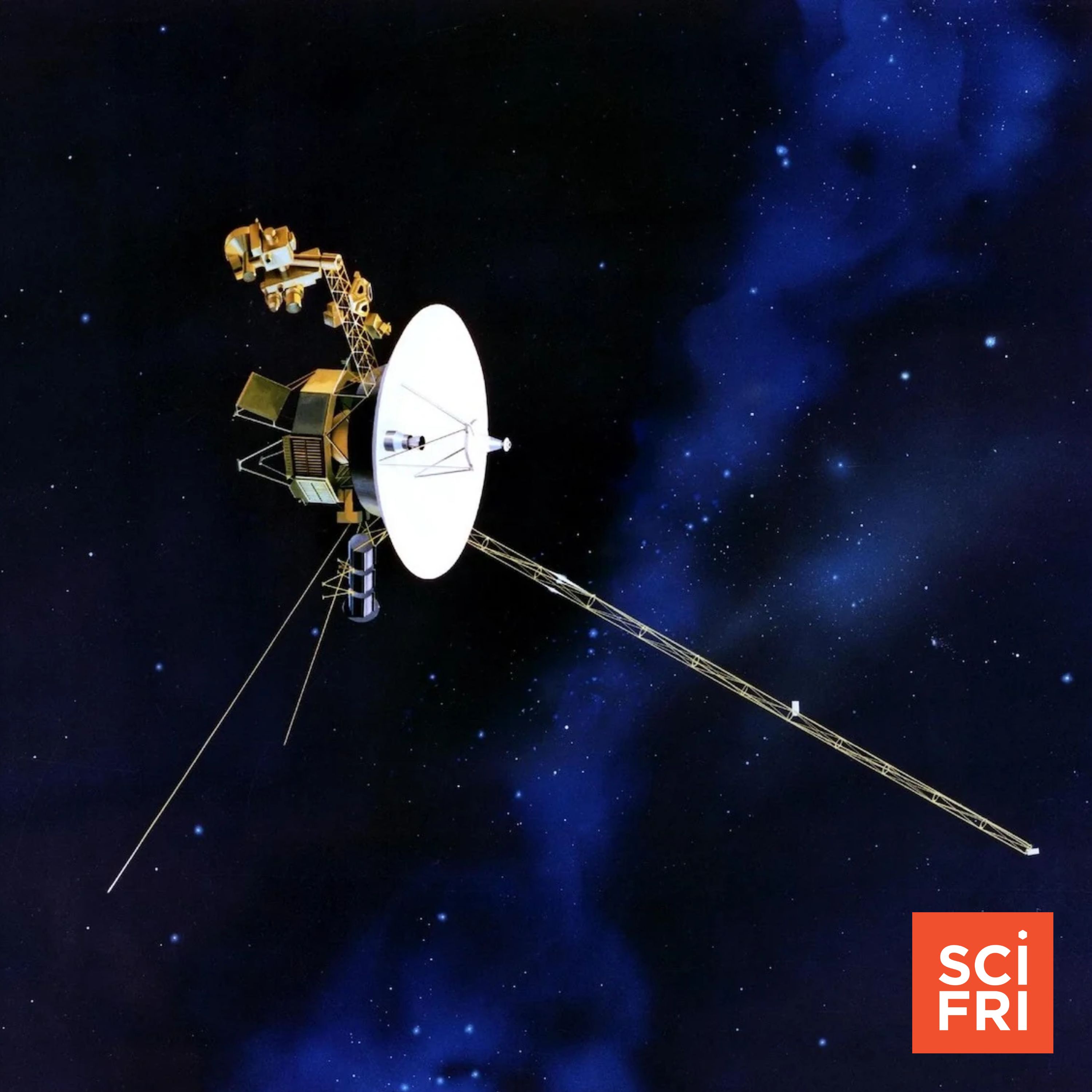
On November 18, the Voyager 1 spacecraft reached a cosmic milestone (https://www.sciencefriday.com/segments/voyager-1-is-a-full-light-day-away/), passing one light-day in distance from Earth, over 16 billion miles. That means that any transmission to or from Voyager takes a full 24 hours to arrive. NASA’s Jennifer Rocca joins Ira Flatow to mark the achievement, and look back on the legacy of the nearly 50-year flight of Voyager 1. Then, in an archival interview (https://www.sciencefriday.com/segments/are-we-there-yet-voyager-1-finally-answers-yes/) from 2013, Ira talks about the mission with the late Ed Stone, who managed the Voyager project for 50 years. Guest: Jennifer Rocca is NASA JPL deputy division manager for astrophysics flight projects. Transcripts for each episode are available within 1-3 days at sciencefriday.com (https://www.sciencefriday.com/segments/voyager-1-is-a-full-light-day-away/). Got a science question that’s keeping you up at night? Call us: 877-472-4374 Hosted by
Co-creator of the philanthropic FEED bags, Ellen Gustafson says hunger and obesity are two sides of the same coin. In her talk, she launches The 30 Project -- a way to change how we farm and eat in the next 30 years, and solve the global food inequalities behind both epidemics. (Filmed at TEDxEast.) Uploaded 01-08-13 Talk by Ellen Gustafson.
Get NordVPN 2Y plan + 4 months extra + up to 20Gb Saily data here https://nordvpn.com/spacetime It’s risk-free with Nord’s 30-day money-back guarantee! Check out the Space Time Merch Store Sign Up on Patreon to get access to the Space Time Discord! All particles belong to two large groups: fermions like protons and electrons make everything we consider "matter", while bosons like photons and gluons transmit the fundamental forces. And that about covers the universe: matter moving through space and time under the action of forces. But what if we could create particles in between these two possibilities. Physics says these neither matter nor force anyons can exist, and they may have some pretty incredible uses. They’re called anyons. PBS Member Stations rely on viewers like you. To support your local station, go to:http://to.pbs.org/DonateSPACE Sign up for the mailing list to get episode notifications and hear special announcements! Search the Entire Space Time Library Here: https://sear
In the rainforests of Madagascar, one species of lemur displays a striking resemblance to an opera singer. Like trained sopranos, these lemurs use special vocal techniques to make their calls carry across the forest. In this episode of Science Quickly, we dive into fascinating new research into how this one species, Indri indri, evolved to have such a striking musical ability and how scientists are tuning in with conservation in mind. Recommended Reading: “Dynamics of Jaw Kinematics and Fundamental Frequency Suggest Vocal Tract Tuning in the Indris’ song,” by Filippo Carugati et al, in PLOS Computational Biology. Published online September 21, 2026 (https://journals.plos.org/ploscompbiol/article?id=10.1371%2Fjournal.pcbi.1014781) “Passive Acoustic Monitoring for the Estimation of Density of the Singing Lemur (Indri indri),” by Valeria Ferrario et al, in Conservation Science and Practice. Published online October 9, 2026 (https://conbio.onlinelibrary.wiley.com/doi/10.1111/csp2.70428) Ou
"Humans in the Lead" - AI is accelerating jobs, not taking them (yet) - Localization and Translation Episode release date: 22 Jul 2024 Core Ideas: Metamodernism: Narratives and emergence view of reality - Reduce suffering - Increase prosperity - Increase understanding mantra: Seek knowledge. DISCLAIMER: This is a community-driven show. -------------- Keywords: ai future, artificial general intelligence, prompt engineering, singularity, ai masterclass, deep learning, chatbots, machine autonomy
View full lesson: http://ed.ted.com/lessons/pizza-physics-new-york-style-colm-kelleher Uploaded 06-12-12 People love eating pizza, but every style of pie has a different consistency. If "New York-style" -- thin, flat, and large -- is your texture of choice, then you've probably eaten a slice that was as messy as it was delicious. Colm Kelleher outlines the scientific and mathematical properties that make folding a slice the long way the best alternative ... to wearing a bib. Talk by Colm Kelleher, animation by Joel Trussell.
Viewers like you help make PBS (Thank you ) . Support your local PBS Member Station here: https://to.pbs.org/DonateSPACE Uploaded 28-03-18 The Andromeda galaxy is heading straight toward our own Milky Way. The two galaxies will inevitably collide. Will that be the very last night sky our solar system witnesses? You can further support us on Patreon at https://www.patreon.com/pbsspacetime Get your own Space Time t-shirt at http://bit.ly/1QlzoBi Tweet at us! @pbsspacetime Facebook: facebook.com/pbsspacetime Email us! pbsspacetime [at] gmail [dot] com Comment on Reddit: http://www.reddit.com/r/pbsspacetime Help translate our videos! https://www.youtube.com/timedtext_cs_panel?tab=2&c=UC7_gcs09iThXybpVgjHZ_7g (https://www.youtube.com/timedtext_cs_panel?c=UC7_gcs09iThXybpVgjHZ_7g&tab=2) Previous Episode: Scientists Have Detected the First Stars See that fuzzy blob on the sky? The one just left of the Milky Way center in the constellation of Andromeda. That’s M31 – the Andromeda galaxy. It’s
A massive new simulation is offering an unprecedented look at the universe's earliest stages, exploring how the first structures emerged from cosmic darkness. The research provides fresh insights into the mysterious era that shaped the cosmos and how the universe evolved into the vast structure we see today. This episode includes AI-generated content.
After more than four decades of searching, physicists at CERN have found evidence of an extraordinarily rare particle transformation. Detected by the upgraded LHCb experiment, this elusive process offers a new way to investigate the limits of the Standard Model and search for signs of previously unknown physics. As future collider upgrades promise far more data, scientists are preparing to explore an even deeper frontier of the subatomic world. This episode includes AI-generated content.
AI Plain and Simple: What's the big deal? Is it going to kill everyone? How can we do this right? Episode release date: 6 Feb 2024 Core Ideas: Metamodernism: Narratives and emergence view of reality - Reduce suffering - Increase prosperity - Increase understanding mantra: Seek knowledge. DISCLAIMER: This is a community-driven show. ----- Keywords: ai ethics, agi, post labor economics, ai agents
If you'd like an even more comprehensive written deep dive (with references, citations, and additional nuances) you can find it at Stay Curious Metabolism, the world's fast-growing Science Substack: https://staycuriousmetabolism.substack.com/p/should-everyone-take-glp-1s-what?r=40ekz2 And if you're interested in the rapidly evolving world of peptides and human bioengineering, be sure to check out our companion library, Peptides and More: https://staycuriousmetabolism.substack.com/p/peptides ATX-304 Letter: https://open.substack.com/pub/staycuriousmetabolism/p/this-new-diabetes-drug-works-like?r=40ekz2&utm_campaign=post&utm_medium=web&showWelcomeOnShare=true (https://open.substack.com/pub/staycuriousmetabolism/p/this-new-diabetes-drug-works-like?r=40ekz2&showWelcomeOnShare=true) If you want to try ATX-304, you can, but it's expensive. Click here: https://try.gotwingspan.com/norwitzatx-304 Bone Health Letter: https://open.substack.com/pub/staycuriousmetabolism/p/a-masterclass-on-building
View full lesson: http://ed.ted.com/lessons/philip-zimbardo-the-demise-of-guys Psychologist Philip Zimbardo asks, "Why are boys struggling?" He shares some stats (lower graduation rates, greater worries about intimacy and relationships) and the reasons behind them, while challenging the TED community to think about solutions. Talk by Philip Zimbardo.
PBS Member Stations rely on viewers like you. To support your local station, go to: http://to.pbs.org/DonateSPACE ↓ More info below ↓ Uploaded 15-12-20 Sign Up on Patreon to get access to the Space Time Discord! Good news everyone: it looks like the universe is going to end with a series of catastrophic explosions. The very, very long story short is that the universe ends in heat death, as it approaches maximum entropy, and its eternal exponential expansion drives it to effective utter emptiness and absolute cold. But new calculations have revealed we may be able to look forward to one last source of astrophysical cataclysms - a new type of supernova that can only happen at the end of the universe. Check out the Space Time Merch Store Sign up for the mailing list to get episode notifications and hear special announcements! Hosted by Matt O'Dowd Written by Matt O'Dowd Graphics by Leonardo Scholzer, Yago Ballarini, Pedro Osinski, and Adriano Leal Directed by: Andrew Kornhaber Assistant P
View full lesson: http://ed.ted.com/lessons/margaret-wertheim-the-beautiful-math-of-coral Science writer Margaret Wertheim re-creates the creatures of the coral reefs using a technique invented by a mathematician -- simultaneously celebrating the amazements of the reef and deep-diving into the hyperbolic underpinnings of coral creation. Talk by Margaret Wertheim.
Check out the Space Time Merch Store The Moon has been one of the most important theoretical stepping stones to our understanding of the universe. We’ve long understood that it could also be our literal stepping stone: humanity’s first destination beyond our atmosphere. PBS Member Stations rely on viewers like you. To support your local station, go to:http://to.pbs.org/DonateSPACE Sign Up on Patreon to get access to the Space Time Discord! Sign up for the mailing list to get episode notifications and hear special announcements! Search the Entire Space Time Library Here: https://search.pbsspacetime.com/ Hosted by Matt O'Dowd Written by Matt O'Dowd Post Production by Leonardo Scholzer, Yago Ballarini & Stephanie Faria Directed by Andrew Kornhaber Associate Producer: Bahar Gholipour Executive Producers: Eric Brown & Andrew Kornhaber Executive in Charge for PBS: Maribel Lopez Director of Programming for PBS: Gabrielle Ewing Assistant Director of Programming for PBS: John Campbell Spacetime
Neuroscience for AI - Every book I've read to become a world leader in AI Episode release date: 21 Dec 2022 Core Ideas: Metamodernism: Narratives and emergence view of reality - Reduce suffering - Increase prosperity - Increase understanding mantra: Seek knowledge. DISCLAIMER: This is a community-driven show. ------ Keywords: ai innovation, ai future, ai safety, ai masterclass, ai agents, singularity, future technology, ai education
Your internet isn't in space. It's in the ocean. But that might change, and here's why. Elon Musk tweeted that Starlink satellite internet service is now available in Ukraine. What does that really mean? Why is it important? And if it’s a big new thing that the internet is in space then… where was it before? In this video, I dive deep into how your internet gets to you right now, why Elon Musk wants to put it in space, and why it all matters. We’re in the middle of the Internet Space Race. It’s not just Elon with Starlink and SpaceX, it's also Jeff Bezos with Project Kuiper… oh and don’t forget Richard Branson with OneWeb. Why do all these billionaires want to put your internet in space? So much so that they’re willing to put millions of dollars on the line, weather geomagnetic storms, and launch thousands of satellites into orbit, all in an attempt to change the way millions of people get their (your!) internet. But this is more than just a fight between billionaires. It’s a fight for
View full lesson: http://ed.ted.com/lessons/shakespearean-dating-tips-anthony-john-peters Uploaded 22-08-13 Beyond giving the world dozens of English language masterpieces and inventing countless words (including the word countless), William Shakespeare, ever the overachieving bard, especially had a way with the romantic turn of phrase. Anthony John Peters explains why Shakespeare's coy use of metaphor was so effective -- and may just help you get a date today. Lesson by Anthony John Peters, animation by Kat Llewellyn.
PBS Member Stations rely on viewers like you. To support your local station, go to: http://to.pbs.org/DonateSPACE ↓ More info below ↓ Uploaded 30-09-19 Sign Up on Patreon to get access to the Space Time Discord! Check out the Space Time Merch Store The universe is big, but it’s peanuts compared to the eternally inflating multiverse. But just how many universes are there? What are they like? And most importantly, what can they tell us about … aliens? Challenge Answer Winners Steven Mertens David DeLaney Chris Lotery Eneko Fabien Sangouard Ian Bonnell *Please email your selection from the Space Time Merch Store along with your address to [email protected] with the subject line “Challenge Question Winner” Hosted by Matt O'Dowd Written by Matt O'Dowd Graphics by Leonardo Scholzer Directed by: Andrew Kornhaber Executive Producers: Eric Brown and Andrew Kornhaber End Credits Music by J.R.S. Schattenberg: https://www.youtube.com/channel/UCRl6-nb4iOnsij-vnpAjp0Q Imagine it: the observable
Why is the universe made mostly of matter when the Big Bang should have produced matter and antimatter in nearly equal amounts? Scientists at CERN's Large Hadron Collider are investigating this fundamental mystery through the behavior of rare particles. A new LHCb study puts increasingly precise limits on possible hidden effects, helping physicists narrow the search for new explanations beyond our current understanding of nature. This episode includes AI-generated content.